
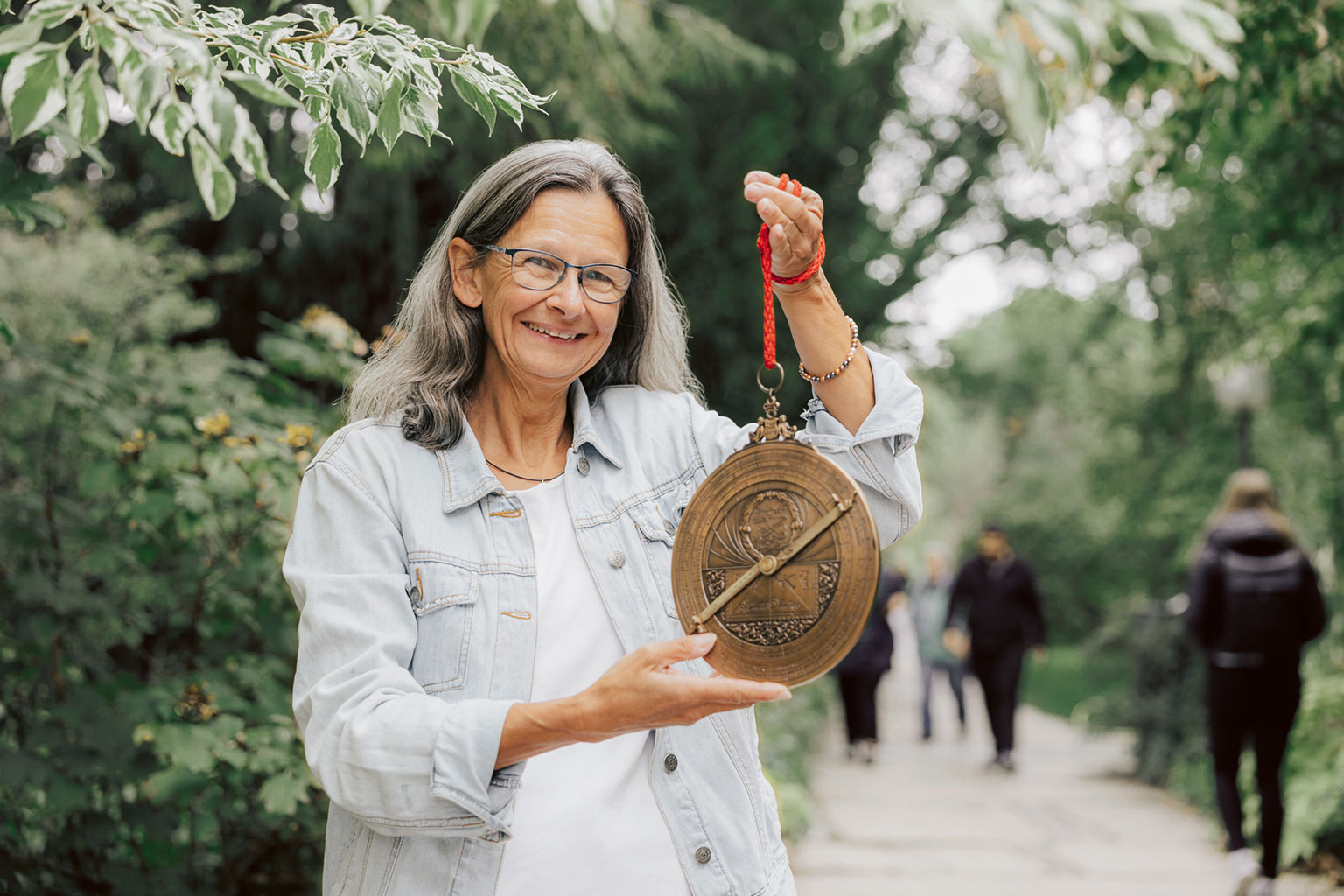
Long-forgotten texts, instruments, and practices are a true treasure for Petra Schmidl. Oftentimes, occult knowledge and modern sciences are much closer than one might think.
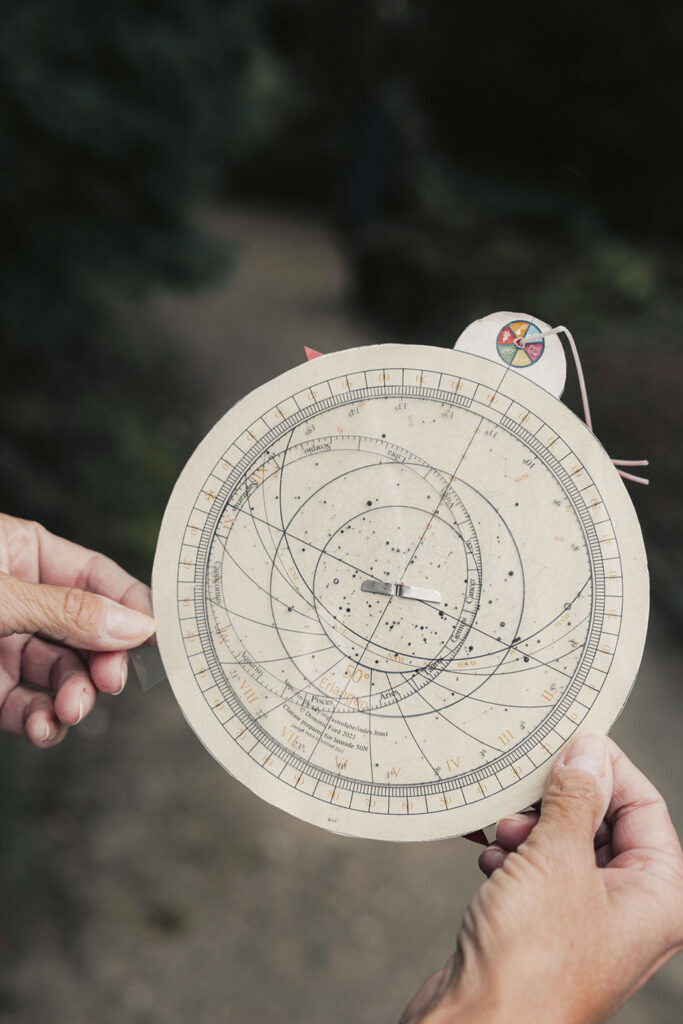
Petra Schmidl opens a dark red box and takes out a round, brass-colored plate that resembles a compass. Rotatable disks, fine scales, and grid lines adorn the solid tool. “People used an astrolabe to determine the position of celestial bodies and the time,” Schmidl explains, placing it in front of her on the table with a dull, metallic sound. Historical instruments like this allow Schmidl, as a science historian to immerse herself in past eras and provide insights into how our current knowledge has developed. In her project “MOSAIC,” short for “Mapping Occult Sciences Across Islamicate Cultures,” Schmidl is therefore working together with colleagues from Belgium, Italy, and the USA to study historical sources on the occult sciences in cultures shaped by Islam, including alchemy, astrology, magic, and prognostics. For this, the team has received an ERC Synergy Grant from the European Research Council worth nearly ten million euros, of which almost 2.3 million will go to FAU. Schmidl’s focus: Prognostic practices. Schmidl is examining instruments and historical texts from the eighth to the fifteenth century that describe these practices. “Most of them are written in Arabic script and, in their structure, resemble instruction manuals,” she explains.
Back at FAU
Since 2012, Schmidl has repeatedly worked at FAU, mostly on a project basis for short periods. The new funding would have allowed her to go to other universities as well. But she chose to return to Erlangen. “I have met wonderful colleagues here who have supported me time and again,” she says. Schmidl discovered her passion for her field of research while studying medieval and modern history in Frankfurt am Main. “In seminars, we examined completely unexplored manuscripts. Finding and deciphering these treasures fascinated me,” she says.
Astonishing discoveries
Currently, Schmidl is searching libraries and museums for Islamic and Eastern Christian sources that deal with occult knowledge. “There are wonderful libraries in many countries, but for political reasons we are unable to visit many of them. That is unfortunate, but most of the time we find an alternative through our contacts.” That is why she started with the manuscript collections in Berlin, some of which she can access digitally. She translates, comments on, and examines these with questions such as: How did prognostic practices work? Who used them, and why? How relevant were they at the time? To what extent did they influence modern science? The team has already made remarkable discoveries. “Recently, my colleagues used an old alchemical recipe to silver-plate a five-cent coin,” Schmidl reports. She herself has also come across extraordinary finds: In two museums, Schmidl discovered two almost identical astrolabes, one of European and one of Arab origin. “The Arab piece, however, was significantly older – it must have served as a model, despite the spatial and temporal distance,” Schmidl says enthusiastically. With her basic research, Schmidl aims to expand the understanding of modern science to include aspects of the occult sciences and their influence. “These practices and subdisciplines were regarded as science at the time. And they have had a strong influence on our current catalog of sciences. I want to find out exactly how by closely examining sources that have so far received little attention,” she says. “I hope this will help to break down the barriers between occult and modern sciences a little.” Another goal: to balance the disparity between European and Islamicate sources, since the latter have hardly been studied so far. The researcher therefore wants to help ensure that these are given greater consideration. Above all, Petra Schmidl wishes for one thing: more openness and more critical engagement with sources. “I hope that my research will raise awareness of where our knowledge comes from. And that we learn to question and contextualize this knowledge. That is especially important today.”
Laura Indelicato
This article is part of the FAU Magazine
The third issue of the FAU Magazine #People is once again all about the people who make our FAU one of the best universities in the world. The examples in this issue show how lively and diverse our research is, the commitment of our students, and the work in the scientific support areas.
Highlight is certainly the new research cluster “Transforming Human Rights.” Or you can follow our scientists into laboratories and workshops, where they make potatoes climate-resistant, teach robots social behavior, or reconstruct ancient ships and cannons. At FAU, students are developing vertical take-off aircraft or impressing with outstanding performances at the Paralympics. And let’s not forget the people who work at our university or remain closely connected as FAU alumni. Visit the Children’s University with them or watch a TV series with an FAU alumna and Grimme Award winner.
- File Name
- FAU_Magazine_2025_2026
- File Size
- 3 MB
- File Type