
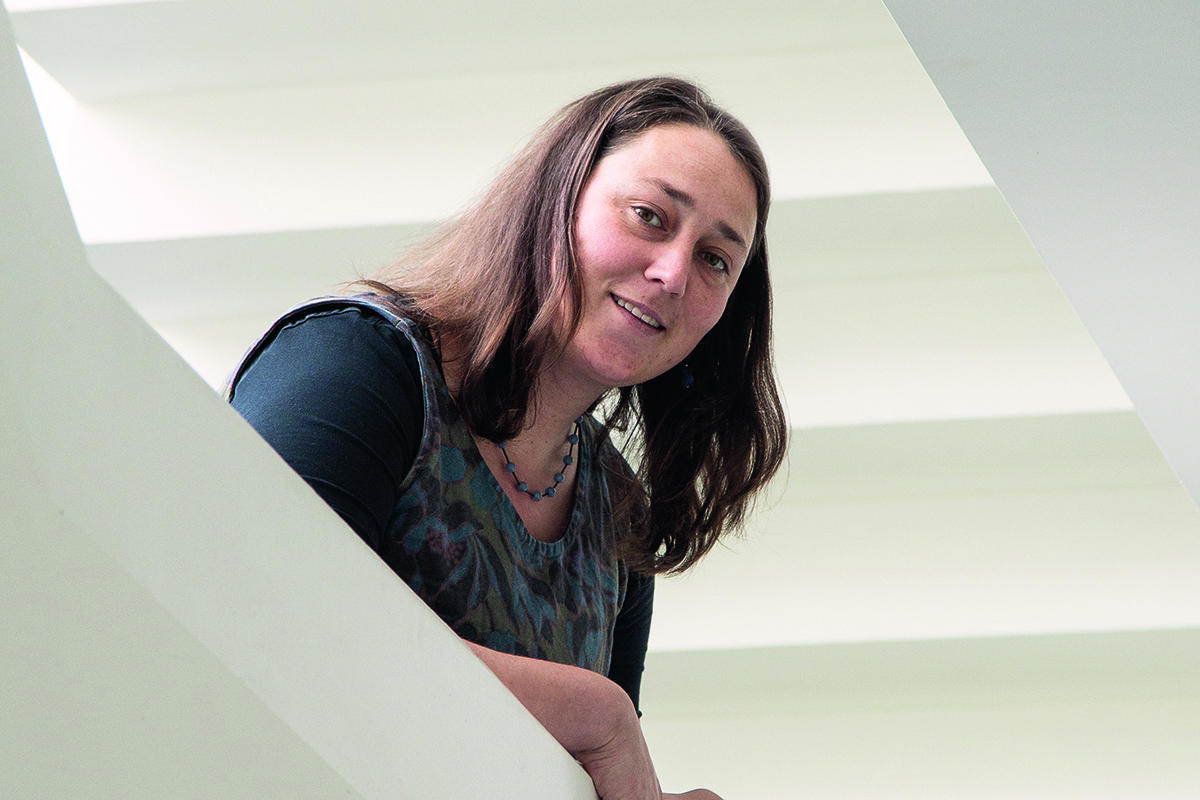
Jana Hutter wants to adapt MRI imaging to the movement of tissue and organs. That would significantly improve the diagnosis of diseases. Her research has been awarded a Starting Grant from the ERC.
When patients go for a scan in the “tube”, they only have one job: not to move. If they remain still, the MRI can produce razor-sharp images which doctors can use to assess, for example, how far arthritis in the knee has progressed. But MRI is also used to examine internal organs, and in those cases, keeping still can be counterproductive,” says Jana Hutter. Hutter is Professor of Smart Imaging and Data Profiling at FAU. She studied applied mathematics in Erlangen and Rennes, France, and researched MRI technologies at Siemens during her doctoral degree. She then went to St. Thomas’ Hospital, which collaborates with King’s College in London. “In London, I worked on projects that mainly focused on the development of fetuses and newborns, as well as the placenta,” she says. “It was always important to me to work with patients as well.”
Supported by sensors and AI
She has continued this work at FAU since 2024, focusing on diseases of the intestine and uterus in the EARTHWORM project. In adenomyosis, for example, endometrial tissue embeds itself in the muscle tissue, which can lead to severe pain and bleeding. “If an MRI is performed at all, the uterus is basically paralyzed with medication in order to obtain high-resolution images. However, important information is contained in the natural movement, which we lose this way.” Hutter hopes to develop MRI technology further until this immobilization procedure is no longer necessary. She is combining traditional MRI scanners with sensors that react within milliseconds to movements of the organs and adjust the imaging process accordingly The process is supported by artificial intelligence: “We will train the AI with thousands of MRI images,” says Jana Hutter. “Machine learning helps us detect anomalies, distinguish them from interference signals, and thus obtain meaningful findings.”
EARTHWORM is supported by the European Research Council with a coveted Starting Grant worth 1.49 million euros. Jana Hutter is also involved in the new joint project EndoKI, which aims to develop improved ultrasound for a related disease, endometriosis, and is being funded by the Free State of Bavaria with 2.9 million euros.
Matthias Münch
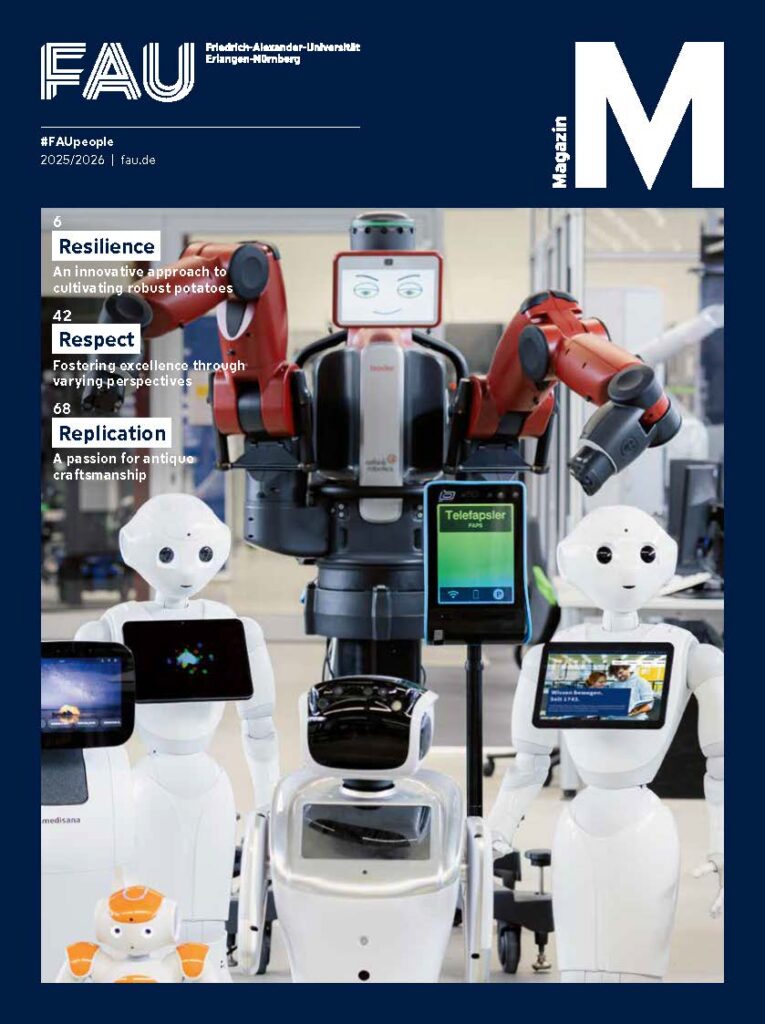
This article is part of the FAU Magazine
The third issue of the FAU Magazine #People is once again all about the people who make our FAU one of the best universities in the world. The examples in this issue show how lively and diverse our research is, the commitment of our students, and the work in the scientific support areas.
Highlight is certainly the new research cluster “Transforming Human Rights.” Or you can follow our scientists into laboratories and workshops, where they make potatoes climate-resistant, teach robots social behavior, or reconstruct ancient ships and cannons. At FAU, students are developing vertical take-off aircraft or impressing with outstanding performances at the Paralympics. And let’s not forget the people who work at our university or remain closely connected as FAU alumni. Visit the Children’s University with them or watch a TV series with an FAU alumna and Grimme Award winner.
- File Name
- FAU_Magazine_2025_2026
- File Size
- 3 MB
- File Type