
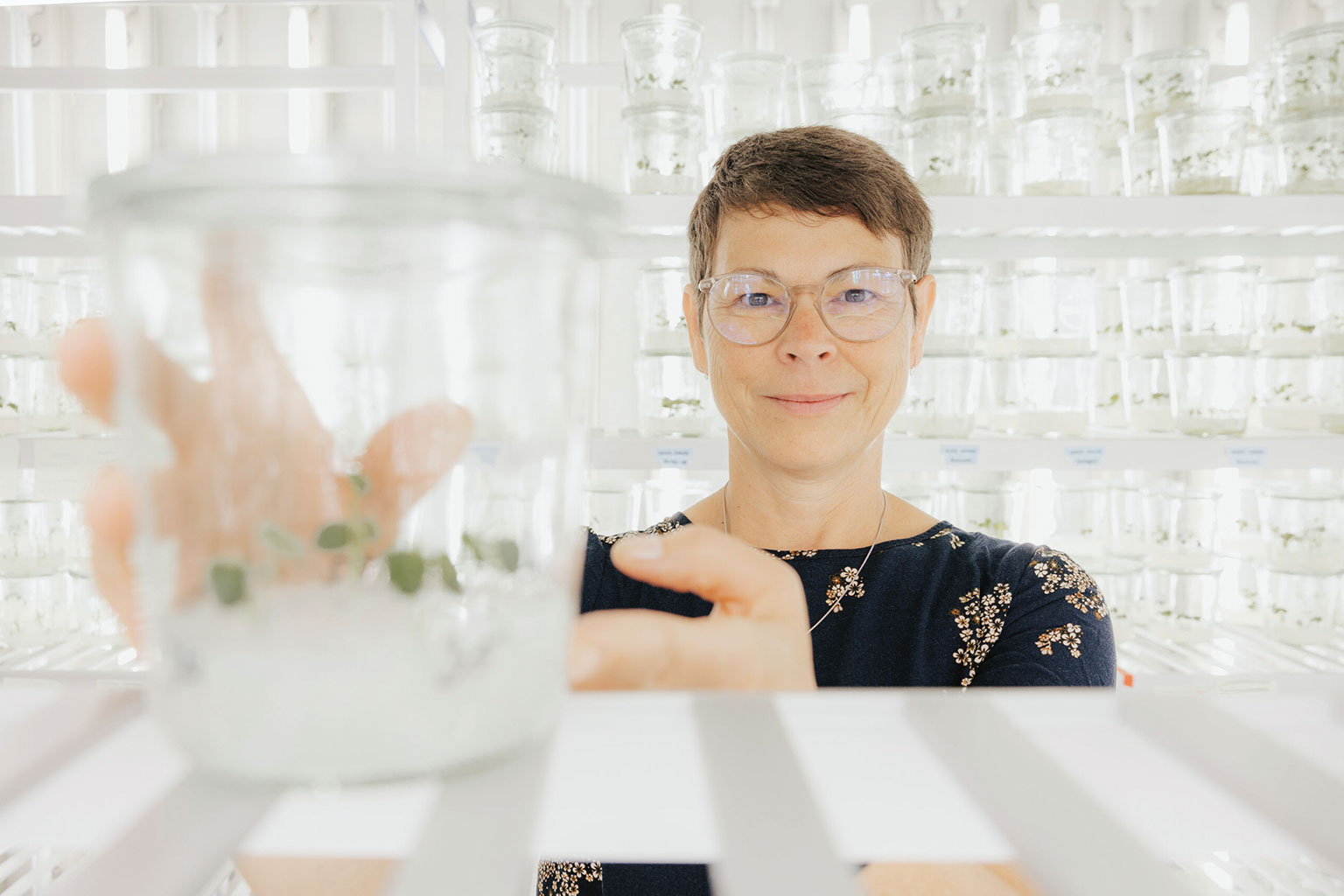
Potatoes are one of the most important crops in the world. Sophia Sonnewald and her team from the Chair of Biochemistry would like to modify potatoes to adapt to the consequences of climate change.
In Germany, potatoes are one of the most important crops and not only end up in any number of shopping carts, but are also processed into many different products like French fries and potato starch. Potato starch is not only an important ingredient in cooking and baking, it is also used to make biodegradable “plastic” bags and adhesives.
However, only few people will have heard of the protein SP6A that plays a decisive role in growing potatoes. This role may become even more decisive when heat and periods of drought increase as a result of climate change, leading to smaller yields or even the destruction of the entire harvest. Late blight also has an adverse effect on potatoes. While there are pesticides that are effective against its pathogen, the fungus Phytophthora infestans, such drastic chemical measures are not welcomed by organic farmers. The Federal Ministry of Agriculture and Food is therefore investing a total of 2.8 million euros into cultivating new types of potato that can cope under organic farming conditions with late blight and the more frequent periods of drought and heat. One of the partners involved in the project “Cultivating potatoes for organic farming that are tolerant against stress and suitable for processing,” KarOLa for short, is the team led by Sophia Sonnewald from the Chair of Biochemistry at FAU.
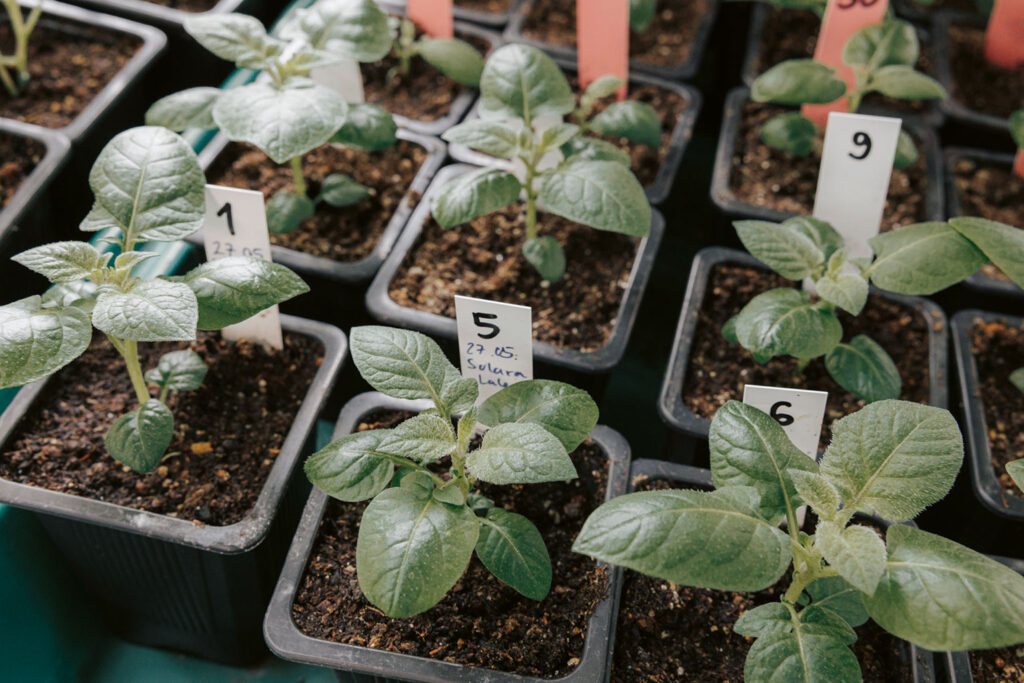
Heat and drought stress potatoes
For the FAU researcher, this project is a further milestone in her academic career. “I actually have always worked with plants,” Sophia Sonnewald remembers. She completed her schooling in 1989, the last class to graduate from high school in the GDR, and then studied biology at Humboldt-Universität, first of all in East Berlin and then in the unified city. “I focused on plant physiology and ecology.” After completing her doctoral degree – also at Humboldt-Universität and naturally on the topic of plants – she moved to the Leibniz Institute of Plant Genetics and Crop Plant Research (LPK) in Saxony-Anhalt as a postdoctoral researcher in 1999, before transferring to FAU in Erlangen at the beginning of 2005.
Her research focuses on the potato, a plant that is fairly robust but that is increasingly suffering from the consequences of climate change. For example, it is not uncommon for phytophthora infestans to ruin the harvest. The fungus penetrates into the plant and switches off its victim’s immune system. As it multiplies, the pathogen destroys the tissue, and eventually the whole plant, including the tuber. The pest can spread particularly rapidly when the potato plants are weakened by environmental stress, for instance heat. “It is not only the fungus that is afflicting the potatoes,” explains Sophia Sonnewald. “Higher temperatures lead to fewer and smaller tubers in general.” This is where the structural protein SP6A comes into play: It activates the formation of tubers, at least under climate conditions like those that have been common in Central Europe to date. During longer periods of hot weather, considerably less SP6A is formed. The consequences are lower yields, or in the worst case scenario a failed harvest.
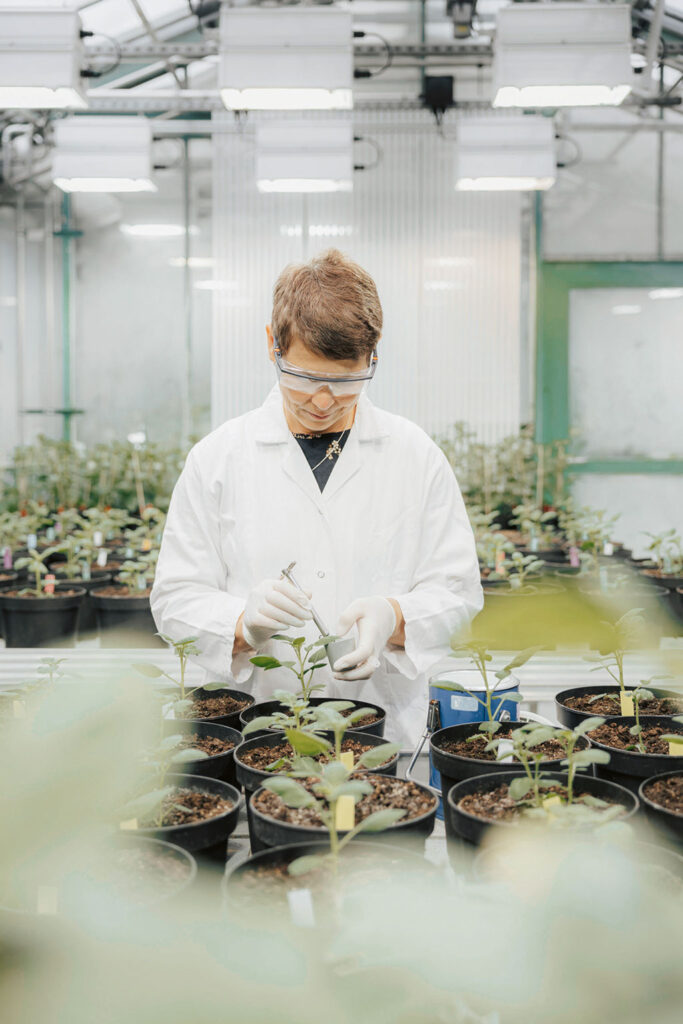
Genetic engineering helps cultivate robust varieties
“With our research, we hope to find out which processes in the plant’s cells play a role with coping with stress,” says Sophia Sonnewald. The research focuses on identifying genetic information for various characteristics of potatoes. “The better understanding we have of these properties and the mechanisms in the cells, the more we can narrow down our search for varieties that cope better with heat waves and are resistant towards pests.” Using traditional genetic engineering methods, the Sonnewald team is altering the genetic factors that play a role in the production of SP6A, thereby increasing or blocking its production. How do the plants react? Do they cope better with heat and produce more SP6A? How does this affect yield, and how much starch is contained in the tubers?
As the potatoes that are the focus of the research take several months to grow in greenhouses, they are kept as cuttings in tissue cultures. This enormously accelerates their reproduction and analysis. The researchers hope that their findings concerning the inner mechanisms in the potato cells will allow new varieties to be developed that cope well with the heat waves brought about by climate change and their side effects. At the same time, they should produce good yields, and last but certainly not least, they should taste good. “It may take quite some time, this research requires a lot of patience,” explains Sophia Sonnewald. The race of research against climate change has already begun for potatoes.
Roland Knauer
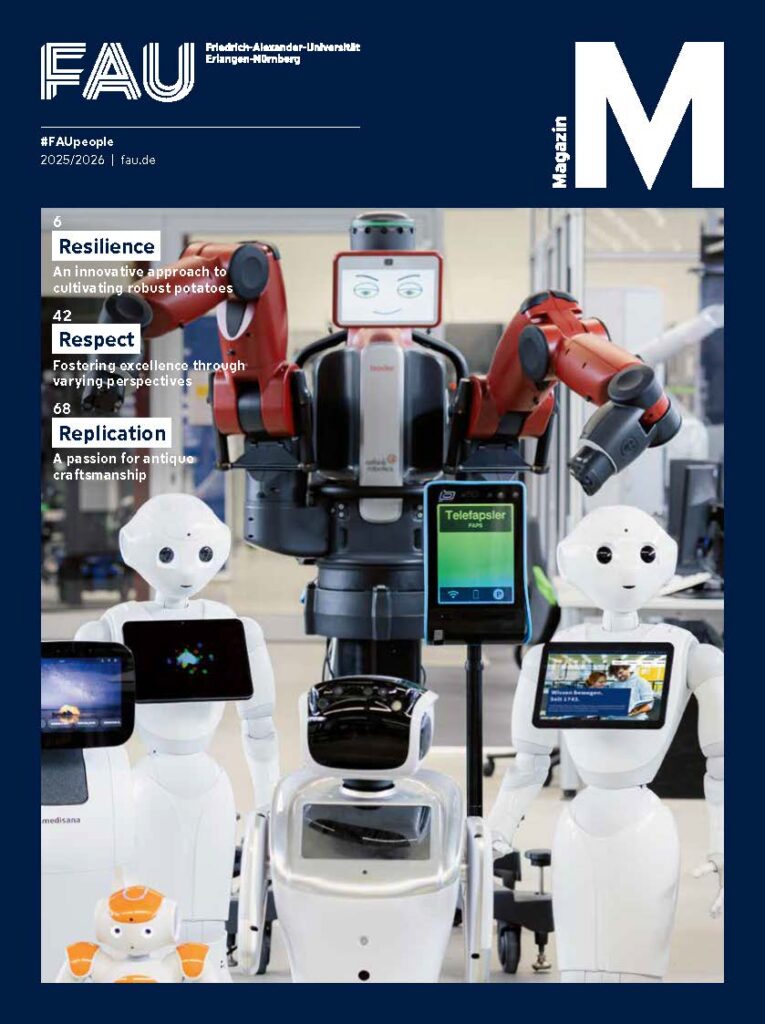
This article is part of the FAU Magazine
The third issue of the FAU Magazine #People is once again all about the people who make our FAU one of the best universities in the world. The examples in this issue show how lively and diverse our research is, the commitment of our students, and the work in the scientific support areas.
Highlight is certainly the new research cluster “Transforming Human Rights.” Or you can follow our scientists into laboratories and workshops, where they make potatoes climate-resistant, teach robots social behavior, or reconstruct ancient ships and cannons. At FAU, students are developing vertical take-off aircraft or impressing with outstanding performances at the Paralympics. And let’s not forget the people who work at our university or remain closely connected as FAU alumni. Visit the Children’s University with them or watch a TV series with an FAU alumna and Grimme Award winner.
- File Name
- FAU_Magazine_2025_2026
- File Size
- 3 MB
- File Type