

2021 marked the start of a new seven year program generation. The focus is on social inclusion, the green energy transformation and the digital revolution as well as on encouraging young people to actively participate in democracy. Visit this website to find out how these key themes are integrated at FAU.
Support for higher education
Based on three key actions, the program provides support for higher education and a range of sectors. A distinction is made between centralized and decentralized applications and actions. The European Commission’s Education, Audiovisual and Culture Executive Agency in Brussels is responsible for centralized actions. Applications for decentralized actions are managed in each program country by national agencies; in Germany the agency responsible for elements of the program related to higher education is the German Academic Exchange Service (DAAD).

Changing lives. Opening minds. Erasmus+. (Bild: Europäische Kommission)
- The FAU is “D_ERLANGE01”
- FAU’s participant identity code (PIC) for previous projects is 999995408. The OID which ought to be currently used for each application is E10209513.
- The legally authorized representative (LEAR) is Prof. Dr. Joachim Hornegger, FAU President.
- FAU has received an Erasmus Charter for Higher Education (ECHE).
- The ECHE code for FAU for projects in 2014-2020 which are now coming to a conclusion is: 28318-LA-1-2014-1-DE-E4AKA1-ECHE
- The current ECHE code for FAU for projects in 2021-2027 is 10101462-EACEA-03-2020-1
- The VAT no. is DE-132507-686.
| ERASMUS Charta und Policy | File size |
|---|---|
| Policy-Statement 2021-2027.pdf | 978 KB |
| FAU Erasmus Charta 2014 2020.pdf | 3.02 MB |
| ECHE-Charta-2021-2027.pdf | 1,004 KB |
| D ERLANGE01-European-Policy-Statement-2014-2020.pdf | 60 KB |
The first key action supports the mobility of individuals for the purpose of learning. The focus is on the interdisciplinary topics of digitalization, inclusion, ‘green Erasmus’ and civic engagement. Advances in digitalization are reflected not only in Erasmus without Papers (EWP), but also in new openings for funding such as ‘blended mobility’ or ‘blended intensive programs’.
- Information for FAU students who would like to study abroad with the Erasmus+ program is available on the page about studying with Erasmus+.
- Information for FAU lecturers and non-academic staff who would like to complete a stay abroad (as a guest lecturer or for further training) is available on our Teaching mobility and Staff mobility web pages.
- University partnerships within the context of Erasmus+ always require a contract to be concluded between the universities in advance to serve as the basis for exchanges of both students and teaching staff. Further information is available on the internal pages on Establishing Erasmus cooperations.
Participants in any of the funding lines with a disability and students with a child who wish to apply for a stay abroad can apply for special funding.
Key action 2 will continue to encourage cooperation between institutes of higher education, and provide various funding lines for different aims, focal areas and regional approaches (see diagram).
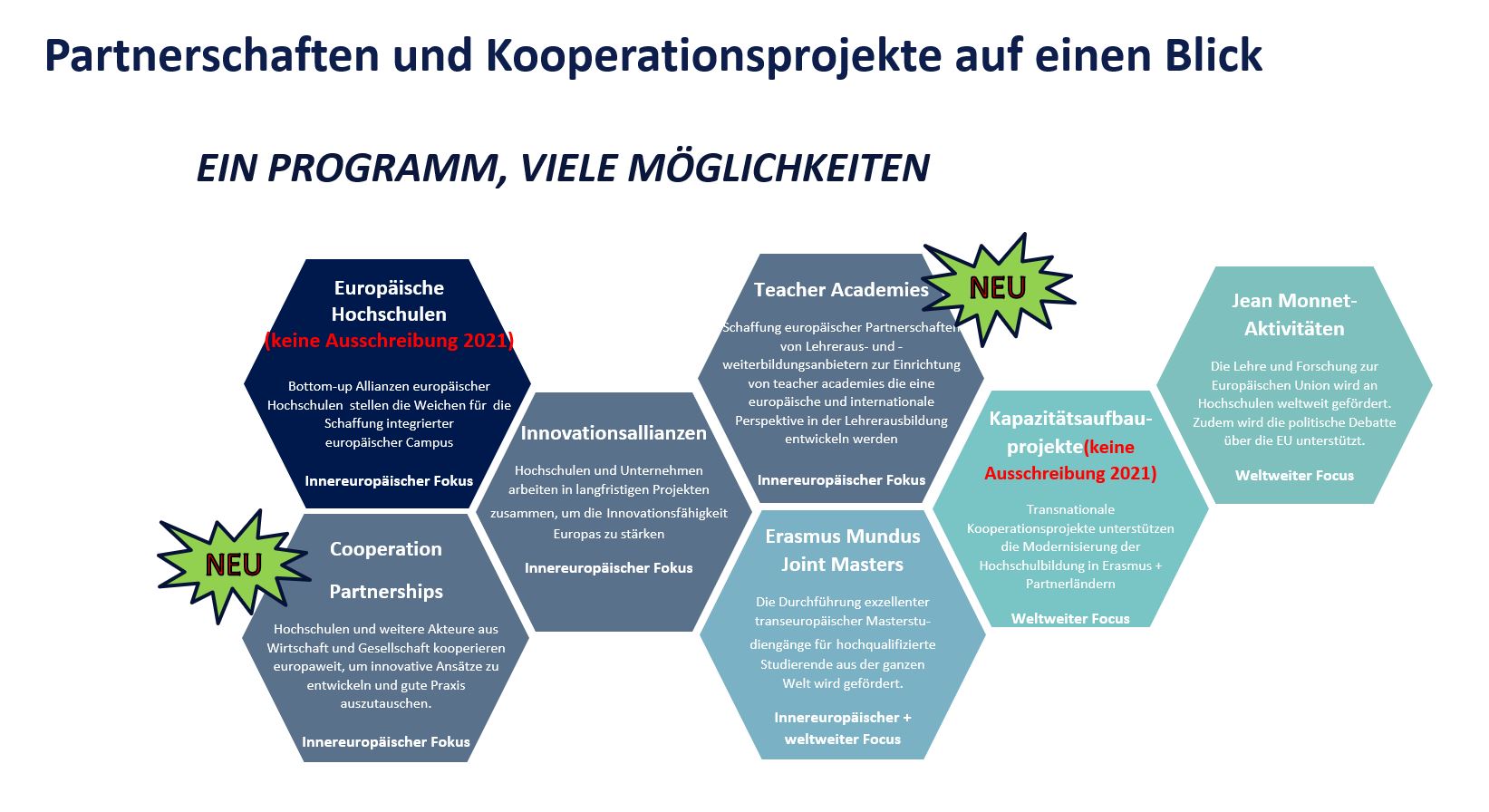
Key action 2 will also focus on the horizontal priorities of digitalization, green Erasmus, inclusion and civic engagement (participation in democratic life).
- European universities, for example at FAU EELISA
- Innovation alliances
- Cooperation partnerships (examples include projects run by the Innovation in Learning Institute)
- Teaching academies
- Capacity building in higher education
- Joint Master’s programs, Erasmus Mundus design measures, for example at FAU EMLex
- Jean Monnet actions (study and research on European integration)
- Sport (actions in the field of sport focus on general sport for all. For the first time, the new program will provide funding to encourage the European mobility of sport coaches)
All applications at the university level ought to be filed either in a decentralized procedure with the national agency, the DAAD, or, depending on the specific line, centrally in the European Commission’s Education, Audiovisual and Culture Executive Agency in Brussels. If you would like to apply for one of these actions, please contact one of FAU’s EU Coordinators.ntielle Antragsteller wenden sich bitte an die unten genannten EU Referentinnen.
Key action 3 funds projects promoting reform processes in the field of education politics. This is a centralized action managed by the Education, Audiovisual and Culture Executive Agency in Brussels.
The aims of Erasmus+ policy development support are:
- Support for policy reform with cooperation projects over several country borders
- Contribution towards making European university reforms more effective and more efficient.
- Encouraging innovative approaches
- Increasing flexibility and transparency of European education systems
- Promoting results-oriented political dialog (by connecting educational sectors and stakeholders)
The EuRopean Action Scheme for the Mobility of University Students – Erasmus+ – is the new EU program for education, training, youth and sport which was launched on January 1, 2014. Some funding projects running under key action 1 from rounds 2019 and 2020 will still continue until July 31, 2022 or 2023. This applies in particular to projects with universities in partner countries (international credit mobility – KA107). KA103 will also fund mobility for students and staff to the United Kingdom until March 31, 2023.
Contact and information
Click on one of the tabs below to find out more:
Bianca Köndgen (M.A.)
ERASMUS+ Institutional Coordinator
Contact
Kira Gehrmann
Head
Contact
Fabian Lettner
Mobility Online Admin
Contact

Martina May
EU Research Office – euRO
Contact

Svenja Talv
EU Research Office – euRO
Contact
Dr. Günter Renner
Research associates
Contact
Contact for complaints in connection with Erasmus+ programs (key action 1)
Click on one of the tabs below to find out more:
Bianca Köndgen (M.A.)
ERASMUS+ Institutional Coordinator
Contact
Silke Bergmann
Administrative staff
Contact

Esther Paulmann
Head
Contact
Disability Liaison Officer
Dipl.-Ing. (Univ.) Petra Leicht
Universitätsstr. 22
91054 Erlangen
Phone +49 9131 85-24130
EU data protection regulations
Data Protection
Address
Contact
Jürgen Hubert
Contact for corruption prevention
Contact
Office of Equality and Diversity
Address
Contact
Dipl. Hdl. (Univ.) Simone Stein
Conflict management
Contact
For students
Dr.-Ing. Jochen Weinzierl
Head
Contact
For doctoral candidates, researchers, and staff:

Prof. Dr. Andrea Bréard
Vice President Education