
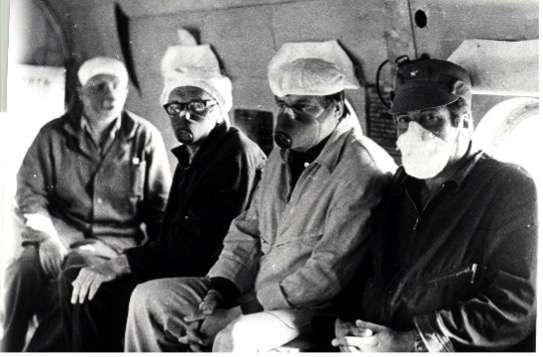
Results to be presented in the exhibition “Living with radiation“
The use of radiation has a long history, with areas of application in medicine, research, industry, and the military. However, people were not aware of the toxic nature of radiation from the outset. Over time, it became apparent that guidelines were necessary for working with radioactive substances. Prof. Dr. Maria Rentetzi and her team from the Chair of Science, Technology and Gender Studies at Friedrich-Alexander-Universität Erlangen-Nürnberg (FAU) have curated an exhibition on the historical role the International Atomic Energy Agency (IAEA) has played in setting radiation standards in the past and up to the present day. The exhibition “Living with radiation“ is based on a research project that has received two million euros in funding as a Consolidator Grant from the European Research Council.
Science diplomacy links different scientific disciplines
For a long time after Henri Becquerel discovered radioactivity in 1896, researchers explored its properties without adequate and uniform protective measures. In particular after the atomic bombings in Hiroshima and Nagasaki, the need was recognized for international diplomatic discussions aimed at deciding on standard protective guidelines. The IAEA led these negotiations with the aim of preventing the use of nuclear weapons and controlling the use of nuclear energy in general. The IAEA regularly reports back to the UN General Assembly on current developments concerning atomic energy.
As the question of protection against radiation has mainly been treated as a purely technical question to date, Rentetzi and her team chose to examine the topic through a societal lens instead, investigating various milestones of nuclear policy for the exhibition “Living with radiation“.
Initial agreements on the use of ionizing radiation
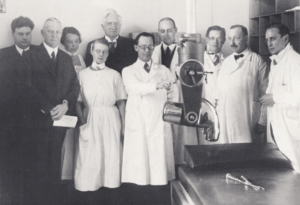
The radiological department of the Radiumhemmet Institute in Stockholm undertook the first pioneering efforts in radiation protection in the 1920’s, enlisting the help of important stakeholders from politics and science. The researchers intended to formulate internationally valid standards. These guidelines for protection against radiation were finally decided at the first international radiology congress in London in 1925.
According to Maria Rentetzi and her team, another major historical milestone in connection with the general regulation of nuclear energy was the establishment of IAEA in 1957. In a rare display of collaboration between the two adversaries in the times of the Cold War, representatives of both the United States and the Soviet Union were present when UN members signed the statute of the IAEA on October 26, 1956 in New York.
Two buses fitted out as laboratories traveled across the globe
Maria Rentetzi reports on another event that underlines the significance of the topic of radioactivity during the Cold War. In 1958, the USA gifted the IAEA two mobile laboratories incorporated into revamped buses in an attempt to dominate the newly established IAEA by providing technical assistance and gifts. The mobile laboratories traveled across the globe to train young researchers in radioisotope research. Another aim of the mobile laboratories was to establish diplomatic relations between the countries during the Cold War.
Exhibition “Living with radiation“
The results of the research project will be showcased in the exhibition “Living with radiation“ in Siemens MedMuseum from June 12 to August 31. Under the guidance of Prof. Rentetzi and research assistant Kristina Ford, the team has collected numerous images from archives throughout the world, including from the archives of the IAEA itself. The exhibition focuses on the fact that working with radiation has always been controversial when seen from a historical perspective. The images in the exhibition track the development of radiation protection and related technology. At the same time, they shine a spotlight on an often overlooked aspect: the contribution made by female researchers in this area.
Two million euros in funding
The European Research Council has provided roughly two million euros in funding for the project within the scope of the Horizon 2020 innovation program. The ERC funding was invested predominantly in establishing a research group at the Chair of Science, Technology and Gender Studies at FAU to investigate the history of radiation protection in a social, diplomatic and political context.
Further information:
Prof. Dr. Maria Rentetzi
www.hrp-iaea.org
maria.rentetzi@fau.de