
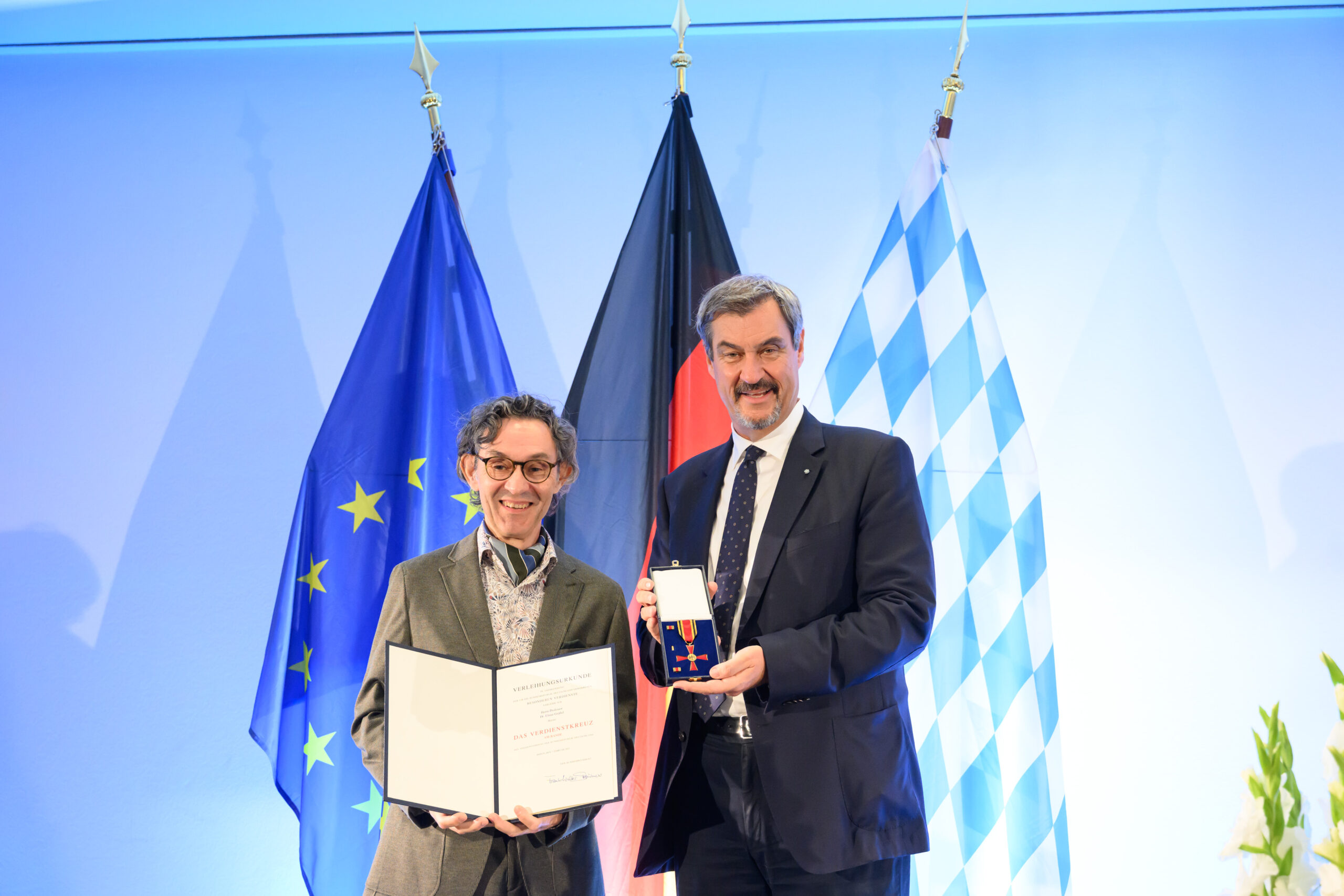
Honor for Erlangen pioneer in dementia care and research into relatives’ needs
On June 30, 2025, Prof. Dr. Elmar Gräßel was honored for his outstanding achievements in dementia research and in his voluntary work with the Cross of the Order of Merit of the Federal Republic of Germany. Gräßel, who is Director of the Center for Health Service Research and Medical Psychology and Sociology in the Department of Psychiatry and Psychotherapy (director: Prof. Dr. Johannes Kornhuber) at Universitätsklinikum Erlangen at Friedrich-Alexander-Universität Erlangen-Nürnberg (FAU), accepted the award from the Bavarian Minister President Dr. Markus Söder.
The award recognizes Prof. Gräßel’s decades of dedication to people suffering from dementia and the relatives and people who care for them. Elmar Gräßel has been researching into dementia and the effects it has on relatives of sufferers for 35 years. He is a founding member of the German Alzheimer’s Association (Deutsche Alzheimer Gesellschaft e. V.) and has been volunteering as Chairperson of the Alzheimer Society of Middle Franconia (Alzheimer Gesellschaft Mittelfranken e. V.) for 25 years.
“Help where it’s needed and wanted.”
Prof. Gräßel’s goal is to noticeably improve the quality of life of people with dementia and of the relatives and people who care for them. This is irrespective of whether those affected by this cognitive impairment live at home, in a care group or in a care home or visit day care centers. Elmar Gräßel’s motto is “help where it’s needed and wanted.” The letter from the Bavarian Minister President said of Prof. Gräßel: “Your contribution to our country has gone above and beyond the norm.” It continued: “Your authoritative studies and publications on non-medical treatments and the wide range of voluntary work you perform ensure inclusion and participation in everyday life and society for those affected.”
Research with a practical focus
Prof. Gräßel’s professional life focuses on two central aspects. On the one hand, his research looks into ways of preventing dementia and into non-medical treatments for dementia. “This is because it is important to improve the resources people with dementia already have and to increase their quality of life at the same time,” he emphasizes. On the other hand, as a health service researcher, providing support and respite to relatives and other people who provide care is a matter close to his heart. “Family caregivers give up so much to provide this care, which means that they urgently need help and support from outside sources. It is our obligation as a society to give something back to them,” explains Prof. Gräßel and continues: “This is the reason why we must conduct research into the best way to help those affected by dementia and their carers.”
Thanks to colleagues and supporters
“The Order of Merit is a huge recognition of my personal dedication and the collaboration between many people. Without the joint effort of very many people, these goals simply cannot be achieved,” says Elmar Gräßel. “I would like to thank all those who have shown so much empathy to me and have actively supported me along the way.”
Innovative non-medical treatment
A milestone of Prof. Gräßel’s achievements is the development of the multi-award winning MAKS® therapy, which is a non-medical activation treatment for people with dementia. MAKS® combines motor skills (M), practical skills (A), cognitive (K) and social (S) activities and has been proven to visibly reduce cognitive decline and improve patients’ quality of life. The efficacy of MAKS® therapy has been proven in major studies and can be implemented quickly and with little outlay.
“As yet, there is no cure for dementia. Psychosocial, non-medical forms of treatment such as MAKS® are therefore a decisive method of stabilizing the capabilities of people with dementia and improving their wellbeing”, says Prof. Gräßel. MAKS® therapy is now being used with much success in German-speaking countries, in Mexico, China and in Norway. In Germany alone, more than 3000 nursing and care staff have received training for MAKS® therapy. “This is an important milestone for improving the care provided to people with dementia,” emphasizes Prof. Dr. Johannes Kornhuber, Director of the Department of Psychiatry and Psychotherapy at Universitätsklinikum Erlangen.
Numerous awards
Prof. Gräßel’s scientific projects have received many awards, including research awards from the German Alzheimer’s Association (Deutsche Alzheimer Gesellschaft e. V.), the Erlangen Prize for Medicine, Technology and Health, the Theo and Friedl Schöller Prize for Geriatric Medicine, and most recently, the MSD Health Prize.
Concept for the future
“In view of the changing demographics and the increasing number of people with dementia in Germany, much work still needs to be carried out so that the MAKS® therapy concept developed by Prof. Gräßel can make a decisive contribution to improving the care being provided to those with dementia and the relatives and people who care for them in future,” says Prof. Dr. Peter Kolominsky-Rabas, who manages the health service research project digiDEM Bayern in conjunction with Prof. Gräßel.
Information about MAKS® therapyFurther information:
Prof. Dr. Elmar Gräßel
Phone: +49 9131 85-34142
elmar.graessel@uk-erlangen.de