
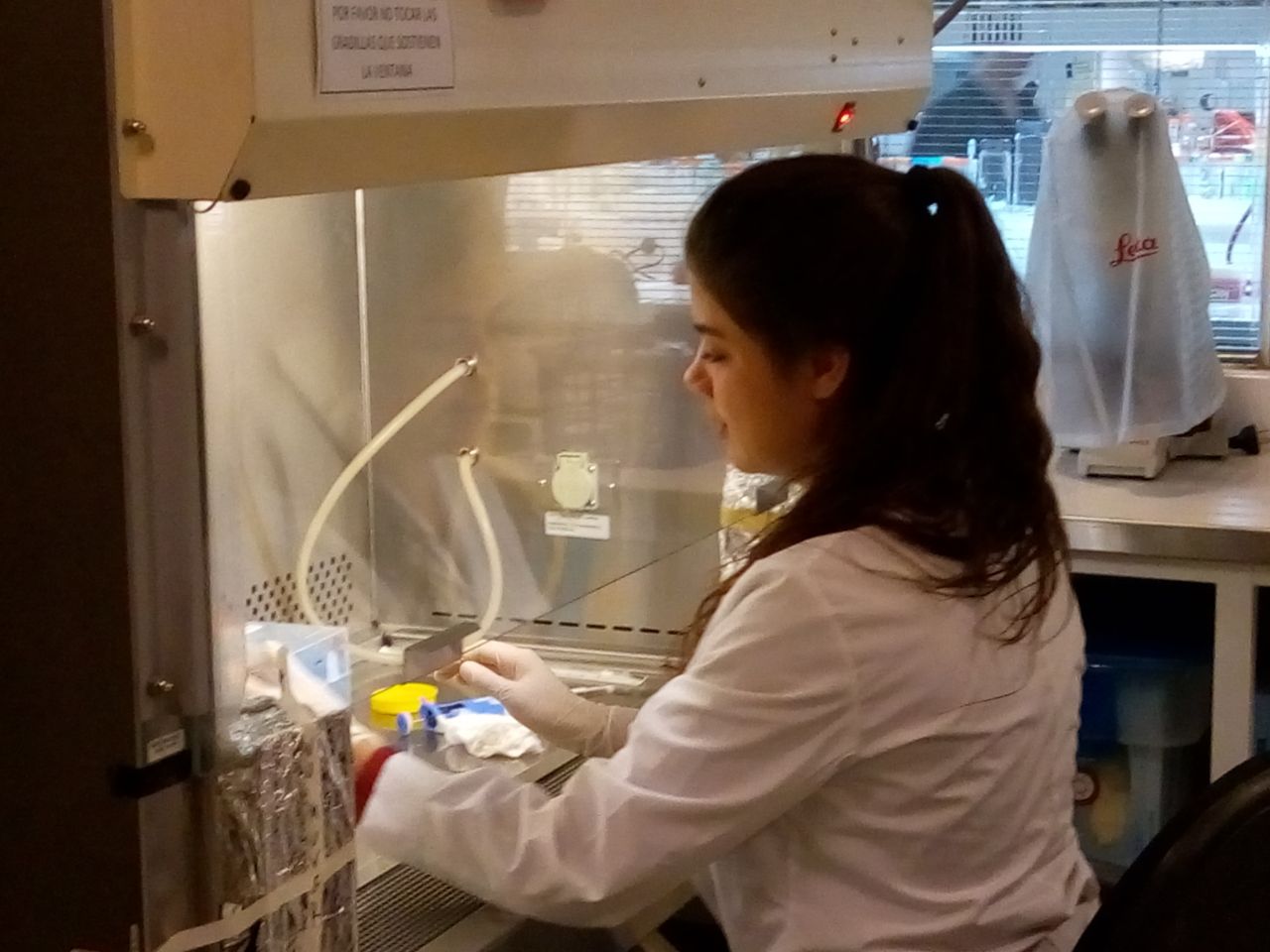
Dr. Victoria Guglielmotti discusses footprints of migrating cells, their interactions and memory effects in cell dynamics
If you are intrigued about what Hansel and Gretel have to do with cell memory, you have to ask Dr. Victoria Guglielmotti. After completing her doctoral degree in chemistry, she is now conducting research with Prof. Benoit Ladoux at the Chair of Biophysics at the Institute of Condensed Matter Physics at FAU. At the end of last year, the researcher was awarded one of the sought-after European Postdoctoral Fellowships that funds excellent researchers in the EU and in states associated with Horizon Europe. Whenever she has to explain her research to people who are interested in what she does, she likes to refer to fairy tales:
“In the fairy tale, Hansel and Gretel dropped breadcrumbs to help them find their way back. In my research, I would like to find out what the breadcrumbs in cells are. When cells migrate, they leave tracks that can trigger a reaction in other cells or in them themselves. My aim is to find out what these tracks look like and how they influence cellular reactions.”
Dr. Guglielmotti was born and brought up in Argentina, she studied Materials Science and Engineering at the National University Mar del Plata, before completing her doctoral degree at the Institute of Chemical Nanosystems at the National University San Martin. She was aware of the need to develop analytical instruments to allow a deeper understanding of how the cellular environment influences cells’ behavior.
Doctoral degree: How cells communicate with their surroundings
In her doctoral thesis, she investigated how cells react to various stimuli. Cells are not merely simple building blocks of life, they are highly sensitive, interactive systems that communicate constantly with their surroundings. One important part of these surroundings is what is known as the extracellular matrix (ECM), a type of scaffolding made of molecules that surrounds the cells and transfers many signals that influence their behavior.
For her doctoral thesis, she artificially created properties of the extracellular matrix and investigated the cells’ reactions in real time, recording how they reacted to different arrangements. She came to the conclusion that cells perceive their surroundings very closely. Guglielmotti demonstrated how researchers can intervene in these surroundings to gain a better understanding of cells. The results of her research may contribute directly to the development of new biomedical technologies, for instance in sensors that recognize illnesses at an earlier stage.
European Postdoctoral Fellowship

Victoria Guglielmotti followed Prof. Ladoux’ work with interest for some time before contacting him after her doctoral degree to inquire whether he would have a postdoctoral position available for her. After several conversations, it was clear that they were both interested in working together. Applying for a European Postdoctoral Fellowship was her idea, but it was a joint decision to actually apply.
The European Postdoctoral Fellowships from the European Union are part of the Marie Skłodowska-Curie Actions (MSCA), a central funding program offering early career researchers the opportunity to improve their skills, gain international experience and connect with other researchers and institutions. The aim of the postdoctoral fellowships is to support researchers in their careers and promote outstanding research achievements. The postdoctoral fellowships are aimed at postdoctoral researchers who would like to conduct research abroad, gain new skills and boost their career. The funding program is highly competitive and is considered one of the most prestigious funding opportunities for early career researchers in Europe.
“For early career researchers like me, leading a research project independently is a great opportunity. For researchers who intend to pursue a career in academia, gaining experience in leading projects is very important, and this scholarship is a great stepping stone in that direction. That apart, it is also a significant recognition of one’s personal achievements, as it is one of the most prestigious awards in Europe, and opens doors to future opportunities. It also encourages researchers to make international connections.”
Dr. Victoria Guglielmotti is convinced that scholarships such as the European Postdoctoral Fellowship help to train the next generation of leaders in science and industry. They impart important skills and experiences needed to tackle global challenges. By funding researchers, these programs invest in the future of innovation, knowledge, and advances in society.
“The fellowship offers me the possibility to conduct top research, to work with world-class institutions and to develop skills that are important for my career. As well as financial funding, the fellowship encourages international mobility that allows me to conduct research in a new setting, to exchange ideas with leading experts and to build an international network. Furthermore, the program also encourages interdisciplinary approaches that are indispensable for tackling the complex scientific challenges of today.”
My research project
She came to Prof. Ladoux during an in-between phase, while he was establishing his working group at Friedrich-Alexander-Universität. The idea for her current research project is based on a presentation given by his working group at the Institut Jacques Monod in Paris. She is exploring the impact, the cellular “footprints”, of tracks left by migrating cells. Cell migration is a fundamental process in development, tissue repair and progress of disease.
Cells restructure their extracellular matrix by dismantling and depositing components, and they can perceive and react to various chemical and mechanical environmental stimuli. Although scientists are aware of the interplay between these processes, earlier studies have mainly looked at them in isolation. Until now, no major research has been carried out into the impact of the restructuring of the extracellular matrix on the wider migration dynamics of cells. Her research project now aims to close this gap in knowledge. It investigates how cellular footprints contribute to memory effects in cell dynamics and their effects on behavior within the ECM.
“Our research combines principles of physics and chemistry with advanced cell biological techniques in order to observe how long cellular footprints remain. We are also investigating the biochemical and mechanical properties of cellular footprints and their role in the regulation of cell organization,” explains Dr. Victoria Guglielmotti.
With a wide range of opportunities for future research, she is unlikely to be bored any time soon. And Hansel and Gretel will continue to keep her company.
More on the project: https://mpzpm.mpg.de/research/benoit-ladoux