
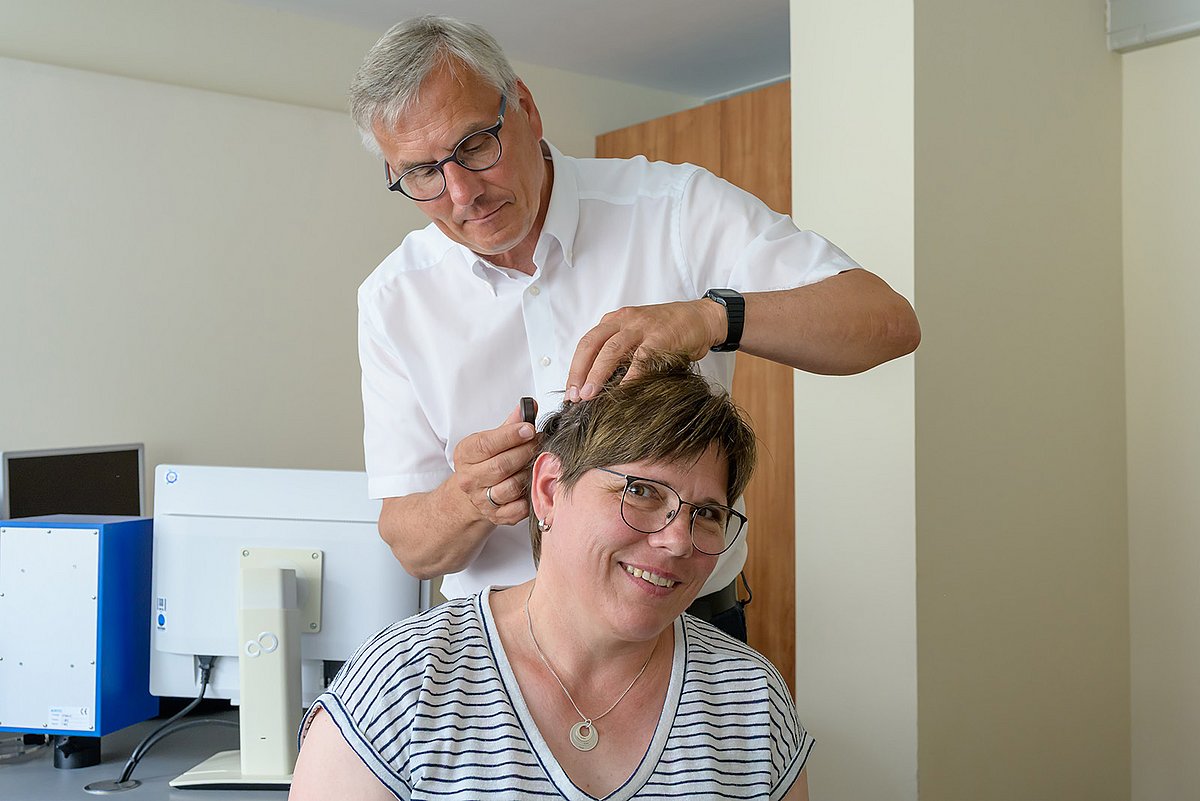
The Department of Otorhinolaryngology – Head and Neck Surgery in Erlangen is just one of three centers worldwide that are fitting smart cochlea implants for the first time
“You could compare it with the leap in innovation from cellphones with keypads to smartphones,” says Prof. Dr. Dr. Ulrich Hoppe, Director of Audiology and the CICERO Cochlear Implant Center at the Department of Otorhinolaryngology – Head and Neck Surgery (Director: Prof. Dr. Sarina Müller) at Uniklinikum Erlangen. This groundbreaking innovation comes from market leader Cochlear Ltd., unveiling the world’s first smart cochlear implant system featuring an integrated processor and built-in memory chip. It was officially launched in June 2025, but CICERO started fitting the new system in July 2024. This is because the Department of Otorhinolaryngology – Head and Neck Surgery in Erlangen is only one of three centers worldwide that was selected by the Australian manufacturer for a controlled market release. “Over the course of the last year we successfully fitted over 100 of these new implants, putting us way ahead of other hospitals,” reports Prof. Hoppe. “The fact that Cochlear Ltd. selected us as a partner for the market launch is proof of our expertise and the international recognition of Prof. Dr. Joachim Hornung, who, as deputy head of department, carries out the surgery with these new implants.”
“A cochlea implant is always recommended if a conventional hearing aid is no longer sufficient, that is when the hair cells in the cochlea are no longer able to send electrical impulses to the brain via the auditory nerve,” explains Ulrich Hoppe. “Whereas a hearing aid merely amplifies noises and stimulates the hair cells that are still functioning, a cochlea implant completely bypasses the damaged cells: It converts sound directly into electrical signals and stimulates the auditory nerve, even when there are no functioning hair cells left.” Such serious loss of hearing can be present at birth but also develop during a person’s life, for example due to permanent exposure to loud noise, infections such as bacterial meningitis or autoimmune diseases. Sudden hearing loss can also lead to permanent deafness. This is precisely what happened to Elke L. who is undergoing treatment at CICERO at Uniklinikum Erlangen and received the new CI system there in February 2025.
Suddenly the world went quiet
“In summer 2022, I experienced sudden hearing loss in my right ear and couldn’t hear anything with it from one day to the next – without any apparent cause. In the beginning, I hoped that my hearing would come back. But my hearing on the right side did not return,” explains the 51 year old patient. “The doctors at the Department of Otorhinolaryngology – Head and Neck Surgery at Uniklinikum Erlangen advised me to get a cochlea implant right from the start,” she remembers. “I was afraid of having surgery and initially turned it down.”
Small operation, great effect

“When a cochlea implant is fitted, a small incision is made in the skin behind the ear to access the cochlea. The fine electrodes are carefully inserted into the cochlea and the implant is attached under the skin,” explains Prof. Hoppe. The language processor, which detects background noise and converts it into electrical impulses, is attached to the scalp via a magnet. “The surgery usually lasts around an hour and, thanks to the expertise of our surgeons Prof. Dr. Joachim Hornung and Prof. Dr. Sarina Müller, has a very high success rate; our surgical procedures are safer than almost anywhere else.” Around 170 cochlear implants are fitted in Erlangen each year and the first one was fitted in 1993. This means that the Department of Otorhinolaryngology – Head and Neck Surgery at Uniklinikum Erlangen is one of the leading centers for this field worldwide.
Time, patience and practice
However, surgery alone is not enough. This is because the speech processor is only fitted after the recovery period of around three weeks and the noise perception function is activated. The system must them be programmed and gradually adapted to the patient’s hearing; the auditory nerve only slowly adapts to the new stimulation, which means time, patience and expertise is required during follow-up care. This is the reason why a team of experienced audiologists, logopedic specialists and therapists is on hand at CICERO. As part of out-patient care, the team is responsible for fine-tuning the system and providing support to patients to learn this “new way of hearing”. “Everything is under one roof here – it’s really great,” says Elke L. happily. She decided to have an implant at the beginning of 2025 after an in-depth consultation.
Smart out-patient care
“Individually adapted, high-quality aftercare is just as important for the success of the treatment as surgery itself,” emphasizes Ulrich Hoppe. “The world’s first smart CI system, which we were one of the first to fit last year, makes this process much easier and offers other benefits to our patients.” With its integrated processor and memory chip, the implant can identify the optimal electrode placement on the auditory nerve, allowing for precise and personalized adjustment. Another decisive advantage is that if a patient should lose the magnetic speech processor, patient data can be restored without any problems. Complex reprogramming is no longer necessary. “They often get lost at Erlangen’s Bergkirchweih beer festival, for example,” smiles Prof. Hoppe. In addition, the firmware can be updated allowing regular sound processor updates to be installed and optimized energy consumption allows for longer battery life.
Life sounds so beautiful
Elke L. is one of the first patients to now benefit from the new smart CI system and she is very glad she decided to have the surgery. “Before the operation, someone would call my name and I wouldn’t know where the voice was coming from. Now I know exactly which direction a sound is coming from,” she says smiling. “This is such an improvement to my quality of life!” When asked whether she would recommend a cochlea implant to other sufferers of hearing loss, she doesn’t hesitate a second to say “Absolutely!”
Further information:
Prof. Dr. Dr. Ulrich Hoppe
Uniklinikum Erlangen
Phone: + 49 9131 85-32981
cicero@uk-erlangen.de