
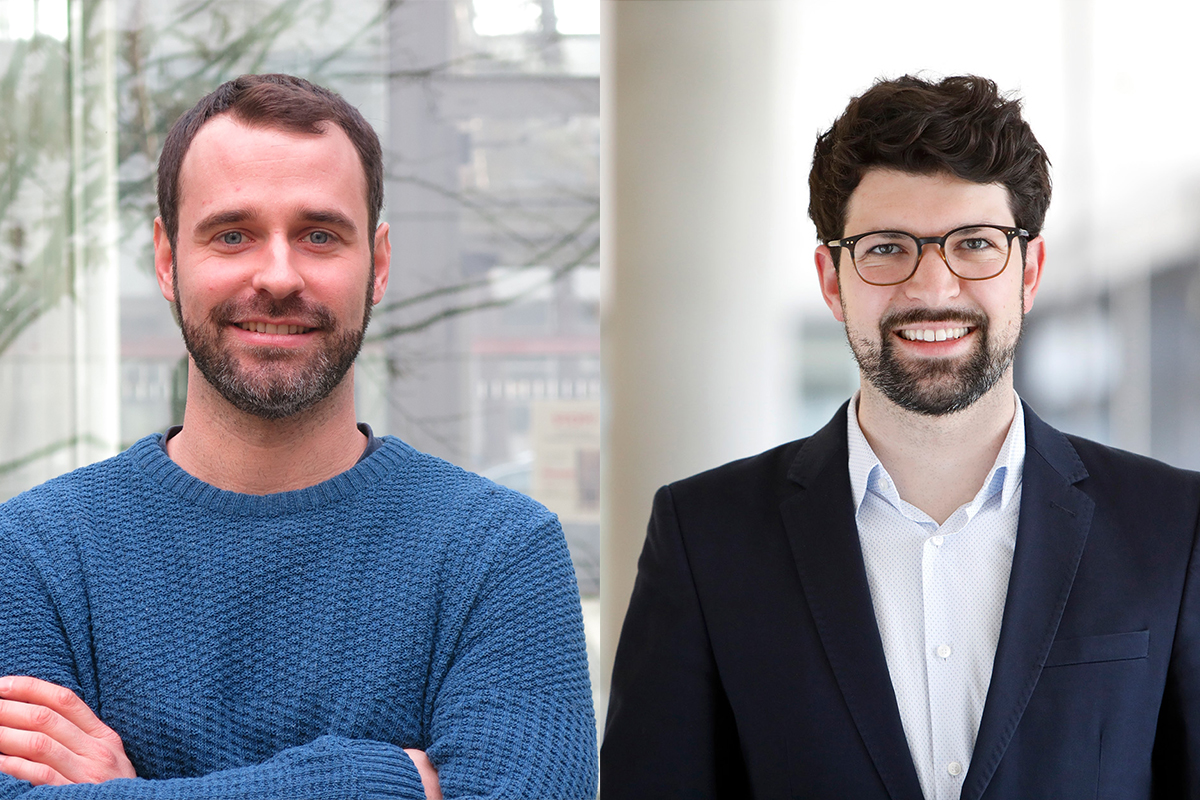
Two FAU researchers awarded coveted EU funding worth millions of euros
Two researchers from Friedrich-Alexander-Universität Erlangen-Nürnberg (FAU) have been awarded a Starting Grant each from the European Research Council (ERC). In the new round, Dr. Carlos L. Bassani with the project “Kinetic Pathways to Control Nanocrystal Shapes“ (kineticSHAPES) and Prof. Dr. Adrian Meier with the project “Social Well-Being from Hybrid Interactions in Hybrid Work“ (HYIHY) are set to receive funding of 1.5 million euros each.
Cubes, spheres and nanopyramids
With the project kineticSHAPES, Dr. Carlos L. Bassani, research associate at the Professorship for Modeling of Self-Organization Processes, hopes to develop simulation techniques that will improve our understanding of the shape of nanocrystals. These tiny crystals can adopt the shape of cubes, spheres, pyramids, plates, and other defined forms. The shape of nanocrystals is decisive for their surface, reactivity, optical characteristics, mechanical strength and their self-organizing behavior. But how do nanocrystals take on these shapes? “The current theory for their shape is based on a thermodynamic equilibrium that states that every crystal structure takes on an almost unique form, with only a few morphological variations,” explains Dr. Bassani. While this theory explains the shape of crystals in mineralogy, it often does not apply to nanocrystals. “This shows that is necessary to explain the shape of nanocrystals without thermodynamic equilibrium,” says Bassani.
The determination of shape diagrams that show the thermodynamic conditions and kinetic factors that lead to optimum shapes is of central importance here. This is due to the fact that crystals can drastically influence the properties of materials through interaction with light. This in turn can lead to the creation of new technologies such as photocatalysis for the green energy transition or new types of treatment for cancer. “kineticSHAPES will facilitate the theory and computer-based development and optimization of synthesis protocols for nanocrystals with various shapes and thus lead to fundamental understanding of nanomaterials in the future,” says Dr. Bassani.
Dr. Dr. Carlos L. Bassani has doctoral degrees in chemistry, mechanical engineering, and materials science. In addition to the ERC Starting Grant in 2025, he has also been awarded a Humboldt Research Fellowship, the CAPES Thesis Award from the Brazilian Science Foundation, the Thesis Prize of the Brazilian Society of Mechanical Sciences and Engineering (ABCM) and second place for the Thesis Prize of the French Society of Process Engineers (SFGP).
Hallway conversations with AI coworkers
“Our daily life at work is an important factor for our social wellbeing,” says Prof. Dr. Adrian Meier, Professorship for Communication Science at FAU. “This is why it’s worrying that loneliness among employees has risen worldwide.” One in five feels lonely most of the time, with the numbers rising, and this holds many risks for staff members, organizations and companies. How are the most recent changes to the world of work, such as hybrid working and hybrid interactions, affecting social wellbeing? Are they contributing to the “loneliness epidemic” or could they be part of the solution? These are the questions Prof. Adrian Meier is now investigating in his HYIHY project funded by the ERC.
This is because hybrid working, which involves working in the office and at home, is the new normal for many. “Communication is changing because of this,” says Adrian Meier. This means fewer “water cooler chats” in person and more chats during Zoom meetings and via messaging services. “And, at the same time, chat-based and voice-based AI applications are developing into increasingly human-like AI coworkers with socio-emotional skills. We can use them to practice difficult conversations with our boss, get feedback about team behavior or get advice in conflicts.” In short, this means that it’s not only our work that is becoming hybrid, but also communication – a mixture of “face-to-face”, digital and human and AI interactions.
This is why Adrian Meier would like to lay the foundation for a deeper understanding of social wellbeing in the world of work in his project with a novel mix of methods comprising data from chats, digital behavior, studies of panels, journals and interviews, and field experiments.
Prof. Dr. Meier studied Communication and Political Science at the Universities of Mainz and Göteborg (Sweden) and gained his doctoral degree in Communication Science with a focus on Media Psychology at the University of Mainz. After working as an assistant professor at the University of Amsterdam, Meier was appointed Assistant Professor of Communication Science at FAU in 2021. His research, among others about the role of social media on mental health, has been recognized by several awards, including best paper awards and thesis awards from the International Communication Association (ICA) and the German Communication Association (DGPuK).
Grants from the European Research Council
The European Research Council – ERC – was founded by the European Commission. It offers funding programs for excellent researchers in Europe who pursue groundbreaking projects and innovative research ideas. The ERC grants are prestigious and aimed especially at supporting projects with a high scientific and social impact. These grants offer significant financial resources and allow the researchers who obtain the funding to pursue their research aims independently and at an internationally competitive level.
Further information:
Dr. Carlos Lange Bassani
Phone +49 9131 85-70529
Email: carlos.bassani@fau.de
Prof. Dr. Adrian Meier
Professorship for Communication Science
Phone +49 911 530-295670
Email: adrian.meier@fau.de