
During the year of quantum physics, three scientists from this discipline have received a special honor: the Nobel Prize in Physics. The researchers created the basis for the development of the next generation of quantum technology, including quantum cryptography, quantum computers and quantum sensors. These topics are now being researched at Friedrich-Alexander-Universität Erlangen-Nürnberg (FAU) and the Max Planck Institute for the Science of Light (MPL).

Prof. Dr. Florian Marquardt, Chair of Theoretical Physics at FAU and Director of the Max Planck Institute for the Science of Light (MPL) explains: “This year’s Nobel Prize was awarded to the researchers who laid the foundations for one of the most successful variants of quantum computing that we have today, namely superconducting quantum processors. The work of John Clarke, Michel Devoret and John Martinis in the1980s dealt with a seemingly easy question: What happens when you cool an electrical circuit, which is essentially a piece of metal, right down to the lowest-possible temperature? The fact that metals at low temperatures can have an electrical resistance of zero and conduct electricity without generating heat was already known. However, the three scientists observed something strange: The entire electrical circuit behaves like a single quantum object. In a similar way to single electrons or atoms, the electrical circuit demonstrates properties that are typical for quantum physics. In particular, this includes the tunnel effect during which an object can switch between two states even though there is a large barrier between them. This was an oddity at the time. Developments in technology have made significant advances since then. These groundbreaking experiments ultimately led to the invention of superconducting qubits.”
Huge potential for applications in information technology

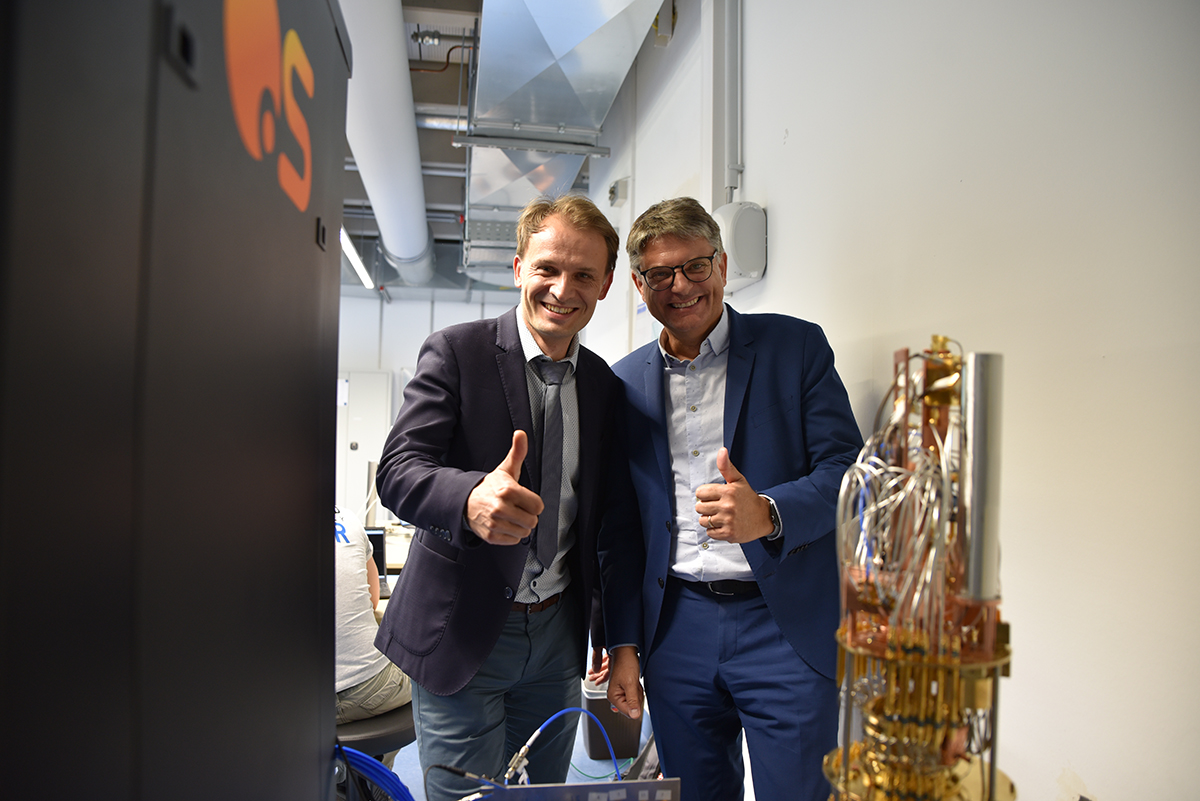
It is exactly these superconducting circuits that the research group led by Prof. Dr. Christopher Eichler, Chair of Experimental Physics at FAU, works on. He says: “We were extremely pleased for the three winners of this year’s prize. With their groundbreaking work about the quantum tunneling effect in superconductors, these three pioneers have laid the foundation for a completely new field of research with a huge potential for applications in information technology. Nowadays, such quantum tunneling contacts can be integrated in increasingly complex electric circuits. This enables quantum information to be stored, initialized, processed and read. You can also perform calculations with quantum information. All thanks to the quantum tunneling effect. We are certainly going to see several more exciting developments during the coming years that are based on the work of Clarke, Devoret and Martinis.”
In June of this year, MPL gathered 300 physicists on the island of Helgoland in order to celebrate 100 years of quantum mechanics. Nobel Prize winner Michel Devoret held one of the keynote speeches and explained how these counterintuitive quantum effects appear in his latest experiments with superconducting quantum circuits.
Experience quantum physics in Erlangen
To celebrate 100 years of quantum physics, FAU and the Max Planck Institute for the Science of Light will be putting quantum research into the spotlight during the Long Night of Sciences on Saturday, October 25 at FAU in the Audimax lecture hall with fascinating presentations about research trends. The Max Planck Institute will be opening its labs and giving insights into current questions in quantum research.
Link to Long Night of Sciences
Further information:
Prof. Dr. Florian Marquart
Chair of Theoretical Physics
Phone: +49 9131 7133400
florian.marquardt@mpl.mpg.de
Prof. Dr. Christopher Eichler
Chair of Experimental Physics
Phone: +49 9131 85-28371
http://quantum.nat.fau.de