
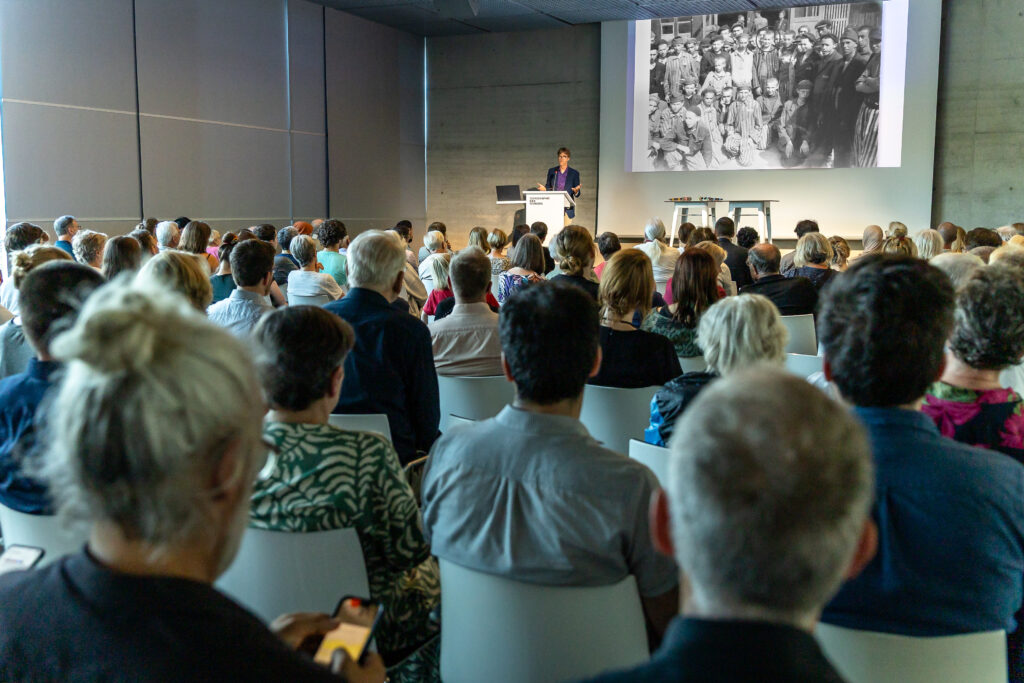
High school students are working on an exhibition with FAU about dealing with the National Socialist era. Whether its court trials against former concentration camp staff or the public debate about street names, how we deal with the National Socialist era is the subject of much debate. The touring exhibition “Die Nazis waren ja nicht einfach weg” (“The Nazis didn’t just disappear”) being held at the School Museum at Friedrich-Alexander-Universität Erlangen-Nürnberg (FAU) examines how Germany has dealt with the National Socialist era since 1945. The exhibition is currently in Berlin and will come to Nuremberg in fall 2026. An interview with the curator of the exhibition, Dr. Mathias Rösch, Director of FAU’s School Museum.
How did the idea for the exhibition “The Nazis didn’t just disappear” come into being?
During some workshops with young people, we noticed that they also grapple with the period after 1945. Above all, they are concerned about the question as to why many of the perpetrators have remained unpunished. Two meetings gave the final impetus: On the one hand, during the preparations for our previous exhibition almost everyone we interviewed first reported the subtle or obvious presence of the issue of National Socialism in teaching in schools in Germany from the 1950s to the 1980s. On the other, a discussion with the daughter of a high-ranking Nazi perpetrator made it clear how deeply affected this woman was by her family’s past, even decades later. It was clear to me that this issue is highly topical.
How did you decide to devise the exhibition in conjunction with high school students?
My co-curator Udo Andraschke and I wanted to make the perspectives of young people visible by not talking about young people, but talking with them. This is why we involved schools with very different backgrounds from four different Federal states in Germany: Bavaria, Hesse, Thuringia and Berlin.
Can you give us a brief summary of how the content of the exhibition came about?
The young people themselves selected objects from the collections of FAU’s School Museum and several other archives, made suggestions for content and devised questions. The high school students were interested in how young people lived during the time after the Second World War. We then developed the concept based on these elements. This all developed into an exhibition that takes the interests and needs of young people into consideration to a great extent. This is because it is precisely this audience that will decide in future how we deal with the National Socialist era.
What surprised you the most when you were working with the high school students?
I was impressed by how seriously and with how much empathy several of the young people approached the topic. One example in particular is a student who brought one of her family’s old photographs that moved many students in her class to tears. In it, a man and a woman are looking into each other’s eyes and it is the man’s last period of leave during the war. He was killed at the front shortly afterwards. This led to the question in class: Are we allowed to grieve for a soldier who has died during a criminal war?
Which part of your work on the content of the exhibition stays in your mind in particular?
It was the moment when we spoke openly about antisemitic attitudes. The one to one discussions with young people who express these sentiments were not about judging them, but about trying to understand them: Where does this way of thinking come from? Which narratives are behind it? These discussions were difficult, but decisive. They showed that dialog is possible. Much would be gained if it were possible for these young people to start questioning the narratives they have taken on.
An overview of the handling of the National Socialist era
Using the fates of several individuals, the exhibition tells the story of various aspects of dealing with National Socialism: For example, the denial of their own Nazi past in the 50’s, the trivialization of the atrocities against millions of Jews, the return of the perpetrators or the largely failed prosecution of those responsible for Nazi crimes. Other parts of the exhibition are dedicated to the fight for memorials or against right-wing extremism using the period known as the “baseball bat years” from 1990 onwards as an example.
The exhibition is at the Topography of Terror Documentation Center in Berlin until January 11, 2026. It will then move to the Museum of Communication Frankfurt and, from fall 2026, it will be located at the Documentation Center Nazi Party Rally Grounds in Nuremberg.
More information:
Dr. Mathias Rösch
School Museum of Friedrich-Alexander-Universität Erlangen-Nürnberg
mathias.roesch@fau.de]]>