
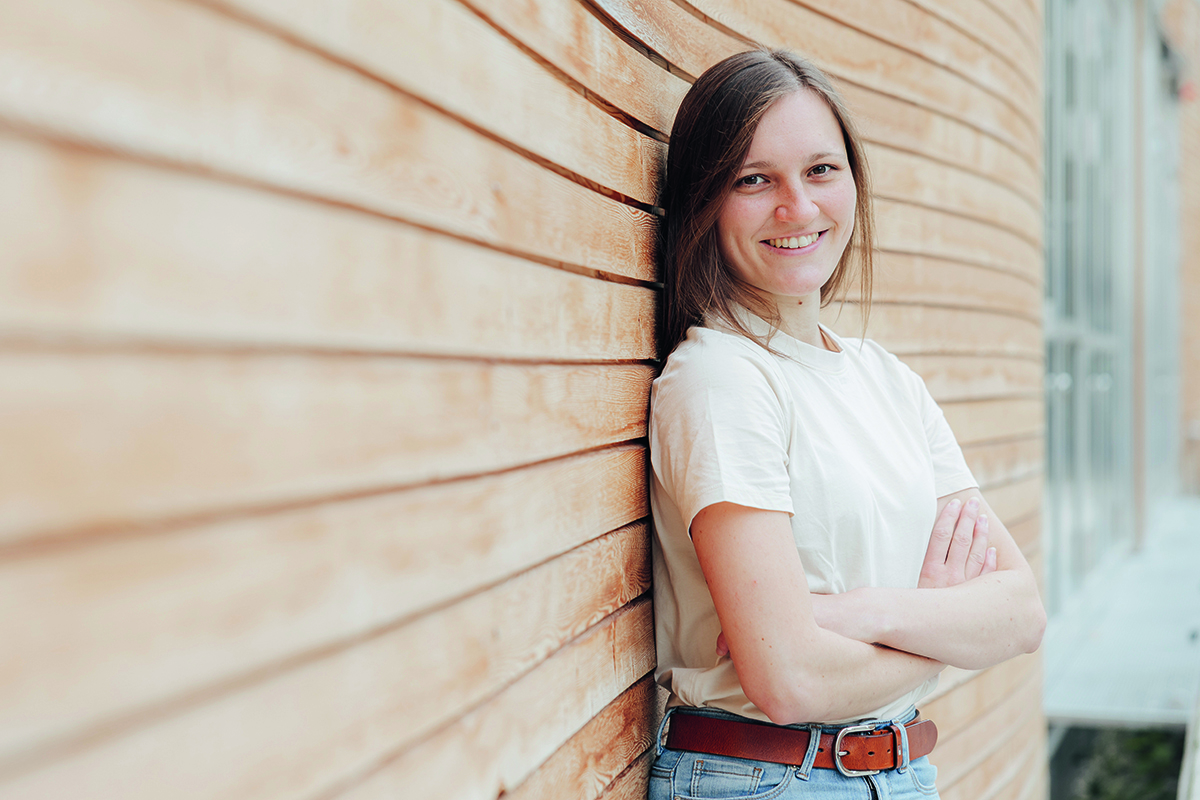
With her Master’s thesis on innovative energy storage, Tamara Hein won the Hightech Prize Bavaria. The doctoral candidate is researching how sustainable energy can be used more effectively.
When Tamara Hein was informed by email about her nomination for the Hightech Prize Bavaria, she could hardly believe it. “I didn’t even realize that the dean of the Faculty of Engineering had nominated my work,” the 28-year-old says. She hadn’t expected to be among the five best graduates in Bavaria, alongside Johanna Geiß. At the award ceremony in April, she was supposed to spontaneously present her research topic to a large audience. “It’s not often that you have to explain scientific topics in simple terms.”
In her Master’s thesis at the Chair of Chemical Reaction Engineering, she supported the development of plate catalysts for releasing hydrogen from so-called LOHC compounds. These liquid organic hydrogen carriers make it possible to store hydrogen more efficiently than in its gaseous form. When energy is needed, the hydrogen can be released from the compound again. By reusing the LOHC molecules, a cycle is created that is suitable for ensuring a sustainable energy supply.
From secondary school to cutting-edge research
Her scientific career began unconventionally: Hein transferred between German secondary school systems and even repeated a grade. “Chemistry has always been one of my favorite subjects,” she says in retrospect. In 2017, she began studying chemical engineering at FAU. For her Master’s, she specialized in chemistry and process engineering. When she saw the posting for a Master’s thesis on LOHC as part of Phillip Nathrath’s doctoral project, she was immediately enthusiastic. Two students had already done preliminary work on plate catalysts to optimize their design and to generate as few byproducts as possible during dehydrogenation.
“A few years ago, I was sitting in the seminar room myself and everything was still quite abstract. Now I use these things every day.”
Tamara Hein
Experiments under real-world conditions
Hein worked on her Master’s thesis for seven months. She is especially proud of the dynamic experiments, which were not originally planned. “That corresponds much better to real-world conditions,” she explains. This is because energy consumption fluctuates throughout the day, so the system must be able to release varying amounts of hydrogen. The result: Her reactor concept also works under fluctuating conditions and is more efficient than conventional fixed-bed reactors. Since February 2024, Hein has been pursuing her doctoral degree in the research group “Catalytic Systems for Chemical Energy Storage” led by Patrick Schühle, and is now exploring alternative ways of producing hydrogen from biomass. At the same time, she teaches the “chemical reaction engineering” lab for Bachelor’s degree students. “It’s cool to see that a few years ago I was sitting in the seminar room myself and everything was still quite abstract. Now I use these things every day.” For the future, Tamara Hein is keeping all her options open. She can imagine switching to industry after completing her doctoral degree. “Research is really a lot of fun, but industry is also important.” She has not yet decided whether she will remain committed to hydrogen or turn to other chemical processes.
Lea Maria Kiehlmeier
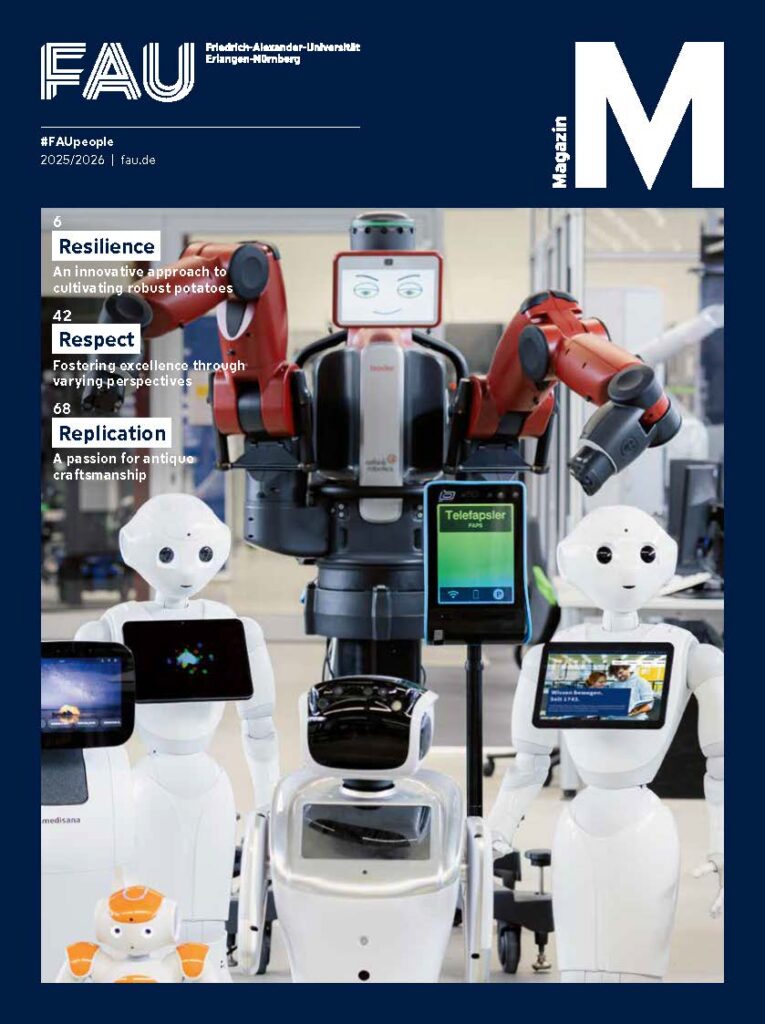
This article is part of the FAU Magazine
The third issue of the FAU Magazine #People is once again all about the people who make our FAU one of the best universities in the world. The examples in this issue show how lively and diverse our research is, the commitment of our students, and the work in the scientific support areas.
Highlight is certainly the new research cluster “Transforming Human Rights.” Or you can follow our scientists into laboratories and workshops, where they make potatoes climate-resistant, teach robots social behavior, or reconstruct ancient ships and cannons. At FAU, students are developing vertical take-off aircraft or impressing with outstanding performances at the Paralympics. And let’s not forget the people who work at our university or remain closely connected as FAU alumni. Visit the Children’s University with them or watch a TV series with an FAU alumna and Grimme Award winner.
- File Name
- FAU_Magazine_2025_2026
- File Size
- 3 MB
- File Type