
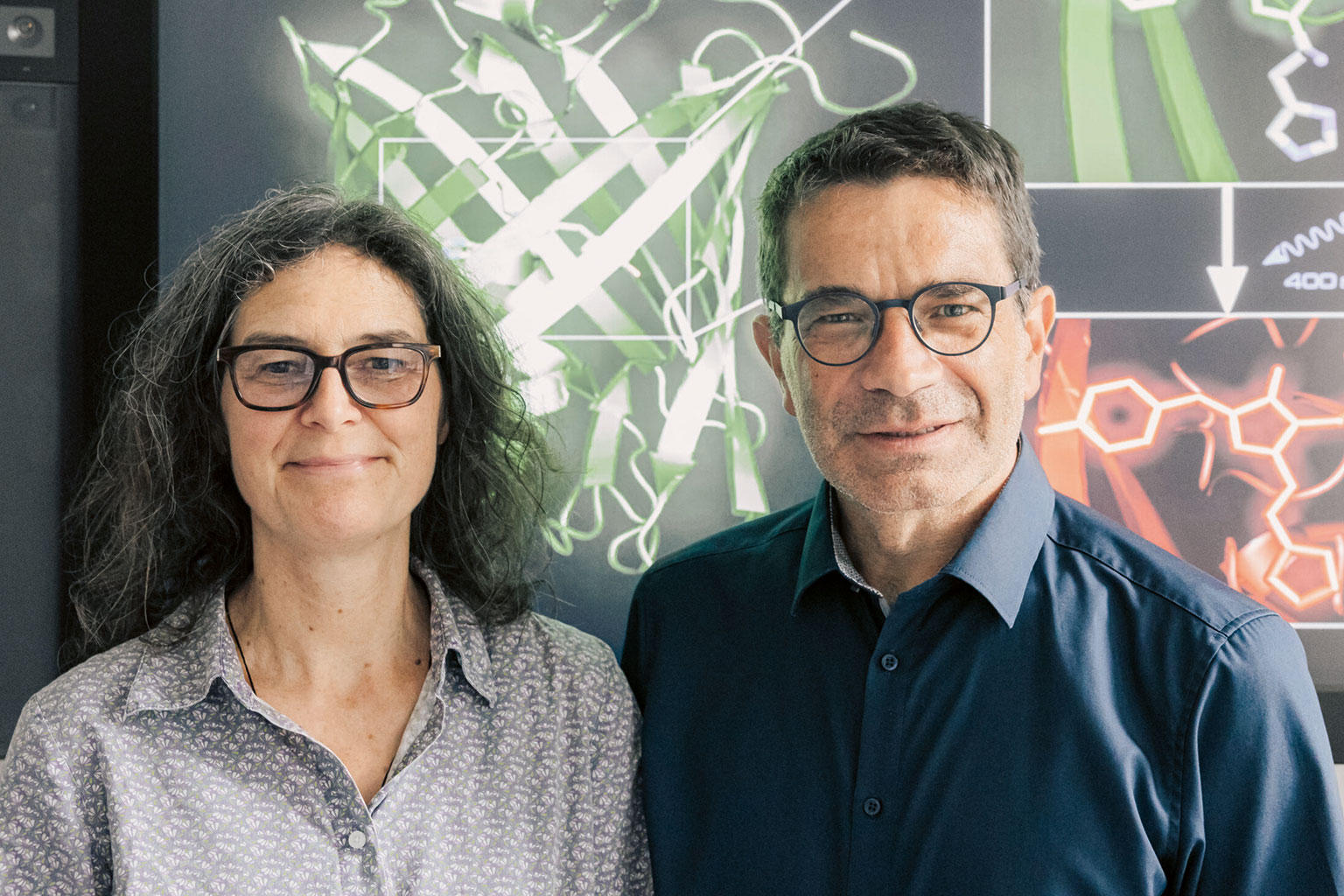
The supercomputers Helma and Alex housed at FAU are among the most powerful computers in the world. Petra Imhof and Gerhard Wellein support research groups from all over Germany in harnessing this concentrated computing power for scientific projects.
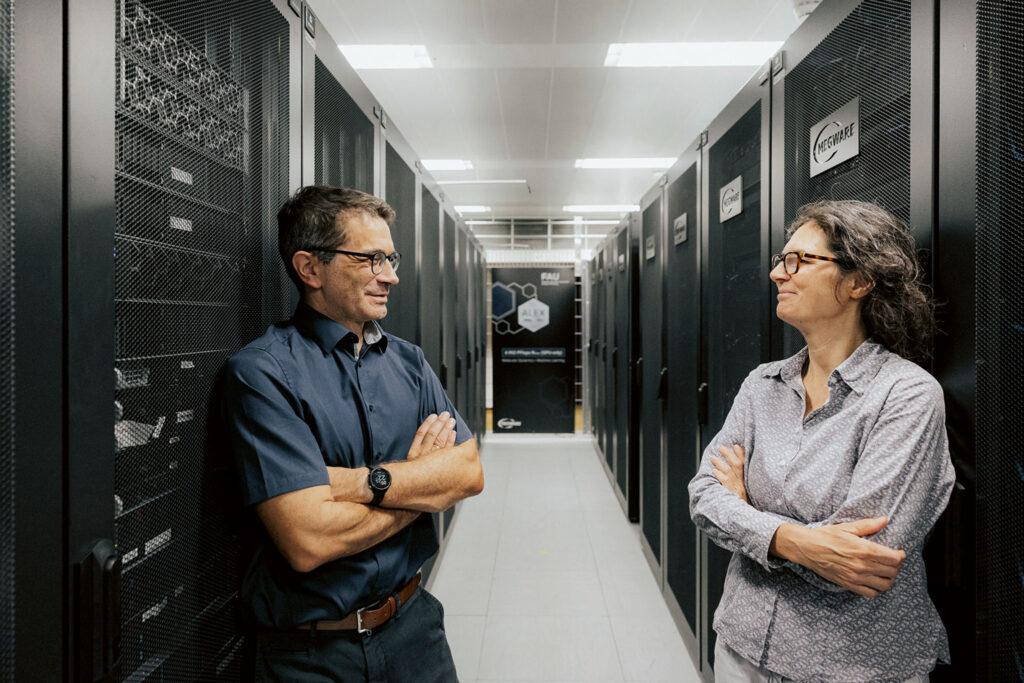
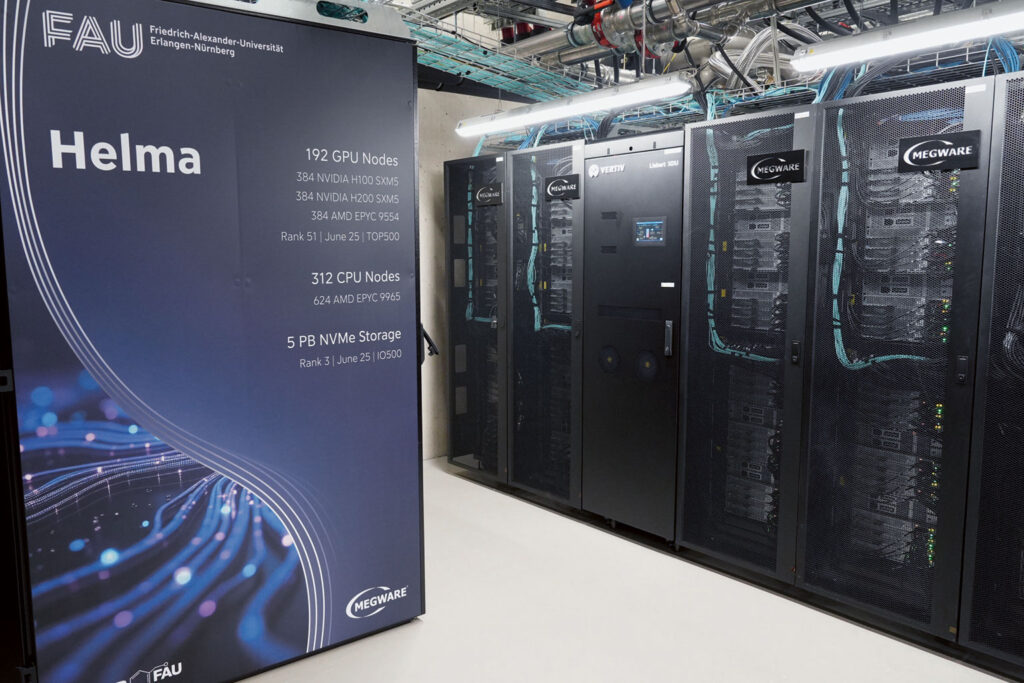
The room is bathed in pale neon light, and a loud humming makes conversation almost impossible. The interior is not very inviting either: walls of bare concrete, a tangle of water pipes on the ceiling leading to a few dark gray cabinets. Behind their perforated fronts, green and yellow LEDs are blinking, providing a few sparse splashes of color. The cabinets house a computer that FAU is quite proud of. It consists of 192 connected compute nodes, each of which is powered by four high-end Nvidia GPUs. The cluster goes by the charming name of “Helma” – after Wilhelmine, Margravine of Brandenburg-Bayreuth, whose husband Friedrich founded the University of Erlangen in 1743 and who later bequeathed her private library to the university.
And “Helma” is incredibly fast: on the list of the world’s most powerful computers, the cluster currently ranks 51st, and among supercomputers at German universities, it is at the very top. Research groups across the entire country can take advantage of this concentrated power. That’s because Helma – just like her brother Alex, currently ranked 290th worldwide – is part of the National High-Performance Computing Alliance, abbreviated NHR. A total of nine centers have joined together in this network, which aims to help meet research’s ever-growing demand for computing power. The project is funded by the Federal Ministry for Research, Technology and Space (BMFTR) and the states involved.
”Computing power is one thing – using it profitably is another.”
Gerhard Wellein
Simulation of large molecules
“But the money doesn’t just go into hardware,” emphasizes Gerhard Wellein, who heads NHR@FAU, the Erlangen branch of the NHR. “Computing power is one thing – using it profitably is another.” Each site needs researchers who know how to configure the computers for scientific questions in the most efficient way possible. And who, thanks to their expertise, are able to help other users solve problems. “Here at FAU, for example, we have colleagues who are extremely knowledgeable about calculating molecular dynamics,” says Wellein. “Or who train large AI models for specific applications. They have an enormous wealth of experience that other research groups can benefit from.”
One of these experts is Petra Imhof. The professor of computational chemistry has been working for years on atomistic simulations, a key focus area of NHR@FAU. “We want to understand how the atoms within molecules move relative to each other,” she explains. Molecules are not rigid, as the ball-and-stick models from chemistry class might suggest. For example, groups of atoms can twist around a bond. How they do this depends on the attractive and repulsive forces at work within the molecule. These forces also determine the three-dimensional shape a molecule will take.
At NHR@FAU, not only are such processes simulated on the computer, but also the interactions between different molecules. “Sometimes we’re dealing with hundreds of thousands of atoms, all interacting with each other at the same time,” explains the chemist. That’s what makes atomistic simulations so computationally intensive. At the same time, they are extremely important: they can be used to modify pharmaceuticals at the digital drawing board and to predict whether these changes will make them more effective.
AI in medicine
Another focus at NHR@FAU is training AI models. Artificial intelligence is particularly adept at detecting certain anomalies in data. In this way, it can help to diagnose diseases like cancer earlier and treat them more precisely. “The Free State of Bavaria is extensively promoting this technology and has financed a large part of Helma as part of its High-tech Agenda,” explains Gerhard Wellein. The Department of Artificial Intelligence in Biomedical Engineering established at FAU in 2019, is also largely funded by the Bavarian state. Here, research is being conducted on AI systems that can support doctors in analyzing image data, whether it’s MRI scans of tumors or ultrasound videos of the heart.
The Helma cluster plays a central role in this. “Its computing power makes it possible to analyze image data from far more patients than ever before,” explains Prof. Dr. Bernhard Kainz, Head of the Intelligent Data Exploration and Analysis Lab at FAU. “This will also benefit the accuracy of the AI results. However, Helma is only an intermediate step on the way to even more computing power: in the coming years, a new high-performance computing center with state-of-the-art infrastructure will be built at FAU. The Free State plans to invest up to 270 million euros to ensure that the University continues to play in the top league on this important issue.
NHR Alliance: bundled power
The National High-Performance Computing Alliance (NHR) has existed since 2021. On the one hand, the NHR provides computing capacity free of charge to scientists at German universities; on the other hand, it supports users, especially through consulting and training, in the use of high-performance computing in their fields of application. Within the alliance, university computing centers at the following locations work together: Aachen, Berlin, Darmstadt, Dresden, Erlangen, Göttingen, Karlsruhe, Mainz, and Paderborn. The federal and state governments provide more than 60 million euros annually for the work of the NHR. The alliance is managed by the Association for National High-Performance Computing e. V.
Frank Luerweg
This article is part of the FAU Magazine
The third issue of the FAU Magazine #People is once again all about the people who make our FAU one of the best universities in the world. The examples in this issue show how lively and diverse our research is, the commitment of our students, and the work in the scientific support areas.
Highlight is certainly the new research cluster “Transforming Human Rights.” Or you can follow our scientists into laboratories and workshops, where they make potatoes climate-resistant, teach robots social behavior, or reconstruct ancient ships and cannons. At FAU, students are developing vertical take-off aircraft or impressing with outstanding performances at the Paralympics. And let’s not forget the people who work at our university or remain closely connected as FAU alumni. Visit the Children’s University with them or watch a TV series with an FAU alumna and Grimme Award winner.
- File Name
- FAU_Magazine_2025_2026
- File Size
- 3 MB
- File Type