
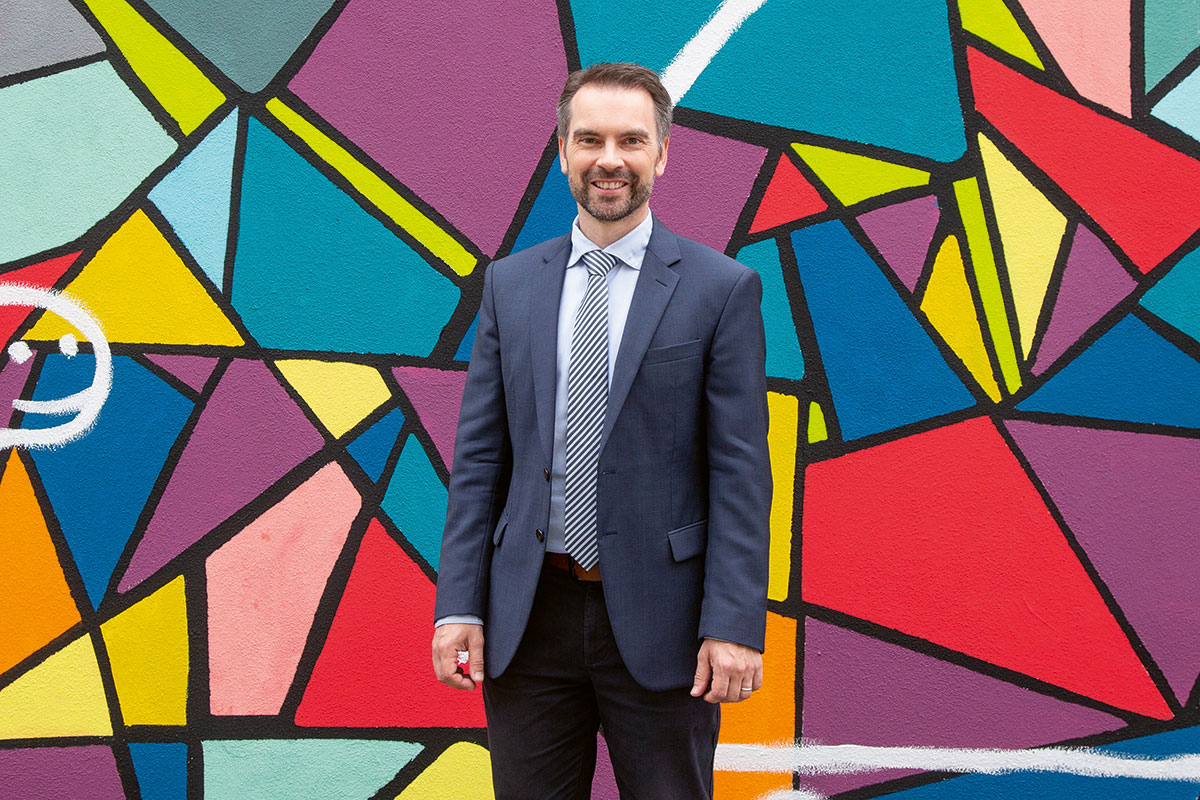
Andreas Ramming, Professor of Immunology of Organ Damage and deputy director of Department of Medicine 3 – Rheumatology and Immunology at Uniklinikum Erlangen is developing a new therapy for chronic inflammatory diseases.
Our immune system is similar to the police force of a big city. There are cells that patrol and keep an eye out for dangerous intruders, response units that arrive to provide reinforcement when needed and special forces with a license to kill. There’s even a fingerprint database. It is this diversity of protective mechanisms that has fascinated Andreas Ramming since his student days. “The immune system works like a well-oiled machine,” he says. “At least in the ideal case.” Unfortunately, the body’s own law enforcers sometimes overshoot their target. They go after bacteria and viruses with such force that they end up damaging healthy tissue. Normally, doctors then try to suppress the immune response with medications like cortisone. But that’s like taking away the police’s firearms – in a bank robbery, they’d be at a real disadvantage.
Activating self-protection
Ramming wants to tame the defense forces in a different way. Body cells actually have protective mechanisms that prevent them from being attacked by mistake. If these don’t work well enough, chronic inflammations like rheumatoid arthritis, asthma, Crohn’s disease, type 1 diabetes, or possibly even Alzheimer’s disease can result. “We want to reactivate this tissue-specific protection,” explains the immunologist. Thanks to support from the EU, this goal is now much closer. Ramming was recently awarded a “Proof of Concept” grant from the European Research Council (ERC). With this financial backing, he now wants to conduct an initial study in humans. “The advances in immunology already allow us to treat many diseases much better than before,” he says with no small amount of pride. “Our approach can be another strategy for this. And that’s exactly what drives us: To help patients whom we could not treat before or only with limitations. If we succeed, it’s extremely rewarding.”
Frank Luerweg
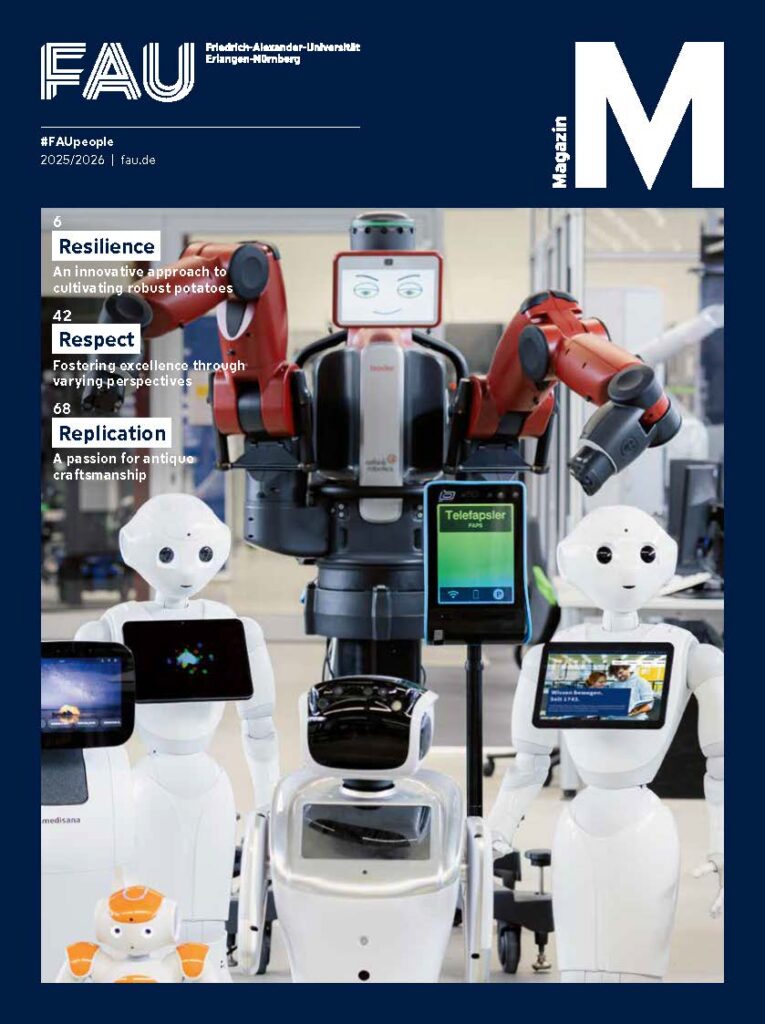
This article is part of the FAU Magazine
The third issue of the FAU Magazine #People is once again all about the people who make our FAU one of the best universities in the world. The examples in this issue show how lively and diverse our research is, the commitment of our students, and the work in the scientific support areas.
ighlight is certainly the new research cluster “Transforming Human Rights.” Or you can follow our scientists into laboratories and workshops, where they make potatoes climate-resistant, teach robots social behavior, or reconstruct ancient ships and cannons. At FAU, students are developing vertical take-off aircraft or impressing with outstanding performances at the Paralympics. And let’s not forget the people who work at our university or remain closely connected as FAU alumni. Visit the Children’s University with them or watch a TV series with an FAU alumna and Grimme Award winner.
- File Name
- FAU_Magazine_2025_2026
- File Size
- 3 MB
- File Type