
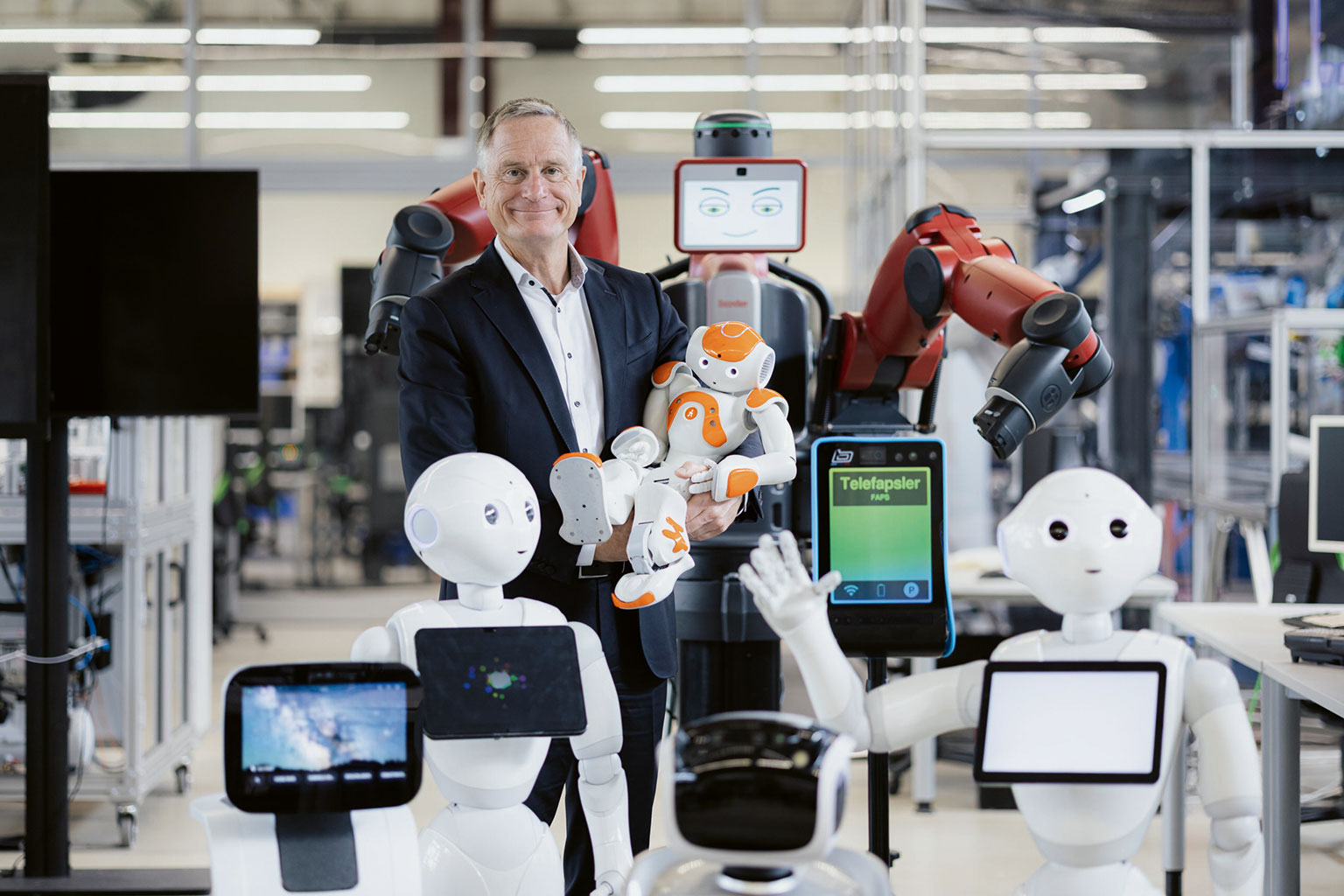
Mechatronics engineer Jörg Franke and psychologist Cornelia Niessen are researching a new generation of robots. These robots are intended to master social behaviors and become assistants for humans.
Imagine coming home in the evening. Your robot greets you warmly, tells you that your dinner is on the table, and can already tell from your response whether you need comfort or peace today. Jörg Franke would like to make this vision reality in the medium term. A future in which smart machines accompany people in everyday life, ease their burdens, and perhaps even put a smile on their faces. “Whether it’s space travel, motorcycles, or cars, technology has fascinated me since I was a teenager,” reveals the head of the Chair of Manufacturing Automation and Production Systems (FAPS). After studying manufacturing engineering and earning his doctoral degree at FAU, he then moved into industry. In his various positions – including at Bosch, ZF, and Schaeffler – he led hundreds of employees at numerous locations in management roles. In 2009, he accepted the call to the FAPS chair and succeeded his doctoral supervisor.
Under Franke’s leadership, the Chair grew to nearly 100 employees. At 61, he not only wants to guide the researchers, but to inspire them. Above all, he wants to “encourage young engineers to bring great technologies to market in their own start-ups.” His goal as an engineer is to research disruptive technologies. These also include social robots. Their development is to be advanced within the research consortium “FORSocialRobots,” for which he serves as spokesperson and coordinator. The project, which will run until 2027, involves research institutions, companies, and users. “Humans and robots are to work together in flexible teams. New robot applications are to be researched and developed in several subprojects,” explains Jörg Franke.
While industrial robots have been taking over monotonous tasks for decades, their “new colleagues” are meant to adapt to humans: for example, to make contact with them, be empathetic, and help when needed – whether in care, manufacturing, or the service sector. The technology is based on image processing and large language models. The participants want to use a digital twin to simulate and validate appropriate software modules that enable robots to predict human behavior and proactively adjust their own actions.
Social skills required
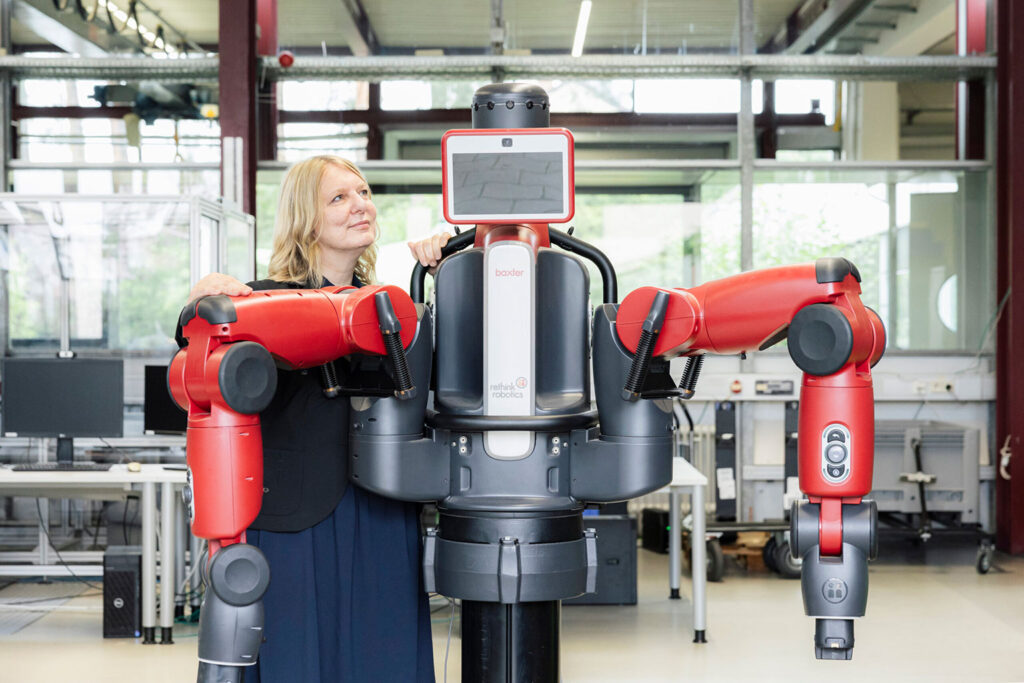
However, some challenges must first be overcome: “Social behavior requires a complex understanding of empathy and communication. In order to master the unwritten rules of human interaction, robots would have to ‘read’ gestures, facial expressions, language, and context and respond accordingly,” explains Cornelia Niessen, whose Chair of Work and Organizational Psychology is participating in the joint project. Cornelia Niessen’s interest in psychology has accompanied her since her school days. After graduating from high school, the Wilhelmshaven native went abroad, as she has always been interested in new experiences. She found the work experience – but above all, meeting people in Israel, Egypt, and Italy – enriching. She then studied at TU Berlin, where she also earned her doctoral degree. After positions at TU Braunschweig and the University of Konstanz, she took over the newly established Chair of Work and Organizational Psychology at the Institute of Psychology in Erlangen in 2011. Niessen researches questions such as how people deal with change and what enables them to remain healthy, capable of action, and adaptable during transformation processes. Within the research consortium, she and her team want to explore how robots can support people at work. To make this a reality, robots must be able to act socially and respond to situations appropriately. “The challenge is to design and understand robot interactions in such a way that they are perceived as socially adept and ethically acceptable,” the psychologist describes. She also wants to investigate the effectiveness and acceptance of robots among potential users – for example, whether care staff see robots as colleagues or more as tools.
Another aspect concerns the autonomy of the robots: To what extent will people accept that a social robot not only performs tasks on command, but also takes on tasks proactively – that is, independently seeks out and completes certain tasks? Whether such self-initiated actions are perceived as helpful or as an intrusion into work routines depends largely on the robot’s communicative and emotional skills and its understanding of social situations. The path to empathetic helpers is a long one. After all, science has not yet fully explained social behaviors in humans. The research project aims to provide answers so that human abilities can later be transferred to automated systems. According to the two researchers, the decisive factor for the use of social robots is not technical feasibility or cost. Which tasks should remain with humans is ultimately an ethical question that society must address in depth.
AI and quantum technology: Robotics at FAPS
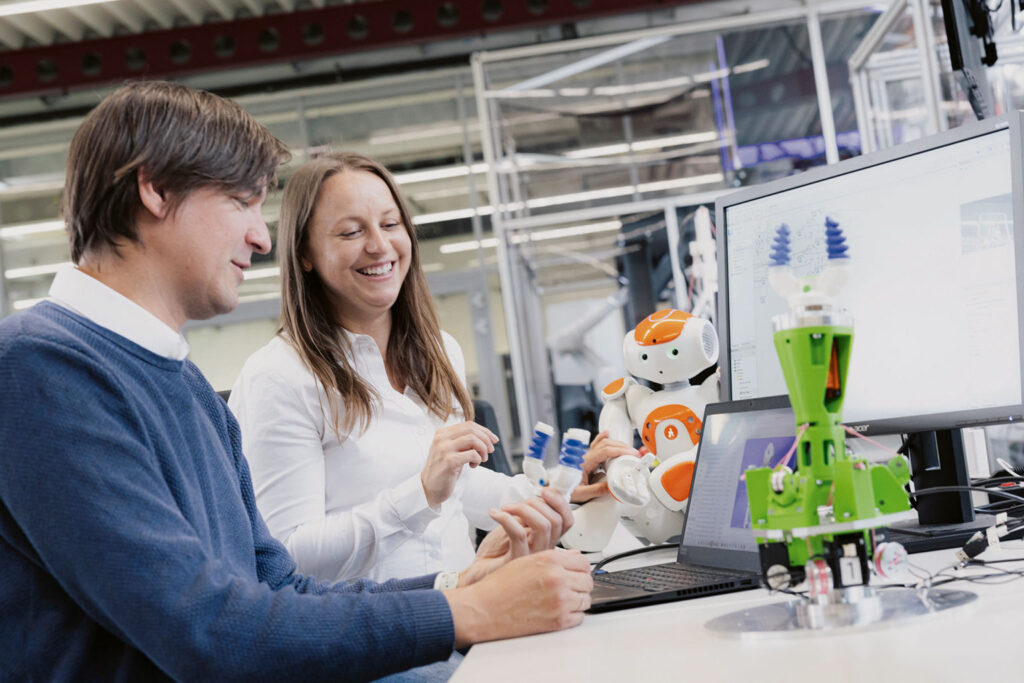
Robotics is one of eight research areas at the Chair of Manufacturing Automation and Production Systems – FAPS for short. In numerous individual projects, researchers are working on linking artificial intelligence with mechatronic components, perfecting cable-driven robots for positioning tasks on construction sites, and making unmanned aerial vehicles quieter and more energy efficient. Research on social robots focuses on increasing their autonomy on the one hand, and on making them more empathetic on the other, in order to boost users’ trust and acceptance. At FAPS, researchers are also investigating how future quantum computers can be integrated into computer architectures to enable real-time data processing. This would make robots even more powerful.
Eve Tsakiridou
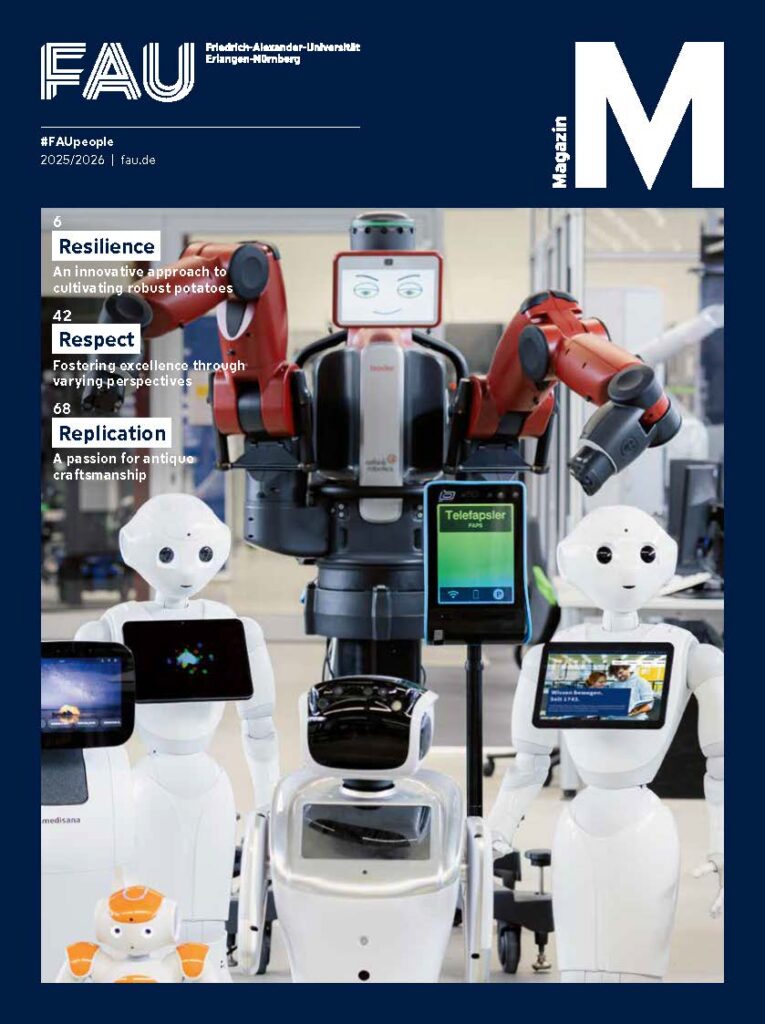
This article is part of the FAU Magazine
The third issue of the FAU Magazine #People is once again all about the people who make our FAU one of the best universities in the world. The examples in this issue show how lively and diverse our research is, the commitment of our students, and the work in the scientific support areas.
Highlight is certainly the new research cluster “Transforming Human Rights.” Or you can follow our scientists into laboratories and workshops, where they make potatoes climate-resistant, teach robots social behavior, or reconstruct ancient ships and cannons. At FAU, students are developing vertical take-off aircraft or impressing with outstanding performances at the Paralympics. And let’s not forget the people who work at our university or remain closely connected as FAU alumni. Visit the Children’s University with them or watch a TV series with an FAU alumna and Grimme Award winner.
- File Name
- FAU_Magazine_2025_2026
- File Size
- 3 MB
- File Type