
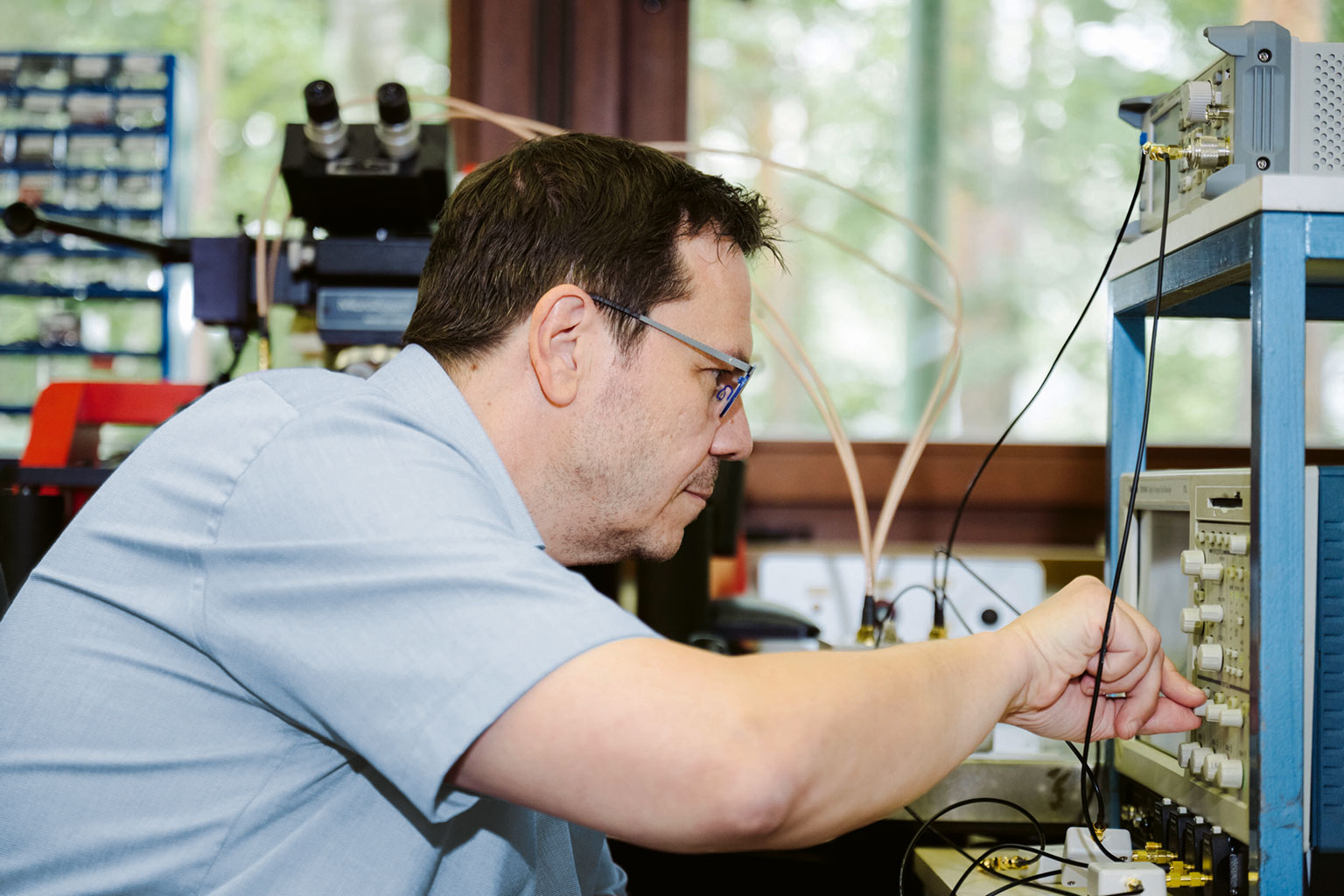
Vojislav Krstić carries out research into quantum computers that work at room temperature instead of having to be cooled down to an energy-guzzling minus 273 degrees Celsius. That would be a huge step forward toward widespread use.
Vojislav Krstić is not prone to emotional outbursts, on the contrary: “Training as a physicist trains your patience and stamina,” says the Professor of Applied Physics at FAU. This is all the more so if you are involved in fundamental research like Krstić. And yet he can hardly conceal his excitement when he mentions the impressive commercial funding of roughly 900,000 euros: “That is a lot of cash for our work.” He believes his research is pioneering in Germany. However, the US investors will still not be able to get their hands on a turnkey prototype after the two years project duration.
Quantum computing at room temperature
Krstić and his team of four researchers are working together with US colleagues on nano particles with a diameter of between 500 and 1,000 nanometers. A human hair is up to 200 times thicker. Their research focuses on topological insulators; fascinating materials with a crystal structure that means that they are only able to conduct electricity and transfer information on their surface. If the crystal layer is thin enough, the electricity is even just conducted at the edges, without being disrupted in any way by external influences, in other words protected by topology.
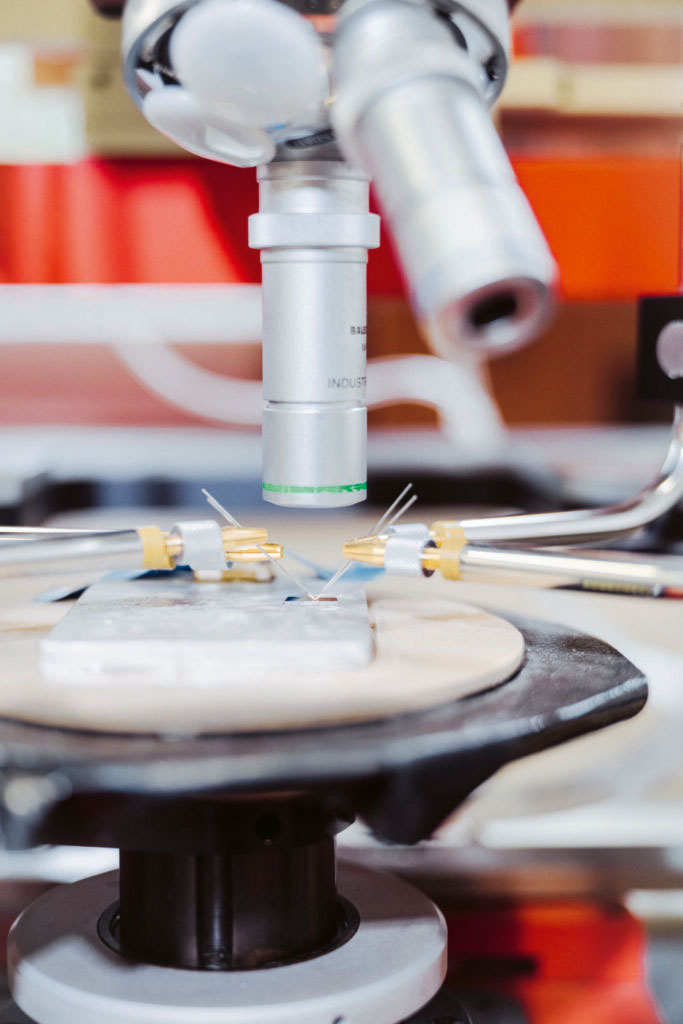
The second key aspect is symmetry-breaking in the system. For this, nanoparticles are twisted like a spiral so that they no longer align with their mirror image counterpart. The scientific term for this is chirality. “One example is the left and right human hand,” explains Krstić. The aim is to break symmetry in this manner and combine the above-mentioned edge currents, creating a two-state system. The idea behind the research is that a quantum bit, known as a qubit, that is protected by topology can be used in quantum computers irrespective of external influences such as the room temperature.
”Qubits can represent very many different states at once. That saves time. Compared to a conventional computer, a quantum computer is 10,000 to 100,000 times quicker.”
Prof. Dr. Vojislav Krstić
Game changer for the digital greed for energy?
The classic bit, the fundamental element of all everyday digital computational processes, is a zero-one pair. Heads or tails, if you want to compare it to a coin. Qubits, on the other hand, can represent all the different states in between, like a spinning coin. That is what makes quantum computers so much faster. In principle, quantum computing at room temperature could prove to be a game changer for the growing digital greed for energy. Quantum computers would be able to be operated with a fraction of the energy that is currently required at their current state of development. “Marketable solutions in the size of a tablet or a smartphone might over-compensate the energy-saving effect by the huge number of devices,” warns Krstić. But even if that is not the case: It is still a long way to go until we have quantum computers that fit in your pocket.
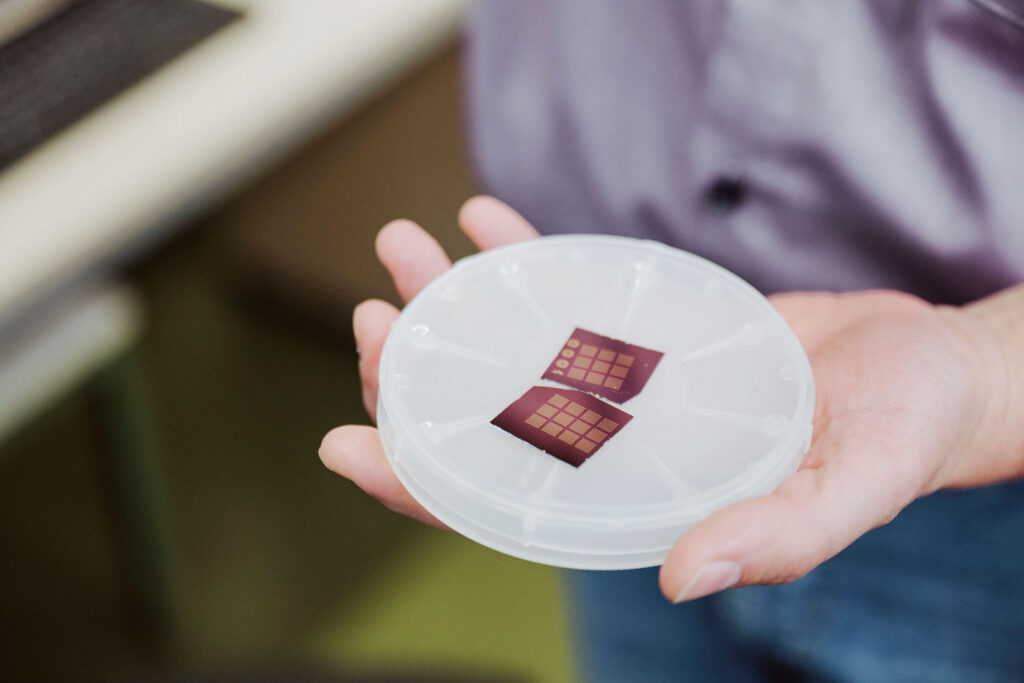
Quantum computing: a quantum leap for technology
Quantum physics describes the behavior of minuscule matter such as electrons or photons. Completely different rules apply than in classical physics: Objects are both particles and waves at the same time. An international group of researchers led by Vojislav Krstić has succeeded, for instance, in confirming an over 150 year old research approach concerning the propagation of photons in chiral material, known as the Chiral Faraday effect. This demonstrates how chiral-magnetic interactions can influence photons in nanoscale materials. Understanding such effects help in the research and development of innovative new materials for quantum technologies.
Time savings through parallelization
Quantum computers take a parallel and not a sequential approach to tasks. Krstić explains the concept of quantum supremacy as follows: “qubits allow extremely many states to be shown at once. Conventional computers can only deal with one at a time. This parallelization leads to considerable time savings. Compared to a conventional computer, a quantum computer is between 10,000 and 100,000 times quicker.” In addition, the computing power doubles with each additional qubit.
Fascinating phenomena in quantum physics
“Time is not money.” Krstić, born in 1972 in Mannheim, has learned this during his career as a researcher. He explains, money can always be found from somewhere, but additional time cannot. That is what makes quantum supremacy so fascinating. Krstić has always been interested in nanophysics and phenomena in quantum physics, even when working on his degree and as a doctoral candidate at the Max Planck Institute for Solid State Research. “For me, symmetry and chiral symmetry-breaking at the nanoscale are highly exotic and fascinating concepts. I have always been driven by this intrinsic curiosity and fascination.”
Thomas Tijang
This article is part of the FAU Magazine
The third issue of the FAU Magazine #People is once again all about the people who make our FAU one of the best universities in the world. The examples in this issue show how lively and diverse our research is, the commitment of our students, and the work in the scientific support areas.
Highlight is certainly the new research cluster “Transforming Human Rights.” Or you can follow our scientists into laboratories and workshops, where they make potatoes climate-resistant, teach robots social behavior, or reconstruct ancient ships and cannons. At FAU, students are developing vertical take-off aircraft or impressing with outstanding performances at the Paralympics. And let’s not forget the people who work at our university or remain closely connected as FAU alumni. Visit the Children’s University with them or watch a TV series with an FAU alumna and Grimme Award winner.
- File Name
- FAU_Magazine_2025_2026
- File Size
- 3 MB
- File Type