Until now, quantum theory has not been applicable to gravitation. Wolfgang Wieland has developed a theoretical approach that provides a quantized upper limit for gravitational waves.
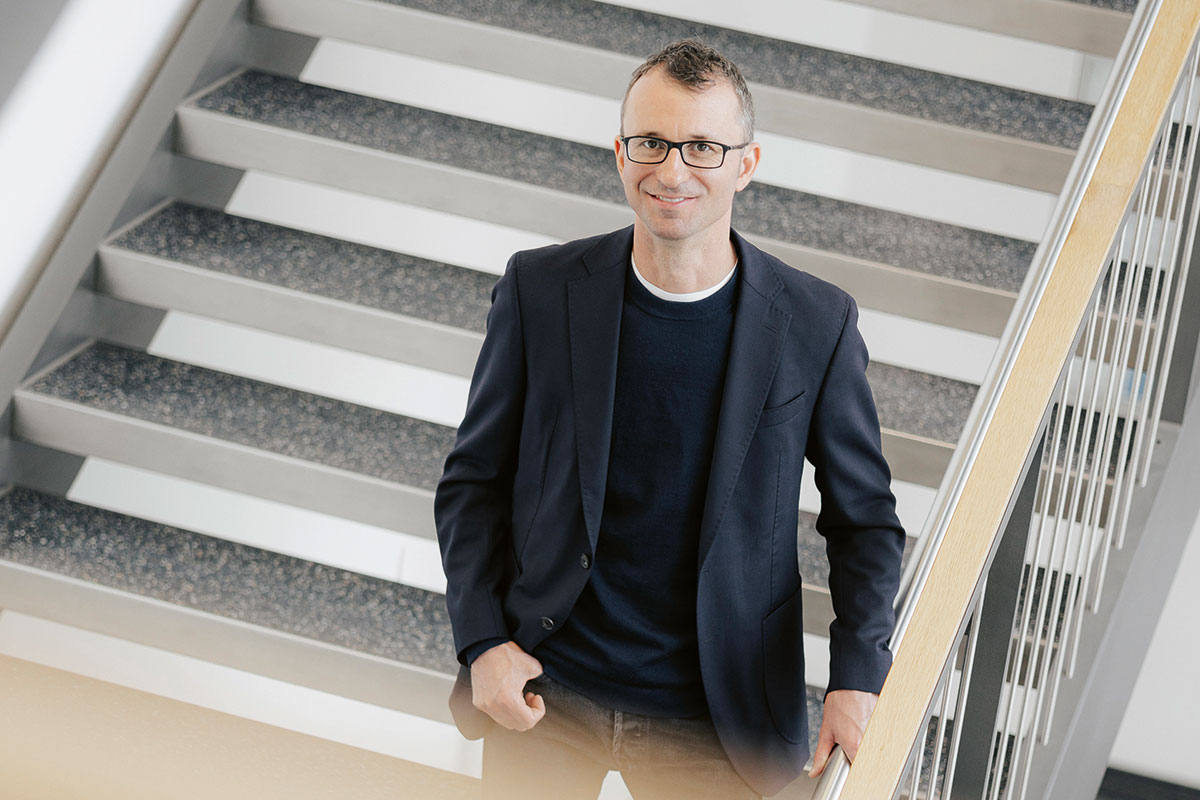
Wolfgang Wieland sits in his office on Erlangen’s Staudtstraße, a coffee cup beside him, a white wall behind him. He does have a computer, but he prefers to work with pencil and paper. With these, he sketches ideas and calculations that could revolutionize our understanding of the universe. “The problem with physics,” he says matter-of-factly, “is that its two central models, quantum mechanics and relativity, still do not fit together.” Wieland is working with leading researchers at the Chair of Theoretical Physics III on a theory of quantum gravity with which they hope to resolve this contradiction. If they succeed, they will have cracked the toughest nut of modern physics. In his general theory of relativity, Albert Einstein defined gravitation – that is, gravity – as the curvature of spacetime. It determines the distribution of galaxies in the universe and keeps planets in their orbits. The best way to describe spacetime is as an invisible, elastic net that is deformed by masses and forces light rays to follow the resulting curvature.
Universe versus microcosm
However, general relativity cannot explain the processes in the microcosm of elementary particles. Here, interactions occur in tiny portions, so-called quanta. Like some of his international colleagues, Wieland has been working for some time to “integrate gravitation into a quantum model and thus describe all fundamental forces.” This could finally allow gravity, like the other forces of nature, to be broken down into tiny packets of energy. Even as a student, Wolfgang Wieland was interested in mathematics and physics. He was influenced by the American science fiction series “Star Trek”. According to Wieland, the phenomena in Star Trek were “fascinating, but from a scientific perspective not tenable.” After graduating from high school, he studied theoretical physics in Innsbruck and Vienna. Wieland, who was born in Austria and grew up near Innsbruck, first dealt with quantum gravity during his doctoral studies at the University of Marseille.
Infinite values
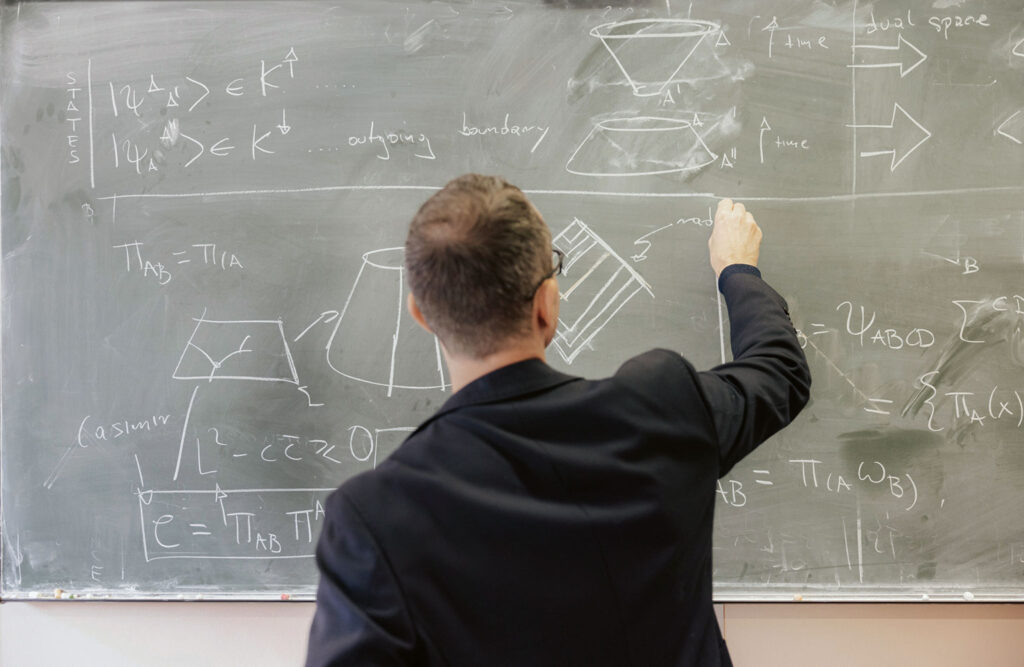
During his postdoctoral positions in the USA, Canada, and Austria, he explored the subject in greater depth. In 2023, he moved to FAU, where he has been funded since 2024 as head of a junior research group through the DFG’s Heisenberg Program. With his theoretical work, Wieland also aims to explain extreme states such as the Big Bang or black holes. In these phenomena, spacetime curves to infinity, and the density of matter also becomes infinite. Mathematically, singularities such as these cannot be solved, since infinite values appear in the equations. “Maybe it’s not gravitation that is quantized, but space and time,” the researcher speculates. The basis for this is the theory of loop quantum gravity. This theory assumes that space and time consist of tiny, discrete units – like a fabric that, under a microscope, appears as a net-like mesh of nodes. In this model, the geometry of spacetime is not only curved, but also entangled in loops – that is, quantum mechanically connected. “If you break down space and time into quanta, the infinite values that have so far overwhelmed mathematics disappear,” the physicist explains, while also emphasizing: “Under certain circumstances, the solution could be less spectacular than some might hope.”
Planck power sets the limit
Wieland’s approach is exceptional because it directly links the quantization of spacetime with the measurable power of gravitational waves. He bases this on what is known as Planck power, which indicates how much energy can be transmitted per unit of time at most. With it, it would be possible to demonstrate that gravitational waves cannot transport unlimited power, but that there is a “quantized upper limit.” “I hope that future gravitational wave detectors, such as the planned Einstein Telescope, will provide evidence of quantum gravity,” the researcher explains.
Eve Tsakiridou
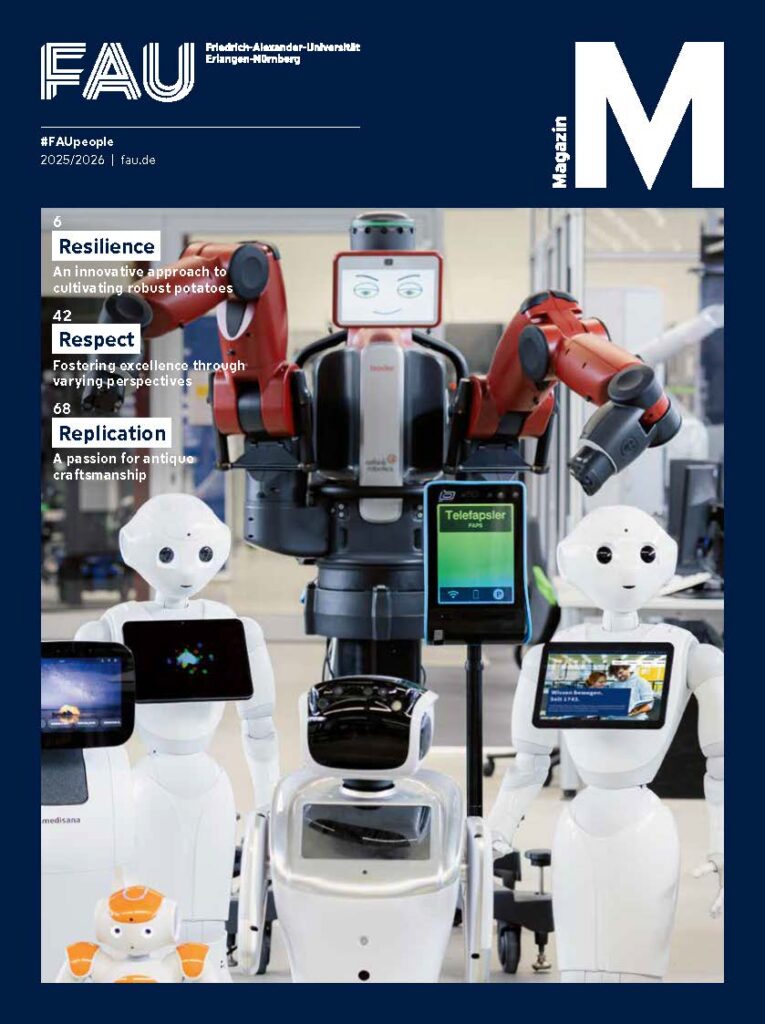
This article is part of the FAU Magazine
The third issue of the FAU Magazine #People is once again all about the people who make our FAU one of the best universities in the world. The examples in this issue show how lively and diverse our research is, the commitment of our students, and the work in the scientific support areas.
Highlight is certainly the new research cluster “Transforming Human Rights.” Or you can follow our scientists into laboratories and workshops, where they make potatoes climate-resistant, teach robots social behavior, or reconstruct ancient ships and cannons. At FAU, students are developing vertical take-off aircraft or impressing with outstanding performances at the Paralympics. And let’s not forget the people who work at our university or remain closely connected as FAU alumni. Visit the Children’s University with them or watch a TV series with an FAU alumna and Grimme Award winner.
- File Name
- FAU_Magazine_2025_2026
- File Size
- 3 MB
- File Type