
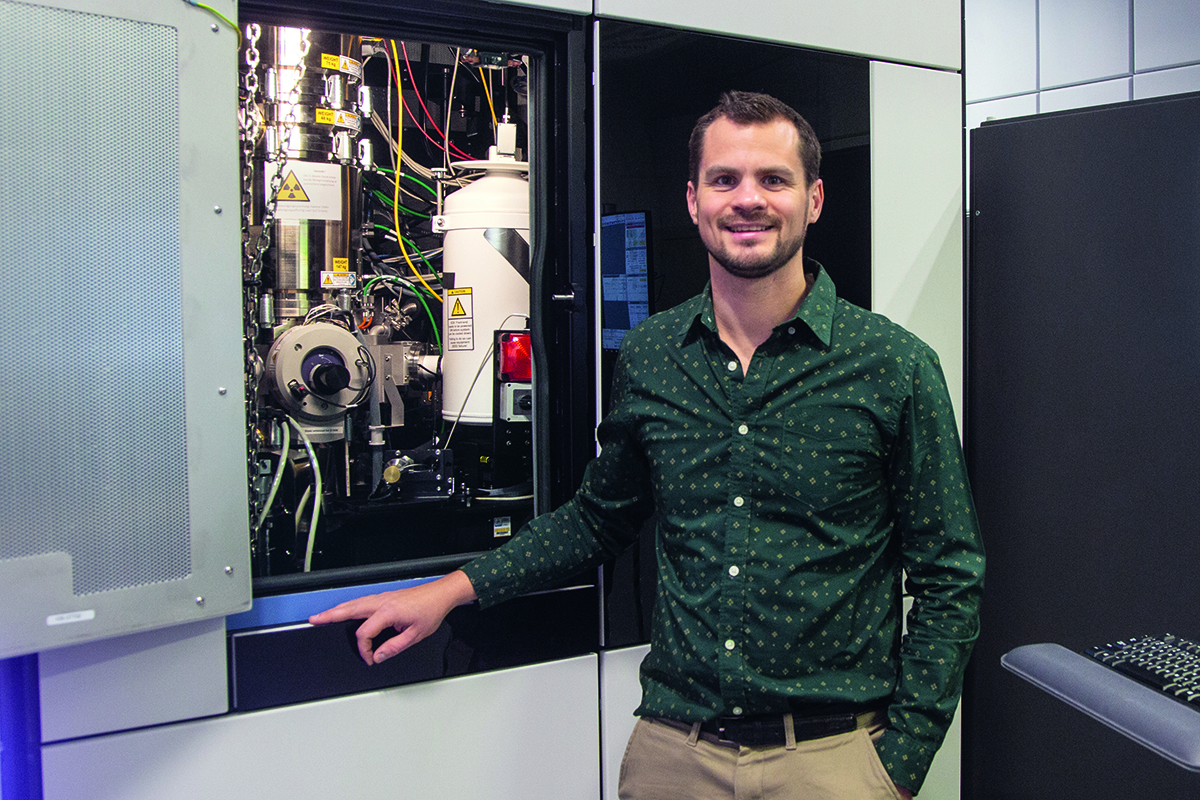
Philipp Pelz develops imaging methods that make material properties visible at the atomic level without detours. His research is supported by an ERC Starting Grant.
Killing two birds with one stone isn’t enough for Philipp Pelz. He wants to answer as many questions as possible at once with a single approach. With electron microscopes, he wants to examine materials in such a way that you can immediately see which elements they are made of and how they are structured in three dimensions. “That is one of the great dreams of materials science,” says the Professor of Computational Materials Microscopy at FAU. In the HyperScaleEM project, Pelz is working on imaging and analyzing even large material samples three-dimensionally at the atomic level. “That is anything but trivial,” he says. “Very light elements like hydrogen and oxygen are hardly detectable with existing methods. Alloys whose components show very similar contrast have also been difficult to characterize so far. Another focus is nano- and quantum electronics: Here, the properties of the materials depend crucially on the exact position of individual atoms. Pelz also wants to make these structures visible. And finally, the challenge is to actually derive reliable and useful information about the materials from the highly complex data.
AI makes technology more autonomous
To achieve these goals, the physicist is optimizing both the detection technology and the imaging algorithms. His research is being funded with an impressive 2.3 million euros as part of a Starting Grant from the European Research Council (ERC). “Part of the money goes into expensive equipment, such as a spectrometer or cameras that can record electrons directly without the detour via light signals,” Pelz explains. The grant also enables him to strengthen his team – with two doctoral students and a postdoc. “Such a project would be impossible alone. It is only through the work of the team that the vision of HyperScaleEM can become reality.” When it comes to imaging algorithms, the team relies on artificial intelligence to merge different channels and to make the electron microscopes work more and more independently. The ERC project offers Philipp Pelz the ideal opportunity to connect his academic interests. He focused on electron microscopy during his doctoral degree, after studying physics and computer science in Munich. “For me, it’s the perfect combination: you need physics to understand how the data in the microscope comes about, and computer science to extract information from it.”
Matthias Münch
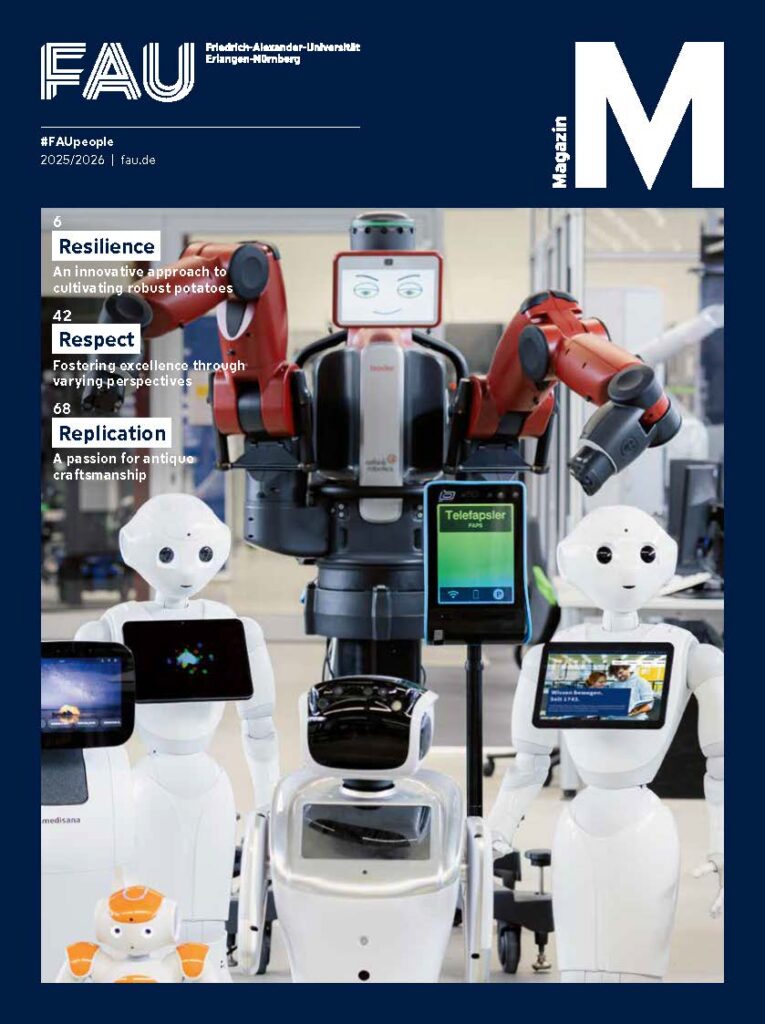
This article is part of the FAU Magazine
The third issue of the FAU Magazine #People is once again all about the people who make our FAU one of the best universities in the world. The examples in this issue show how lively and diverse our research is, the commitment of our students, and the work in the scientific support areas.
Highlight is certainly the new research cluster “Transforming Human Rights.” Or you can follow our scientists into laboratories and workshops, where they make potatoes climate-resistant, teach robots social behavior, or reconstruct ancient ships and cannons. At FAU, students are developing vertical take-off aircraft or impressing with outstanding performances at the Paralympics. And let’s not forget the people who work at our university or remain closely connected as FAU alumni. Visit the Children’s University with them or watch a TV series with an FAU alumna and Grimme Award winner.
- File Name
- FAU_Magazine_2025_2026
- File Size
- 3 MB
- File Type