

Professor of Ancient History Boris Dreyer does not limit himself to the study of ancient written sources. He tests Roman designs, which have been reconstructed using ancient manufacturing methods, for their practical usability and increases public interest in antiquity.
Caesar defeated the Gauls. “Didn’t he at least have a cook with him?” asks Bertolt Brecht in one of his poems. What he means by this: Isn’t our view of history shaped too much by rulers and intellectual elites? And is the contribution of ordinary people, especially craftspeople, being overlooked? After all, most contemporaries of antiquity did not belong to the privileged groups; their lives were shaped by hard manual labor. Whether legionaries or merchants, Romans or Celts – trade and change in antiquity depended on the functionality of handcrafted tools, vehicles, or weapons. “If we want to precisely examine the functionality and performance of ancient designs, trying is better than studying,” says Boris Dreyer. Since 2017, the professor of ancient history has rebuilt three Roman boats: the “Fridericiana Alexandrina Navis,” a Roman patrol boat from the first century AD, the “Danuvina Alacris,” a boat from the fourth century, as well as a Roman transport boat, the “Alchmona rediviva.” Dreyer and his team have so far reconstructed two artillery pieces from different periods and a catapult from the fourth century, an oven, 22 shields, as well as a Celtic chariot and a Roman travel wagon.
“90 to 95 percent of the material and written records from antiquity have been lost.”
Prof. Dr. Boris Dreyer
Smartphone and chisel
“For weapons and vehicles of this kind, there are of course no manufacturers who could be commissioned and paid by the university through a bureaucratic tendering process,” says Boris Dreyer. Although he has now become quite adept with saw, plane, paintbrush, and blacksmith’s hammer, his most important tool for reconstructing ancient equipment is his smartphone. With it, Dreyer brings together students, volunteer helpers, fellow professors, boat builders, sailmakers, artisan blacksmiths, performers, educators, government officials, politicians, tourism experts, sponsors, journalists, and documentary filmmakers at breathtaking speed and awakens their interest in experimental archaeology.

Experimental archaeology does not focus – like “living history” or “reenactment” – on the subjective experience of history, but instead follows a strictly scientific approach. The basis for the reconstructions is archaeological finds, contemporary visual representations such as reliefs or wall paintings, and, where available, written sources. Nevertheless, the state of the sources presents Dreyer with a problem: “About 90 to 95 percent of the material and written records from antiquity have been lost,” he says. That is why new knowledge can only be generated through reconstructions and functional tests. “There are no records from ancient shipbuilders; presumably, they passed on their knowledge only orally. Roman writers and artists, on the other hand, generally had neither practical experience nor were they interested in technical details,” Dreyer explains further.
Practicability turn and public outreach
Since the 1970s, classical studies have increasingly focused on ordinary people, but their designs have not been subjected to any historically plausible performance tests. That is exactly what Dreyer wants to change with the concept of the practicability test which is part of the practicability turn in research. In this way, he and his team discovered that a trained crew can fire up to twelve bolts per minute at an average speed of around 280 kilometers per hour with a field artillery piece. Or that the Onager catapult can hurl a 4.3-kilogram stone 130 meters. Test runs with the “Fridericiana Alexandrina Navis,” or “F. A. N.” for short, showed that the boat is easier to maneuver with a spritsail or lateen sail than with a square sail, which is the only sail type depicted in the sources. And tests showed that a certain shape of the bow allows the boats to glide more stably through the water.

“By now, the insights gained during construction and testing fill numerous qualification and Master’s theses as well as a variety of other publications,” says Dreyer. For the future, he hopes for a dual degree program in which students of ancient history can also earn a trade qualification at the same time. Boris Dreyer does not shy away from being present in the media. Boat races, trade fair appearances, as well as Roman and rowing events attract public interest; his projects are featured in well-known popular science magazines and international documentaries, and he himself is a sought-after expert on Roman technology. “For my teachers, public outreach and serious scholarship were still incompatible,” he says. That has changed: Dreyer himself now sees public outreach as an integrative task that ultimately also fosters understanding and support for this type of research.
Would you like to learn more about the projects of the Professorship of Ancient History?
Mathias Orgeldinger
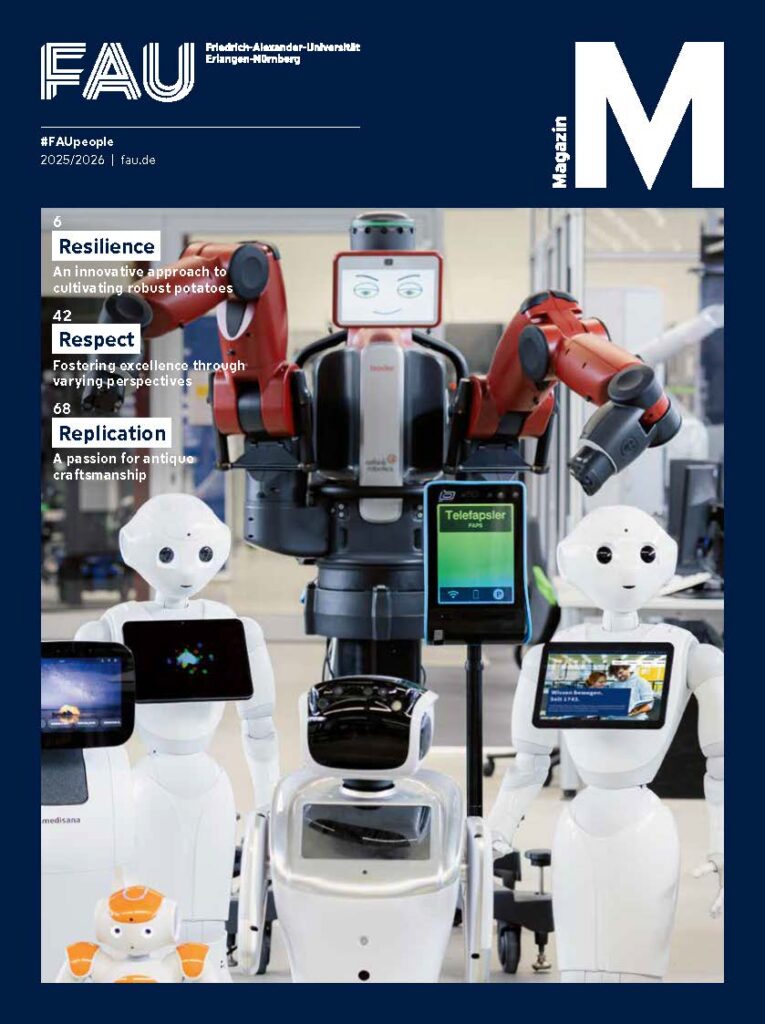
This article is part of the FAU Magazine
The third issue of the FAU Magazine #People is once again all about the people who make our FAU one of the best universities in the world. The examples in this issue show how lively and diverse our research is, the commitment of our students, and the work in the scientific support areas.
Highlight is certainly the new research cluster “Transforming Human Rights.” Or you can follow our scientists into laboratories and workshops, where they make potatoes climate-resistant, teach robots social behavior, or reconstruct ancient ships and cannons. At FAU, students are developing vertical take-off aircraft or impressing with outstanding performances at the Paralympics. And let’s not forget the people who work at our university or remain closely connected as FAU alumni. Visit the Children’s University with them or watch a TV series with an FAU alumna and Grimme Award winner.
- File Name
- FAU_Magazine_2025_2026
- File Size
- 3 MB
- File Type