
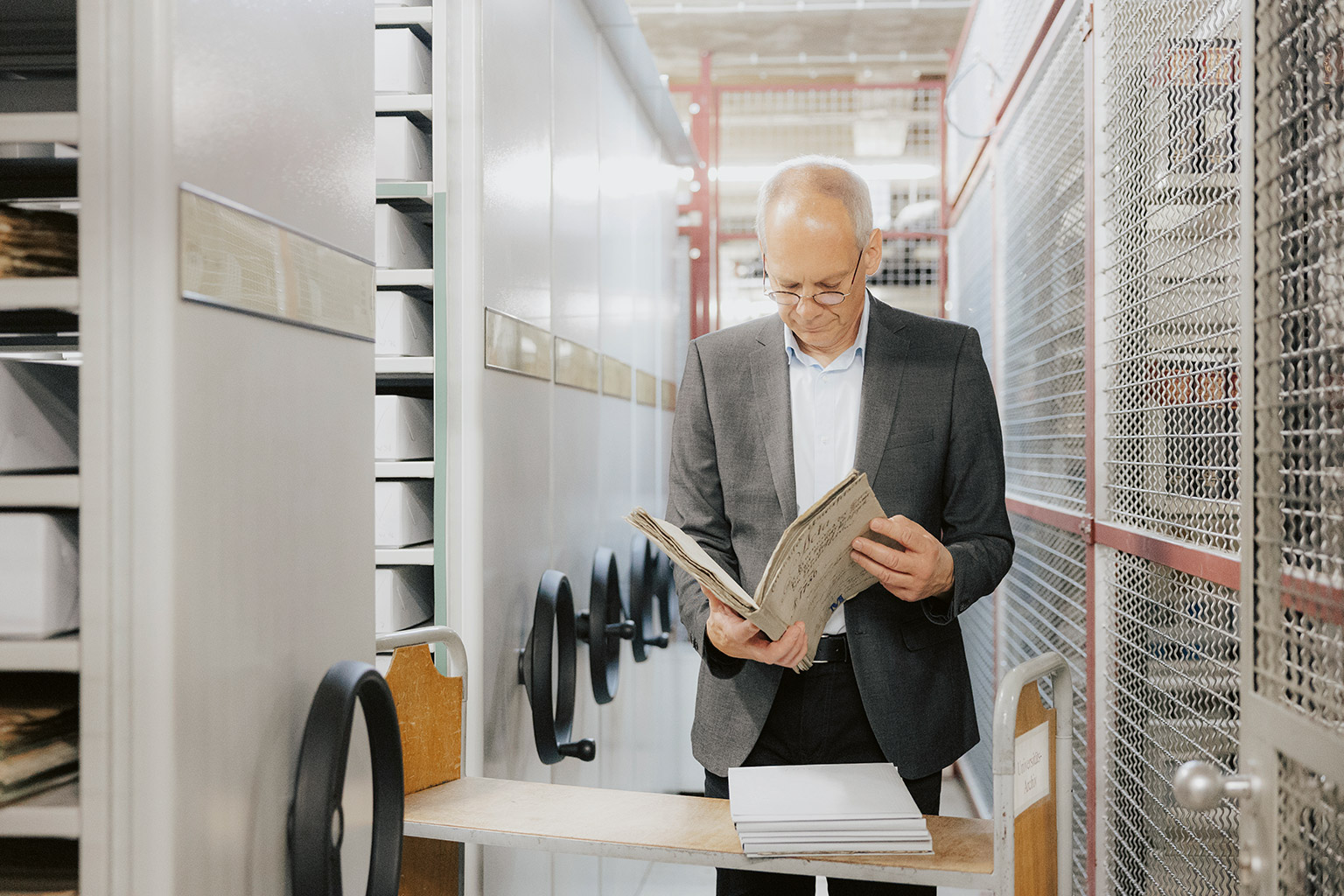
For more than 25 years, Clemens Wachter has been engaged with the history of Friedrich-Alexander-Universität Erlangen–Nürnberg. As an archivist, Wachter manages the university archive and ensures that the past is preserved for us.
Although Clemens Wachter deals with the past on a daily basis, his work as university archivist has a direct impact on the future. After all: He decides which documents are relevant for the further historiography of the university. “Of course, that is not an unimportant decision, because it lays the foundation for how the university’s history can later be evaluated.” In the vast majority of cases, however, it is quite clear what is archived and preserved, and what is not, says Wachter. After all, he has been doing this long enough, and there are many opportunities for exchange with colleagues at other university archives.
Wachter’s fascination with the history of the region has accompanied him since his studies. The historian earned his doctorate in Franconian regional history in 1999, after previously studying German studies and history at FAU. And his passion remains unbroken to this day: “University history is truly interesting, especially at FAU as one of the oldest universities in Bavaria. You can learn a lot about how academia develops in different political systems,” explains Wachter. “Even if there were unpleasant incidents, which can be found in every university’s history, it is an opportunity to learn from them.” Currently, the university archive is actively supporting the team responsible for planning the memorial and learning site on the grounds of the former asylum in Erlangen. The researchers involved in the project are working with numerous sources that are only accessible in archives.
Advancing digitization
In his shelves, Wachter houses not only highly official documents, but also records that provide insight into personal destinies. The historian particularly recalls a document from 1933 about a Jewish student “who was pushed out because she supposedly drew too much attention to herself.” According to the records, the student always sat in the best seat and dressed conspicuously. As a result, the other students wrote an open letter – with success. “When you read that almost 100 years later, that someone was really bullied for ideological reasons – today we would call it that – those are documents that really move you.”
A large part of Wachter’s work consists of answering many inquiries from researchers from all over the world. “In the past, it was rather rare to receive an inquiry from overseas,” he says, but now it is almost an everyday occurrence. Thanks to the advancing digitization of the archive, these inquiries can often be answered quickly. This wasn’t always the case. Wachter recalls that at the beginning of his career, he had to type out documents sentence by sentence, as historical originals could not withstand the heat of a copier: “A huge effort back then!” In this sense, digitization is indeed a great relief, but at the same time, archiving has also become significantly more complex. “A paper file in 100 years? Easily readable. A PDF file from today in 100 years? That will be interesting.” So for Clemens Wachter, too: Nothing is as constant as change.
Matthias Jakoby
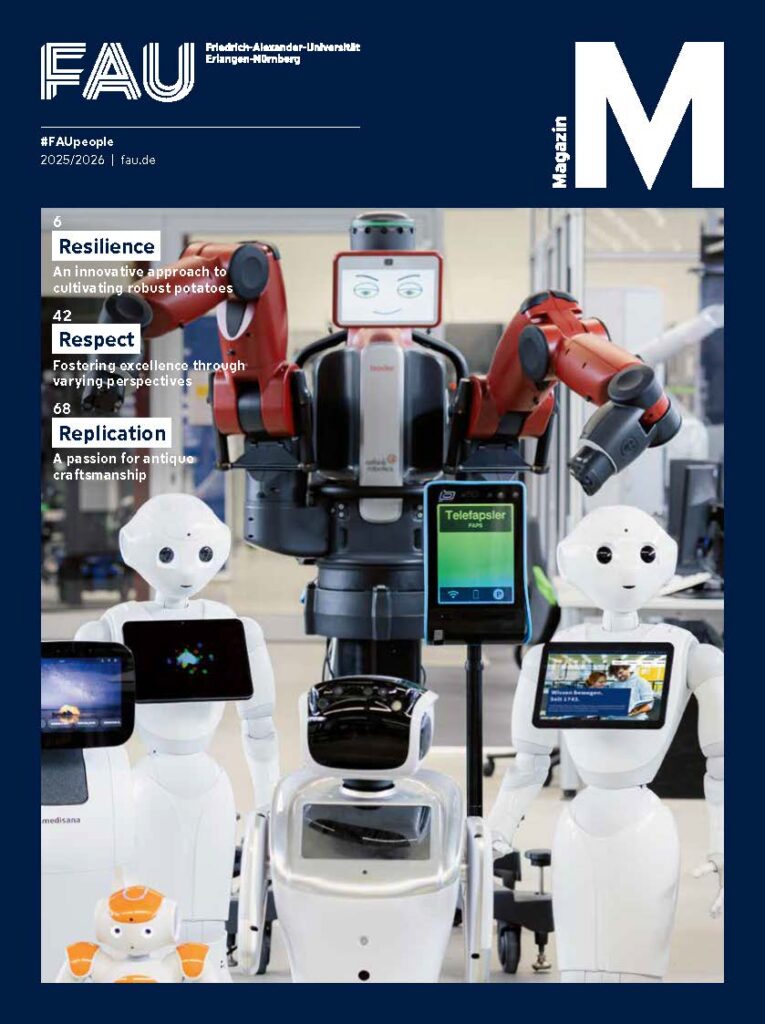
This article is part of the FAU Magazine
The third issue of the FAU Magazine #People is once again all about the people who make our FAU one of the best universities in the world. The examples in this issue show how lively and diverse our research is, the commitment of our students, and the work in the scientific support areas.
Highlight is certainly the new research cluster “Transforming Human Rights.” Or you can follow our scientists into laboratories and workshops, where they make potatoes climate-resistant, teach robots social behavior, or reconstruct ancient ships and cannons. At FAU, students are developing vertical take-off aircraft or impressing with outstanding performances at the Paralympics. And let’s not forget the people who work at our university or remain closely connected as FAU alumni. Visit the Children’s University with them or watch a TV series with an FAU alumna and Grimme Award winner.
- File Name
- FAU_Magazine_2025_2026
- File Size
- 3 MB
- File Type