
With over 270 degree programs, FAU is among the 15 largest and leading universities for research in Germany. Over 6,000 employees and more than 39,000 students promote a culture of innovation, diversity and passion.
Get to know our newly-appointed professors who are driving forward research with their fresh ideas and creative approaches. Find out more about the people behind our research projects and their career paths, visions, and motivation for a successful academic future.
Prof. Dr. Matthias Schwendemann, Professorship for German as a Foreign Language in the Context of Multilingualism
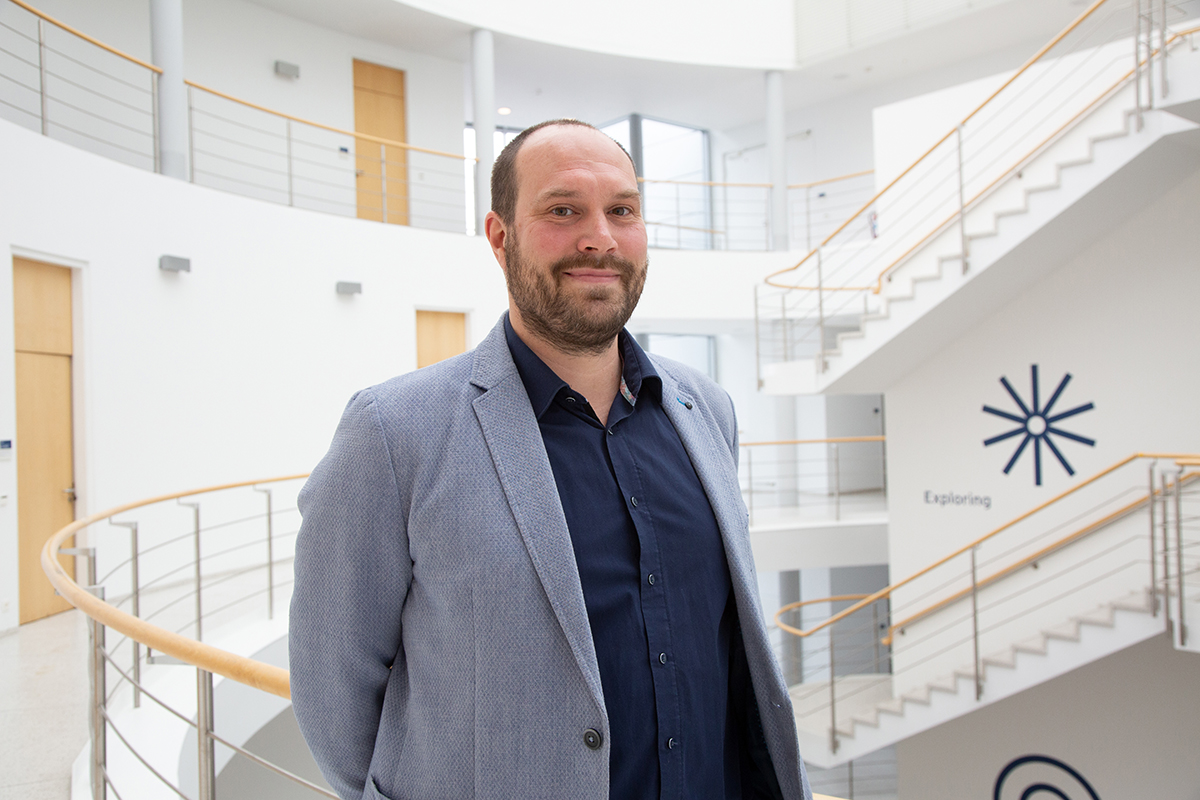
He is an expert for German as a foreign language and has an unbeatable recipe for cheesecake – Prof. Dr. Matthias Schwendemann introduces himself.
What is your main area of research?
In my research, I examine from a linguistic perspective how people learn German as a foreign or second language: How do they acquire certain linguistic structures or how do they develop? For example, I look at how learner language variation and the simultaneous development of systematicity are related. I am interested in learners of all ages in very different contexts – both people who want to learn German outside German-speaking countries and those who are learning the language in Germany. Up to now, I have used a methodical approach for these questions, primarily using learner corpus linguistics, that is, with the help of large and systematically-compiled collections of learner language.
Why did you choose these topics?
I believe that the way we understand language acquisition, linguistic developments and the language of learners also has an influence on how we perceive the learners themselves. All these concepts are highly complex and dynamic and not always predictable. In addition, the decisions made in the area of language diagnostics based on findings in language acquisition research can have far-reaching consequences for learners, who have to take a language test for entering university for example, or in certain interim situations. And this results, among other things, in the great social responsibility that the subjects of German as a foreign language and, of course, German as a second language, have today.
Where were you before coming to FAU?
I started working as a research associate at the Herder-Institut für Deutsch als Fremd-und Zweitsprache at the Leipzig University in 2019. I worked in linguistics for German as a foreign language and applied linguistics and also completed my doctoral degree there in 2023.
Where did you study and what subjects?
I completed my Bachelor’s degree in German linguistics and literary studies and Islamic studies in Freiburg, and then completed a bi-national Master’s degree in Leipzig and Cairo in German as a foreign language in an Arabic-German context.
Which events and activities would you like to take part in in Erlangen and the surroundings?
I am very excited to discover more about Erlangen and the region. I am also not very familiar with Nuremberg either and I am very much looking forward to finding out more. All the people I spoke to about our move here said how lovely the entire region here is. I am looking forward to the Schlossgartenfest in particular, but also to the Poet*innenfest in Erlangen. I’ve had some great tips for my children as well, such as the Children’s University in Nuremberg, which we will certainly try out very soon.
What is your most useful tool as a professor?
I don’t quite know the answer to that yet because I’ve just started my position here. The first thing I can think of is probably my laptop. A good friend of mine said I really need a corduroy jacket…I’ll keep that one in mind.
What did you want to be when you were growing up?
I think I wanted to work on a spaceship for a very long time and then I considered becoming a professional basketball player. Neither of those worked out very well.
Do you have a role model? If yes, did they influence your academic or professional career?
In my academic career so far, I have been very fortunate to have great supervisors and co-workers from whom I have been able to learn a great deal in many different areas. This means a great deal to me and helps me a great deal to find my way around in the complex world of academia. I would, in fact, describe many of them as role models, even if they probably don’t want to be called that.
Have you got any hidden talents?
I have a very secret cheesecake recipe and can make excellent cheesecake and hope that I can put this talent to use very soon.