
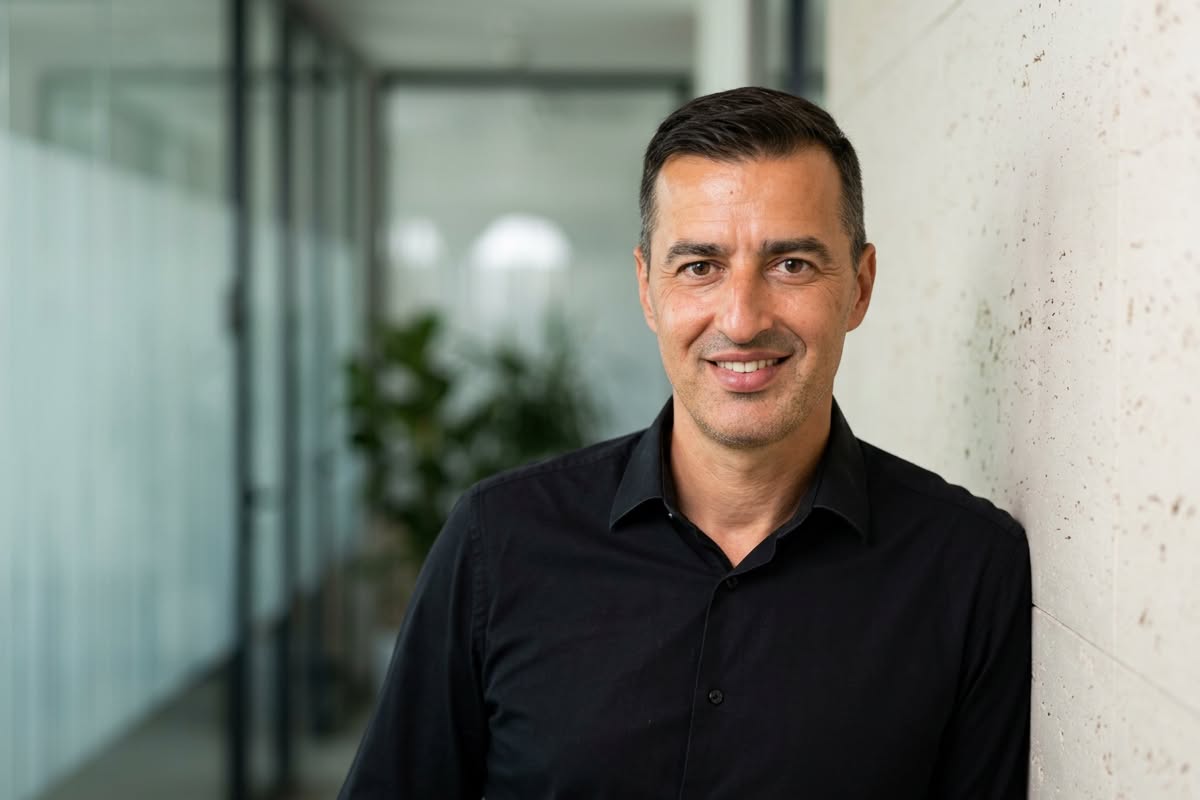
His students secretly nominated him for the German Teachers’ Award – with success: FAU alumnus Serhat Gökce is receiving the German Teachers’ Award 2025 and is thus one of the top ten teachers in Germany. He impressed them not only with his professional expertise, but also with his appreciative approach to his students. They describe him as motivating, understanding, and dedicated – as a trusted person with an open ear, who supports them far beyond the classroom.
The vocational school teacher studied business education at FAU, works at Vocational School 9 in Nuremberg, and, as a mentor at the university school of the FAU, is still closely connected to his alma mater. He shares in an interview with FAU Alumni Management how he learned about the surprising nomination, what good teaching means to him, and what role his time at FAU plays in this regard.
Your students secretly nominated you for the German Teachers’ Award. When did you find out about it, and how did you react?
At the end of November 2025, I learned about it from my school administration. At first, I thought it couldn’t be true and I had to sign a confidentiality agreement until the award ceremony. When I read my graduating class’s detailed reasons, it was a moment that touched me deeply.
How does it feel to be one of the top 10 teachers in Germany today?
It feels like a great honor and validation, but I stand as a representative for countless other dedicated colleagues. The best part is the response from my students: They are proud, and that motivates me enormously to keep going.
What qualities do you believe make a good teacher?
A good teacher builds trust, listens actively, and meets each student where they are. They are consistent but appreciative, and create a fearless environment where learning is fun.
When you think back to your time at university, what do you have particularly fond memories of?
What I remember most fondly is the time with my fellow students – either hours of sharing ideas about theory and life in the WiSo cafeteria, or spontaneous bar nights where business education suddenly turned into life’s big questions. We didn’t just learn there – we lived. The most important insight we gained: The best ideas always come after 10 pm!
How did you come to choose to study business education? Did you always want to be a teacher?
Originally, I wanted to study tourism, but that didn’t work out. So I chose business education as a bridge between business and education. I didn’t want to become a teacher from the outset. It was only negative experiences at school – intimidating and not very appreciative teachers – that awakened my desire to do better.
What did you take from your business education studies for your everyday life as a teacher?
Clear structuring of content and connecting theory with practice – for example, how to make business concepts tangible. Reflecting on learning processes in particular helps me to tailor my teaching to individual students.
What do you find especially appealing about teaching at a vocational school?
The diversity of students’ backgrounds and the proximity to the world of work – here I can prepare young people directly for starting their careers. Everyone brings unique strengths. That makes the lessons lively and relevant.
Can you describe a situation in your teaching where you realized: This is exactly why I became a teacher?
Off the top of my head, I’m thinking of the following from my annual Christmas charity drive with the student council: We give responsibility to Gen Z students, who are sometimes assumed to have less social competence. They organize donations, motivate each other, and embody values such as solidarity. It shows me this is exactly why I’m a teacher – to spark potential nobody expects.
As a liaison teacher, you interact with students on a personal level and mediate between the school, faculty, and parents. Are there moments you find particularly challenging, and how do you deal with them?
Crises such as family problems or conflicts with parents are challenging. That’s when you have to build bridges. I seek honest one-on-one conversations, listen, and, if necessary, connect them with counseling services. That’s how trust is built.
You also work as a mentor at one of FAU’s university schools – what does your connection to your alma mater mean to you?
FAU still feels like a piece of home to me, because I gained so much there, not just professionally but also personally. That makes it even more meaningful for me to be able to give something back as a mentor. And I would especially like to thank Prof. Dr. Karl Wilbers for the excellent implementation of the university school in Bavaria, which brings together academia and school practice in such a valuable way.
If your students had to describe your lessons in three words – which would you hope for?
Trustworthy, appreciative, motivating.
Is there anything else you would like to add that is especially important to you?
Right now, we talk a lot about everything that’s lacking in the school system – from teachers to digital equipment. But I want to emphasize what a fantastic and meaningful profession teaching is: Every day, we have the chance to accompany young people for part of their journey and help empower them for the future. Thank you to FAU, my school administration, and everyone who has influenced me!
Thank you very much for the interview, Mr. Gökce.
(Interview: Nina Bundels, March 2026)