Theater and Media Studies (B.A.)
During this degree program, students engage with a variety of different arts and media that includes everything from theater, dance, and performance art and film, television, photography, acoustic and digital media, to performances in culture, politics, and everyday life. They are taught how to analyze the relationships and interactions between the various forms and techniques of the theater and media and reflect upon them.
Fact Sheet
- Degree
- Bachelor of Arts (B.A.)
- Admission
- No Admissions Restrictions
- Duration of studies
- 6 semesters
- Teaching language
- completely in German
- Faculty
- Faculty of Humanities, Social Sciences, and Theology
- Start of degree program
- Winter semester
- Number of students
- 250-600
- Special ways to study
- 2-subject Bachelor, Part-time degree program
What is the degree program about?
Are you interested in how films work? What effect the movements and voices of the characters on stage have on the audience? Would you like to learn how to design a stage set? Then studying Theater and Media Studies may be just the thing for you. Please note: The degree program in Erlangen has a largely academic focus. You will not receive practical training to become an actor, director or cameraman/camerawoman. Instead, you will receive fundamental knowledge of the history, theory and aesthetics of theater and the media. You will learn how to classify very different theater and media phenomena historically, to compare them with each other and to reflect on them critically. This enables you to see more and further than the practical specialists – a skill that is in demand everywhere.
Here in Erlangen, we take great care to link theory with practice: Technical exercises and practical projects are an integral part of the degree program, and lecturers from the practical world of theater and media give you insights into very different areas and ways of working. FAU has extensive technical infrastructure available for this purpose, including a professionally equipped stage space (“experimental theater”), audio and video studios, and editing suites.
In addition, there are numerous opportunities for students to implement the knowledge and experience gained during the degree program creatively: Many students and graduates work with student initiatives (see below in the section called “Good reasons for choosing to study at FAU”). Students who wish to become creatively active at the institute can do so with their own project and present it to the public there.
Foundation modules
- Introduction (5 ECTS)
- Basic module: Media studies (5 ECTS)
- Basic module: Theater studies (5 ECTS)
- Media studies module (5 ECTS)
- Theater studies module (5 ECTS)
- Practical module (5 ECTS)
Intermediate modules
- Theater history (5 ECTS)
- Media history (5 ECTS)
- Theater and media history (5 ECTS)
- Practical module (5 ECTS)
Specialization modules
- Research perspectives (5 ECTS)
- Research (7.5 ECTS)
- Practical module (7.5 ECTS)
Bachelor thesis (first subject)
- Bachelor’s thesis (10 ECTS)
- A love of reading academic texts
- An openness for media of all forms and generations (for example, this means an interest not only in current cinema productions, but also in black-and-white or silent films)
- A willingness to engage in unfamiliar lines of thought and be open to what may appear at first rather odd lines of reasoning
- The ability to develop a comparatively high potential for frustration with regard to the many different and sometimes mutually contradictory definitions, ideas and descriptions of theater and media that students will encounter during their studies
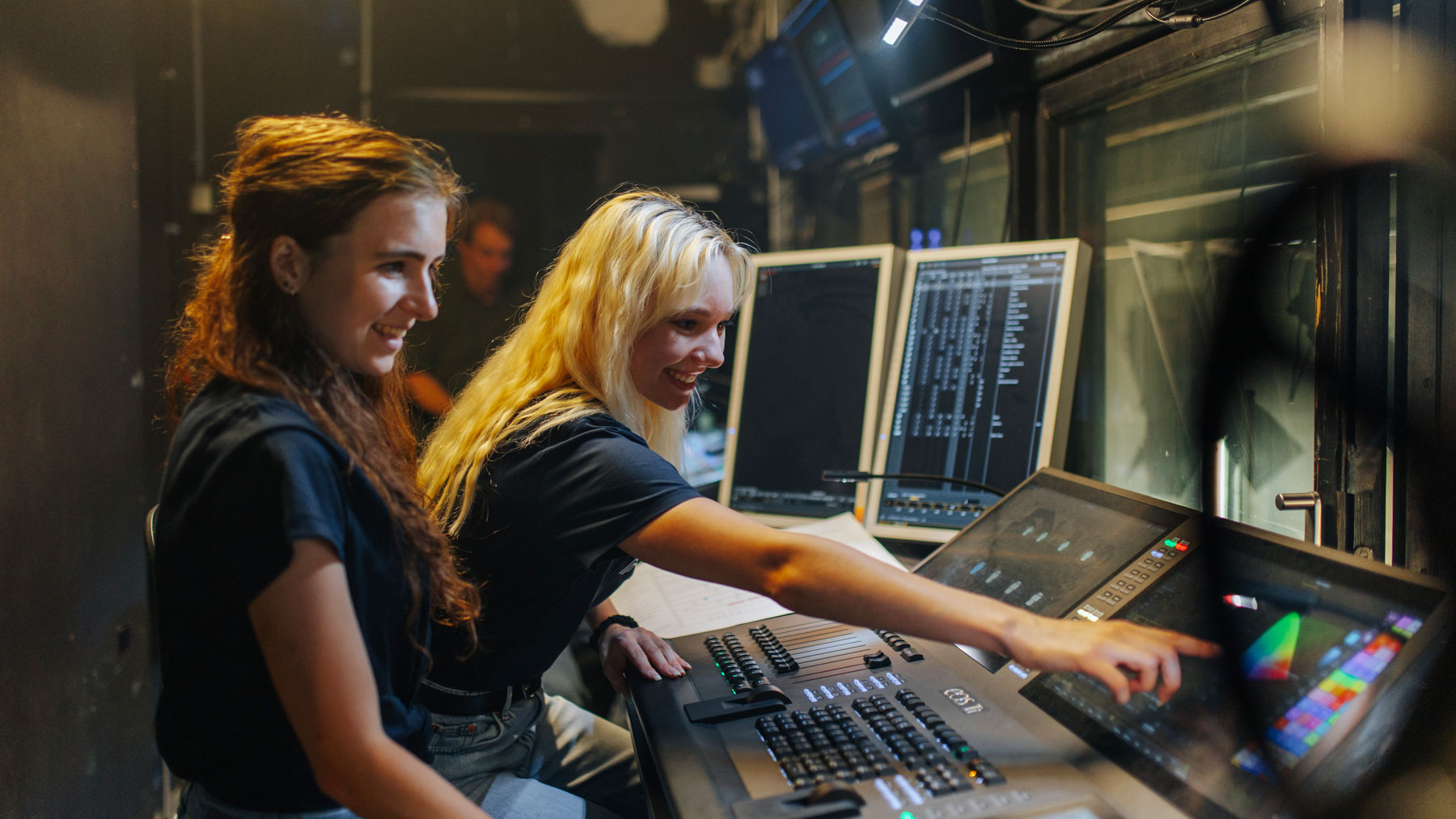
The Institute for Theater and Media Studies has professionally equipped rooms, technical resources and personnel resources that can be used for experimental forms of teaching and learning as well as for independent practice by the students. For scenic project work, the Experimental Theater provides a flexible theater space with state-of-the-art lighting technology, an audio system with multi-channel and surround options, and various video projection options, as well as media studios with audio and video equipment and fully digital editing suites that can be used in any number of ways. The GamesLab is a facility for researching digital games.
In addition, there are a number of student initiatives at FAU in which students can gain experience in cultural work and festival organization while studying, such as the ARENA…der jungen Künste theater and performance festival, the FAU campus media funklust, and the short film platform [ki’ta:so].
The Erlangen-Nuremberg metropolitan region is characterized by a great variety of cultural institutions that attract visitors from the region and beyond: Theater and opera, museums and exhibition venues for contemporary art, a diverse music scene, and a long tradition of international festivals. We cooperate with the most important institutions and stakeholders in cultural life as well as visiting artists, including the Nuremberg State Theater, the Tafelhalle Nuremberg, the Erlangen Theater, the Erlangen Cultural Office (Figure Theater Festival, Comic Salon, Poetry Festival), the Neues Museum in Nuremberg and the Kunstpalais art gallery in Erlangen.
A degree in Theater and Media Studies prepares graduates for careers that are creative and/or critically reflective in theater, film, television, radio, digital media, press, and other cultural institutions. Graduates are suitable for positions in
- Editing, journalism
- Art and cultural management
- Artistic direction (directing, dramaturgy)
- Media production (video/audio)
- Adult education
- Press, public relations
- Proof-reading
- Marketing and advertising
- Art education
- Graduates can continue studying at FAU (e.g. with the Master’s degree programs in Media Studies or Theater – Research – Transfer).
Possible combinations without overlaps
- Art History
- Book Studies
- Business and Economics
- Chinese Studies
- Cultural History of Christianity
- Education
- English and American Studies
- French Studies
- German studies
- Greek Philology
- Hispanic Studies
- History
- Indo-European and Indo-Iranian Studies
- Japanese Studies
- Latin Philology
- Medieval Latin and Neo-Latin
- Oriental Studies
- Philosophy
- Political Science
- Scandinavian Studies (BA)
- Sociology
With these subject combinations, there are generally no overlaps in the timetable.
Possible overlaps in the timetable
- Archaeological Sciences
- Computational Linguistics
- Digital Humanities and Social Sciences
- Geography: Cultural Geography as a two subject Bachelor's degree program
- Islamic Religious Studies
- Italian Studies
If you combine these subjects, individual courses may overlap in your timetable. For this reason, you can only combine the following subjects with your chosen subject after a consultation. Students are responsible for ensuring that the combination can be studied and that the deadlines set out in Section 11 of the ABMStPOPhil are met. When enrolling, proof of a corresponding consultation with the Central Student Advisory Service or the Student Service Center (Faculty of Humanities, Social Studies, and Theology) must be submitted.
Admission Requirements and Application
The following information is intended for German applicants as well as domestic applicants with foreign educational qualifications. Different regulations and deadlines may apply to international prospective students.
Admission
- 1st semester: No Admissions Restrictions
Application deadline
- Winter semester: 30.09.
- Summer semester: not possible
Language skills
- Students pursuing a Bachelor of Arts degree must demonstrate proficiency in two foreign languages, including English, by the end of the 4th semester. Further information can be found here.
- German language skills for international applicants: DSH 2 (written 2 / oral 1) or equivalent
Details and notes
The application deadline for the winter semester for international applicants is July 15th.
In addition to the general qualification for university entrance (Abitur), there are other access options for studying at FAU.