

Studying from A to Z provides an overview of all the most important terms, abbreviations and structures you are likely to come across at university. From administrative processes to specialist terms, it provides a clear and easy to understand definition of key aspects, helping you find your way around the university and find support if you need it.
Studying from A to Z
2FA (Two-factor authentication)
2FA is a security procedure that requires two independent factors to verify a user’s identity, for example a password and a one-time passcode that is sent to a cellphone. It significantly increases the security of user accounts and offers additional protection against unauthorized access.
Accident insurance
Students are covered by accident insurance during their studies (classes, field trips, work in the university library) and on their way between home and university. Accidents must be reported immediately to the Student Records Office.
Information on insurance cover is available on the websites of the Deutsche Gesetzliche Unfallversicherung (German Social Accident Insurance) and the Kommunale Unfallversicherung Bayern (Bavarian municipal accident insurance provider).
Admissions Office
The Admissions Office organizes the admissions process for international and German applicants. It also processes applications for swapping university places.
Contact: zulassungsstelle@fau.de.
Alma mater
Latin for “nurturing mother.” A university is referred to as an alma mater because, figuratively speaking, students are fed there with education and knowledge. The name goes back to the motto of the University of Bologna (“Alma mater studiorum”), which was founded in 1088 and is considered the oldest university in Europe.
Alumni
Alumni are the former students, doctoral candidates, and employees of the university. Incidentally, alumni is plural; a male former student is called an alumnus, and a female former student is called an alumna. FAU offers a free alumni network where all students and alumni can make connections and stay in touch.
The FAU Erlangen-Nürnberg alumni network offers a platform for staying in touch with the university.
More details about the activities and events can be found here.
Apostille
Official German certificates are generally recognized abroad only if their authenticity has been confirmed by the representation of the respective country in the Federal Republic of Germany (legalization).
Under the Hague Convention Abolishing the Requirement of Legalization for Foreign Public Documents, a simplified form of authentication, known as an apostille, replaces legalization in the countries that have signed the Convention. This is issued by the government of Middle Franconia.
Before you can be issued an apostille, you require what is known as prior certification (Vorbeglaubigung) from the University.
AStA
Abbreviation for General Student Committee. At FAU, we have students’ representatives instead of an AStA.
Audimax
Abbreviation for Auditorium maximum, the largest lecture hall at the university. The FAU’s main lecture hall is located at Bismarckstraße 1 in Erlangen and accommodates 893 people.
Bachelor’s degree
A degree originating from the English and American higher education systems that was also introduced in Germany during the restructuring of the higher education system.
The Bachelor’s degree is the first undergraduate degree and can be obtained after just six to seven semesters. It is offered at FAU as a Bachelor of Arts (BA) degree in humanities, cultural studies, social sciences, and business and economics, and as a Bachelor of Science (BSc) degree in sciences and engineering. In the field of Business Law, students earn a Bachelor of Laws (LLB) degree. Students enrolled on a teaching degree at FAU can apply for a corresponding Bachelor’s degree (BA, BSc, BEd) for the credits they have earned during their teaching degree, depending on their subject combination.
In layman’s terms, the Bachelor’s degree could be interpreted as being equivalent to an apprenticeship in academia. To stay with the image of trade qualifications: A Master’s degree would then be equivalent to the master craftsman’s examination.
Bachelor’s thesis
The final thesis in the Bachelor’s degree program. Once you have been admitted to the Bachelor’s thesis, you have two to three months to write it.
Backup
A backup is a backup copy of data that is created so that it can be restored in the event of loss, damage, or failure of the original. Backups can be stored on external hard drives, cloud services, or other storage media. Backups are essential when creating important or labor-intensive documents such as seminar papers and final theses.
BAföG
Abbreviation for Federal Training Assistance Act (Bundesausbildungsförderungsgesetz). This governs state financial support for students in Germany. The abbreviation BAföG is also used colloquially to refer to the financial assistance provided under the law.
Application forms are available from Student Services, but can also be downloaded from the Werkswelt website.
Applications must be submitted to the Training Assistance Office (Amt für Ausbildungsförderung) in either Erlangen or Nuremberg.
Addresses:
Training Assistance Office
Hofmannstraße 27
91052 Erlangen
Training Assistance Office
Andreij-Sacharow-Platz 1
90403 Nuremberg
Bridging courses (preparatory courses)
Bridging courses, also known as preparatory courses, are offered in exceptional cases (for example, when introducing a new language). Information is provided by the Student Advice Center (ZSB) or subject advisors for the respective subject or degree program.
c. t. (cum tempore)
This abbreviation appears after lecture periods and represents the famous academic quarter (15 minute delay between classes). So: 2 pm c. t. means that the lecture or seminar starts at 2.15 pm. c. t. is often omitted, since all lectures or seminars at the University usually begin c. t. The counterpart to this is sine tempore, see s. t.
campo
The campo administration portal is the virtual counterpart to the Student Records Office and the Examinations Office.
It includes student, examination, and course management. Here, students can manage their personal degree program data, register for examinations, and view their grades.
They can also print out their current study certificates and certificates of enrollment.
Online applications are processed via campo as well.
Instructions, videos and FAQs on the campo portal
Registering for/withdrawing from examinations
Academic progress (transcript of records) and schedules
The main menu can be opened using the three horizontal bars on the left-hand side. Then you can select the menu items “My studies” and then “Study planner with module plan”.
The examination regulations view is initially set as default.
You can switch to the module plan view by clicking on “Show module plan”. This is the updated version of the study plan.
Campus
The term campus comes from Latin and originally meant field; today it refers to several buildings of a university at one location. In Erlangen, however, the chairs tend to be dispersed around the city center. Therefore, FAU does not have a real campus. Rather, the entire city center is the “campus.”
The FAU Campus Erlangen (South), as well as Lange Gasse 20 and Regensburger Strasse 160 in Nuremberg, are more comparable to a campus.
As part of site development, the FAU Campus concept is being refined and consolidated. The major locations are referred to as FAU Campus Erlangen Center, FAU Campus Erlangen (South), and FAU Campus Nuremberg.
Career Service
The Career Service at FAU is open to students, doctoral candidates and graduates of all faculties. It offers a free, wide-ranging selection of advice, events, and information on topics such as job applications, choosing a career path, and starting a career.
As a central point of contact, the Career Service provides assistance to students and doctoral candidates with career orientation and helps make the transition from a degree or doctoral degree to a professional career easier for graduates.
The services it provides include:
- Individual advice on career-related topics for students from the first semester onward and for doctoral candidates
- Application portfolio review in German and English
- Seminars on job applications and soft skills
- Information day with presentations on starting a career
- Career meet-ups between students, doctoral candidates, and alumni from various subjects
- Company networking events (Faculty Career Day at the School of Law, phil.Forum)
- Online job portal with part-time jobs, internships, and entry-level positions for all subjects
- Up-to-date information on company events, recruiting events, and much more in the Career Service Blog
- Specialized library with literature on job applications, key qualifications, and choosing a career
The complete range of services can be found on the Career Service website.
The Career Service has been a central point of contact since July 2009 and is continuously being expanded. The Career Service is funded by tuition fees and is part of the Student Advice Center.
Certificate
Certificates are transcripts of records or confirmation of successful participation in a tutorial, a lab course, or a seminar.
The lecturer responsible determines whether successful participation should be demonstrated by means of a written examination, a presentation, a written assignment, a written report, or another form. In modularized degree programs, certificates are usually replaced by module examinations.
Certificate of enrollment
Can be downloaded and printed online from the “campo” portal after enrollment or re-registration. It is proof that you are enrolled at the university.
Chancellor
The most senior official in University Administration. Also responsible for the University’s budget.
Further information about the Executive Board can be found on the FAU website.
Change of name upon change of identity
FAU promotes a constructive approach to diversity and is working to improve conditions for an anti-discriminatory studying and working environment. In order to make it easier for trans*, trans-ident and transsexual students in an academic context and their day to day life at university, FAU allows students to change their name and title provisionally for internal university purposes even before a change of name or status is approved by a court.
All you need to do is submit a supplementary identification card (Ergänzungsausweis) from the German society for transsexuality and intersexuality (DGTI) together with an informal declaration of intent to the head of the department for Teaching & Studying. The Postmaster at the Regional Computer Centre Erlangen (RRZE) can then change your email address accordingly.
Please note: All members of the university can change the name in their FAU email address without giving any reasons by contacting the Helpdesk at the Erlangen Regional Computing Center .
Changing degree program
If you realize that your chosen subject is not right for you, you have the option of changing your degree program. The Student Advice Center (ZSB) provides advice on this and helps analyze problems and develop potential strategies to come to a solution.
Compensation for Disadvantages
When at university, compensation for disadvantages are measures taken to compensate for any difficulties caused by your disability during your studies and in examinations. All information on studying with a disability or chronic illness can be found under Studying with a disability or chronic illness.
Compulsory attendance
Unlike in school, there is no general attendance requirement at university.
Whether attendance is checked depends on the type of course. While you could skip a lecture if necessary, you should think carefully about whether to miss an introductory course, for example. If you are absent too often, you may no longer be able to obtain a certificate of achievement for the course in question.
If you are sick at home, it is often possible for you to watch yourclasses via the FAU video portal, which can be accessed at www.video.fau.de.
Computer rooms
FAU has set up computer rooms at numerous locations for its students and doctoral candidates, offering free Internet access. They are spread across all faculties, some of the libraries, and the RRZE in Erlangen and Nuremberg. Since they were financed through the Computer Investment Program (CIP), they are usually referred to as “CIP pools”.
They also have scanners and printers. User ID is required to use the computers. Instructions are available on the RRZE website.
Copying machines
Almost all libraries at FAU are equipped with copying machines. In addition, there are photocopiers in many buildings housing lecture halls. Students pay with their ID card, the FAUcard.
Course catalog
You can find the course catalog on campo.
Credit points
Credit points are usually referred to as ECTS credits.
In the past, the workload of a teaching unit was expressed in weekly hours or semester hours (SWS), irrespective of whether the teaching unit was a lecture or a seminar.
Today, the amount of work done at home is also added to the weekly hours spent at university. This means that the overall workload can be calculated which is much higher for a seminar than a lecture. The units for measuring student workload are called ECTS credits.
This allows course achievements to be compared and “transferred” to another university or even another country. A Bachelor’s degree program comprises a total of 180 ECTS credits. One ECTS credit corresponds to 25–30 hours of work.
DAAD
Abbreviation for Deutscher Akademischer Austauschdienst (German Academic Exchange Service). The DAAD works together with the international offices of universities and runs programs to ensure that German students and doctoral candidates can go abroad and that international students and doctoral candidates can come to Germany.
De-registration
Students and doctoral candidates can deregister from the university themselves in order to change university, withdraw from or discontinue their studies, and after completing their degree or doctoral degree.
The university can deregister students who fail to re-register, who fail an examination at the final attempt, or who have successfully completed their studies, in this case with effect from the end of the semester in which they sat their final examination.
You can apply to the Student Records Office to deregister at any time throughout the year. Unlike enrollment, de-registration is not subject to deadlines.
Dean
The head of a faculty, elected by the Faculty Council. The Dean represents the interests of the faculty and manages the affairs of the faculty administration, the Dean’s Office.
Degree program regulations
Provisions derived from the degree program and examination regulations for individual subjects that regulate the degree program structure in detail.
Deutschlandstipendium
Students at FAU can apply for a Deutschlandstipendium. Funding amounts to 300 euros per month. It is initially granted for two semesters and, provided that the funding conditions are still met, it can be extended annually until the end of the standard duration of the degree program. Half of the funding (150 euros) is provided by companies, foundations or private individuals with the second half being provided by the German Federal State.
Students can apply for the FAU Deutschlandstipendium from their second Bachelor’s semester onwards, provided they have good grades of 2.0 or better.
As well as achievements while studying, personal circumstances may also be taken into account. These include, for example, study-related stays abroad, volunteer work, and special personal circumstances.
Further information on the Deutschlandstipendium can be found on our website.
Dies academicus
An academic holiday commonly observed at many universities. At FAU, it is November 4. On this day in 1743, the University was founded. FAU celebrates its university “birthday” on this day.
Further information: Dies academicus.
Diploma supplement
A diploma supplement is an addition to a Bachelor’s or Master’s degree certificate that is issued with the certificate. It was introduced as part of the Bologna Process.
It is usually issued in German and English. The diploma supplement contains information about the completed degree program, such as admission requirements, course content, acquired skills, and possible careers.
The contents should focus on the skills and abilities of the graduates.
Disability or chronic illness
All information on studying with a disability or chronic illness can be found under Studying with a disability or chronic illness.
Doctoral degree
A doctoral degree refers to the awarding of a doctorate in a specific subject and, in Germany, is a prerequisite for a habilitation, which in turn is a prerequisite for a professorship in most academic disciplines. It demonstrates the ability to conduct in-depth academic work and is based on an independent piece of academic work, the doctoral thesis, and an oral examination.
Further information on the doctoral degree can be found on our website.
ECTS (European Credit Transfer and Accumulation System)
In the past, the workload of a teaching unit was expressed in weekly hours or semester hours (SWS), irrespective of whether the teaching unit was a lecture or a seminar.
Today, the amount of work done at home is also added to the weekly hours spent at university. This means that the overall workload can be calculated which is much higher for a seminar than a lecture. The units for measuring student workload are called ECTS credits.
This allows course achievements to be compared and “transferred” to another university or even another country. A Bachelor’s degree program comprises a total of 180 ECTS credits. One ECTS credit corresponds to 25–30 hours of work.
Further information can be found on our website.
Electric charging stations
Members of FAU (employees and students) can charge their electric vehicles free of charge at several charging stations on FAU Campus Erlangen (South). Access to charging facilities is secured with both mechanical and electronic systems and is subject to compliance with certain terms of use.
Enrollment
Enrollment or admission to the list of students and doctoral candidates. Information on enrollment can be found on the Enrollment page.
Erlangen Regional Computing Center
RRZE is the abbreviation for the Erlangen Regional Computing Center.
The RRZE is FAU’s IT service provider. Here you can find the coveted and free internet accounts for logging in and the official email addresses that students must use so that the university can contact them. RRZE often offers programming courses and other IT courses (software training) for students free of charge and they are rewarded with credit points as key qualifications for their studies.
Further information can be found on the RRZE website.
Examination deadlines
The examination regulations contain provisions specifying the deadline by which a GOP or final examination must be taken. If a student has not taken the relevant examination by this date for reasons for which they are responsible, the examination will be deemed failed for the first time. The resit examination must then be taken within a specified period of time.
If this does not happen, the examination counts as failed at the final attempt. After failing an examination at the final attempt, you will no longer be possible for you to enroll in the same degree program or the same subject at the same type of higher education institution in the Federal Republic of Germany.
These provisions are intended to encourage students to use their time at university wisely.
Examination regulations
At the beginning of your degree, you should obtain the relevant degree program and examination regulations and base your studies on them to avoid any surprises when registering for exams.
Examinations Office
If you have any questions about the how examinations are organized and conducted, please contact the Examinations Office for the relevant subject. The Examinations Office handles administrative tasks such as registration, admission, and conducting examinations, as well as the preparation and documentation of the meetings of the Examinations Committees.
You can find out which Examinations Office is responsible on the FAU website.
To participate in an examination, students must first register for it in good time (compliance with examination deadlines). All procedures related to examinations are handled by the relevant Examinations Offices at the university.
Campo can be used to manage personal data and print out study certificates. In addition, students register and de-register for examinations via this platform. It also contains an overview of grades already achieved that can be accessed at any time.
Excursion
Field trip or visit outside the university as part of a course trip, e.g., as part of a seminar that is closely related to the curriculum.
FAU is also on Facebook. Check out our Facebook page for updates, news about events and, of course, to get in touch with other students at FAU.
Faculty
Basic organizational unit of the university, in which several related subject areas are grouped together. FAU has five faculties: the Faculty of Humanities, Social Sciences, and Theology, the Faculty of Business, Economics, and Law, the Faculty of Medicine, the Faculty of Sciences, and the Faculty of Engineering.
Further information on the individual faculties can be found on our website.
Family Service
The Family Service from FAU and Uniklinikum Erlangen provides support for families (including parents and family carers) with regard to family commitments and academic life. It offers students, doctoral candidates, and employees of the university and hospital comprehensive advice on all aspects of studying and working at the university with children.
Further information can be found on the FAU Family Service website.
FAU
Short form for Friedrich-Alexander-Universität Erlangen-Nürnberg, named after Margrave Friedrich of Bayreuth and Margrave Alexander of Ansbach and Bayreuth.
More information on the history of the university can be found on the website “Historisches Lexikon Bayerns”.
FAU job portal
If you’re looking, you’ll find it here! Stellenwerk FAU is the job portal of Friedrich-Alexander-Universität Erlangen-Nürnberg. Whether you’re looking for a typical student job, an internship, or your first career position. The website offers suitable job opportunities for students, doctoral candidates, and graduates.
FAU Panel
Every January, students are asked to participate in an online student survey. It is definitely worth taking part, as results are taken seriously and translated directly into specific measures. The aim of the FAU panel is to improve study conditions at FAU over the long term.
FAU student survey
Every January, students are asked to participate in an online student survey. It is definitely worth taking part, as results are taken seriously and translated directly into specific measures. The aim of the survey is to improve study conditions at FAU over the long term. Further information and links to the results of previous surveys can be found on the page analyzing study conditions and on the Quality Management and Evaluation pages.
FAUbox
With FAUbox, the Erlangen Regional Computing Center (RRZE) offers all staff and students 50 GB of free storage on the RRZE servers. Users can synchronize their data easily via app, desktop or web client. To log in, all FAU members need is their IdM username and password. One of the main advantages of the FAUbox compared to other online services is its high level of security.
FAUcard
The FAUcard is a multifunctional chip card that also serves as an ID card for students and doctoral candidates.
It combines the functions of a student or doctoral candidate ID card, a University Library card, a wallet, and an electronic access control card. This chip card will be sent to your German address approximately 6 weeks after you enroll at FAU.
The FAUcard must be validated before you use it for the first time and at the beginning of each new semester. Vending machines are available for this purpose at various locations throughout the university. If you want to use the card’s payment function, for example to pay for meals in the cafeteria, you must first top up credit onto the chip. Several vending machines are available for this purpose across the university.
Further information about the FAUcard can be found on our website.
FAUdir (formerly UnivIS)
FAUdir is the university’s central directory.
Further information can be found directly on FAUdir.
FAUmail
All students at FAU receive a personal email address, which is activated by enabling their student user ID in IdM.
This mailbox can be accessed via the following webmail interfaces:
Helpful guides
- Redirecting emails: If you do not plan to actively use your email address, you can set up a forwarding option as an alternative.
- Optimizing the display for smartphones: You can optimize the FAUMail web interface view for smartphones.
Fellow student
Term used to refer to all students at a university, no matter which semester they are in.
Footnote
Located at the very bottom of a text page and provides additional information or a reference, for instance.
Students are taught how to use footnotes in academic writing in introductory courses or tutorials (see tutorial). If all footnotes are collected at the end of the text, they are called endnotes.
Further training: Studying while working
FAU implements the core idea of lifelong learning by organizing part-time programs in such a way that they are compatible with full-time employment.
GOP (Grundlagen- und Orientierungsprüfung)
The GOP is not a single examination, but rather consists of several examinations that students take during the first two semesters (at the latest in the third). The GOP is intended to provide students with reliable feedback on their suitability for their chosen degree program at an early stage.
Examinations for the GOP may only be repeated once if they are failed at the first attempt. Failing the GOP on the second attempt means that the student has failed at the final attempt and is unfortunately no longer allowed to continue studying the subject in question, not even at other universities.
HiWi
“HiWi” is the colloquial term for a student assistant.
HiWis are students who are employed for a few hours a week in a certain organizational unit or in administration. The activities can vary greatly, for example, media presentations during lectures, preparation of tutorials and internships, laboratory work, or supervision in the library.
These jobs are often preferable to those on the open market, as you don’t lose sight of your studies and, on top of that, you gain a deeper insight into the inner workings of the university.
Hörerschein
Textbooks written by a member of the teaching staff at an institute can be purchased by students at a reduced price in bookstores. To do this, you need what is known as a “Hörerschein” signed by the author. These are usually available from the secretary’s office of the respective institute.
IBZ/Student Advice and Career Service (now Student Advice Center, or ZSB for short)
The Student Advice and Career Service (IBZ for short) is the former name of the Student Advice Center (ZSB) and is the first point of contact for all questions related to studying. Here you can find out everything you need to know about the degree programs offered at FAU, possible subject combinations, planning your studies, admission regulations and application procedures, studying abroad, and much more.
The team can also provide advice if you have any problems during your studies or if you want to change your subject or transfer to another university. The Student Advice Center can provide you with information on structuring your studies and on individual degree programs.
Further information can be found on the FAU website.
IdM
IdM stands for “Identity Management” and is the central user management system at FAU. It is the first point of contact for managing students’ “digital identity.” Your IdM user account is used to access various web services at FAU, such as StudOn or campo.
It also provides you with an overview of your user data and data concerning your degree program.
New students must activate their user ID – which can be found on the information letter handed out by the Student Records Office together with the student ID card upon enrollment – once via the specified URL.
Further information can be found on the IdM portal.
FAU’s Instagram page shows FAU at its best. Insights into the University and various aspects of student life are posted on our Instagram feed several times a week. The University is also happy to repost pictures from other Instagram users. FAU can be found under the name uni_fau, and all images carry the hashtags #unifau and #fau_germany.
International Affairs (RIA/S-INTERNATIONAL)
FAU is part of a large international network and maintains close contacts with around 500 partner universities in 62 countries. Researchers from Erlangen and Nuremberg work closely with leading universities around the world in more than 130 research collaborations.
International Affairs (RIA / S-INTERNATIONAL) is FAU’s central point of contact for students and doctoral candidates from abroad, as well as German students and doctoral candidates who would like to go abroad.
Detailed information about International Affairs can be found on the International Affairs website.
International Office
At FAU, this is called: International Affairs (RIA – S-INTERNATIONAL)
International Affairs is the central point of contact at FAU for students and doctoral candidates from abroad and German students and doctoral candidates who would like to go abroad.
Detailed information about International Affairs can be found on the website “Service International”.
International students
Foreign graduates who are not citizens of an EU member state or Norway, Iceland, Liechtenstein, or Switzerland can remain in Germany for up to 18 months after completing their studies to look for a job, according to current legislation. During this period, you must apply for an extension of your residence permit from the immigration office. During the 18 months, unrestricted employment is permitted.
If you find a job matching your qualifications within this period, you may be entitled to a residence permit for the purpose of gainful employment without being subject to further priority checks. After two years, you may be entitled to permanent residence.
For further questions regarding residence rights, please contact the relevant immigration office.
The contact details for Erlangen are available at www.erlangen.de.
Internship
Internships, for example in commercial or industrial companies, are intended to provide students with practical work experience. In a number of university degree programs, such non-university internships are part of university education, but must be completed during the semester breaks. Further details are specified by the relevant examination regulations.
Current internship opportunities and other job offers can be found in the FAU job portal.
Introductory event
At the beginning of the semester, there are (mostly one-off) introductory events for new students in most degree programs that provide the most important information about the degree program itself, information on creating and managing a study plan as well as other tips and tricks. Not to be confused with the introductory courses offered by the degree programs as a part of the module plans. Link to all introductory events.
IT security
IT security refers to the protection of computer systems and networks from theft, damage, and unauthorized access. It includes measures such as antivirus software, firewalls, encryption, and regular security updates to ensure data integrity, confidentiality, and availability.
Further information and practical tips on IT security at FAU can be found here: https://www.intern.fau.de/informationstechnik-it/infosec/awareness/
Job portals
Many employers post their current job vacancies on online job portals. FAU also has a platform for internal and external job offers: Stellenwerk – the University of Erlangen-Nürnberg’s job portal offers new listings every day for entry-level positions, part-time jobs, internships and final theses for students and graduates.
Key qualifications / soft skills
Key qualifications cover interdisciplinary skills which prepare students to deal with their studies and when setting out into the world of work. Students can choose between special key qualification courses, language courses or courses from other disciplines. Students can also obtain credits for certain external achievements such as placements, internships or time abroad.
The specific rules governing what counts as a key qualification are set out in the respective degree program and examination regulations.
Language courses
At the FAU Language Centre, you can improve your language skills in modern languages or learn new languages. In addition, there is usually the opportunity to take foreign language exams and obtain certificates.
Further information can be found on the FAU Language Centre website.
Language learning advice
Language learning consultations support foreign language learners in achieving the learning goals they have set themselves by encouraging them to reflect on their own learning, strengths, experiences, and resources, develop these further, and use them as a basis for designing strategies and incentives for their own individual learning journey. They are available free of charge to all members of FAU.
Further information can be found on the pages of the Self-Access Language Learning Centre at the Language Centre.
Latinum
Alma mater, alumni, cum tempore, Dies academicus, numerus clausus, etc. Many Latin words are used at the university. You can find out which subjects require a Latinum certificate and which require only a basic knowledge of Latin from the Student Advice Center (ZSB).
Leave of absence from regular studies
If you have a valid reason, you can be exempted from regular study for up to two semesters (leave of absence). Reasons for exemption include studying abroad, illness, pregnancy, or raising children. The application must normally be submitted before the start of the lecture period.
Further information on leave of absence can be found on our website.
Lecture
A course lasting an entire semester with the aim of introducing a specific academic field and providing students with an overview of theoretical approaches, research findings, and research methods. There is no limit to the number of participants.
Lecture hall
A lecture hall is a large room in a college or university where lectures and seminars are taught. It is usually designed so that many students can participate at the same time, often with tiered seating so that everyone has a good view of the lecturer and the blackboard or screen.
Leisure activities
Erlangen and Nuremberg have a lot to offer, not only as university towns but also in the way of leisure activities. An overview of the diverse cultural and leisure activities on offer is available on our website.
Library
When we talk about the library, we usually mean the University Library.
Scientific research also involves reviewing existing literature. The relevant media (books, journals, etc.) can be found in the University Library, or UB or Uni-Bib for short, and all of its branch libraries.
Further information can be found on the website of the university library.
Looking for accommodation
One challenge at the beginning of your studies is finding somewhere to stay.
The following options are available: Student Services accommodation service; municipal housing agencies at the town hall (only social housing); housing cooperatives and non-profit housing associations; advertisements in the local daily newspaper and online portals. Places in student accommodation are allocated by Student Services. For student accommodation that is not run by Student Services, you must apply to the organization responsible for managing the property.
A large number of rooms that become available are advertised at the end of each semester via notices posted in university buildings and, increasingly, via virtual noticeboards.
Further information on finding accommodation can be found on the website of the Erlangen-Nuremberg Student Services Association.
Master’s degree
A degree that follows a Bachelor’s degree and is comparable to a “Diplom” or “Magister”.
Anyone wishing to enroll in a Master’s degree program must first complete the preceding Bachelor’s degree program and meet the requirements stipulated in the relevant degree program and examination regulations.
At FAU, Master’s degrees are offered as a Master of Arts (MA) degree in humanities, cultural studies, and social sciences, and as a Master of Science (MSc) degree in sciences, business and economics, and engineering. The Master of Education (MEd) is awarded in Technical Vocational Education and Training, and the Master of Laws (LLM) is awarded in Law. In addition or as an alternative to the First State Examination, students of teaching degrees for secondary education at Gymnasium can gain a Master of Education (MEd).
Further information on the Master’s degree programs is available on the FAU website.
Maternity protection provisions applicable to pregnant and breast-feeding students
Since the beginning of 2018, maternity protection provisions apply to students if the University lays down binding rules for the time, place and form of a teaching unit or if the students are carrying out an internship or practical course as a compulsory part of their degree program.
The specific implications for pregnant or breastfeeding students can be found on the information pages of the FAU Family Service.
Maximum duration of study
Most examination regulations specify the latest date by which students must register for examinations (e.g., GOP or final examinations). If the maximum duration of study is exceeded without permission from the university, the examination will be counted as failed.
Mensa
The University’s restaurant and cafeteria. The restaurants in Erlangen and Nuremberg are operated by Student Services. The current menu is available online:
www.student-services.fau.de/verpflegung/en/speiseplaene.shtml
The current menu can be accessed here using your smartphone:
Mini-job
Employment in which remuneration does not exceed 450 euros per month (before 2013, the limit was 400 euros) is considered minor employment, also known as a mini-job. Jobs paying up to 450 euros are exempt from social security contributions, i.e., the employer pays a flat rate of 13% for health insurance and 15% for pension insurance, provided that the student is covered by statutory health insurance. If the student has private health insurance, the employer only pays the flat rate for pension insurance.
Income from marginal employment is also taxable. Taxation is either based on a flat rate or the student’s income tax card.
If several minor jobs are performed simultaneously, the employer checks whether the earnings exceed 450 euros. If this limit of 450 euros is not exceeded, the student remains exempt from social security contributions.
The official registration and administrative office for mini-jobs is the Minijob-Zentrale.
Current mini-job vacancies can be found at Stellenwerk – FAU’s job portal.
Minimum duration of study
In a few degree programs, the examination regulations stipulate that students are only admitted to examinations after completing a certain minimum number of subject semesters.
If students meet the subject-related requirements (i.e., they have completed the certificates or ECTS credits required to register for the examination) or have successfully completed the relevant modules and passed the examinations, this deadline may be shortened.
N. N. (nomen nominandum)
Literally translated: The name still needs to be mentioned. This abbreviation can be found, for example, in the course catalog when the lecturer has not yet been determined.
Notice board
Important announcements for students are posted on the bulletin board of an organizational unit or institute.
Here you will find, for example, notices about rescheduled or canceled classes, professors’ and lecturers’ office hours, and examination and registration dates. Students should read the notices regularly.
Nowadays, this information is often communicated electronically, for example, via mailing lists, the Facebook page for the respective subject, or portals such as StudOn and campo.
Numerus clausus (NC)
Admission restrictions for degree programs that are in particularly high demand and have limited capacity.
Places in degree programs with admission restrictions are allocated either by the university or nationwide by the Stiftung für Hochschulzulassung (Foundation for University Admissions, formerly ZVS). The application process also varies depending on the NC.
You can check whether a degree program has admission restrictions or not on the “All degree programs” page.
Office of Equality and Diversity
Instead of focusing only on gender and equality issues, the Office of Equality and Diversity takes a broader approach in its diversity strategy and covers various other aspects of diversity including disability, sexual orientation and gender identity as well as social background and education. The office has various projects and activities related to this.
Further information can be found on the Office of Equality and Diversity website.
One-subject Bachelor's degree program
In contrast to a two-subject Bachelor’s degree program, here you “only” study a single subject, in which you set your focus areas. At FAU, all Bachelor of Science degree programs are one-subject Bachelor’s degree programs, i.e., all subjects at the Faculty of Sciences and the Faculty of Engineering. However, there are also a few one-subject Bachelor’s degree programs in the humanities and in business and economics.
Online catalog (OPACplus)
The online catalog of the University Library includes the printed media of all libraries at FAU and also allows access to all licensed e-media and databases. In addition, searches can be conducted in free data sources and in the Bavarian library catalog B3Kat. The catalog shows the availability of media, provides links to full texts, and allows users to order and reserve media. Access to the library account, where borrowed media can be renewed, is integrated into the catalog.
The online catalog also provides access to the FAUdok document delivery service and to interlibrary loan for literature that is not available at FAU.
Information on additional services can be found on the University Library website.
OPUS FAU
The OPUS FAU online publication system is the central electronic archiving and publishing platform for all members of FAU. Qualified scientific works from research and teaching can be published here free of charge. The full texts are therefore permanently available worldwide and can be easily found and cited via catalogs and search engines.
Parking
Students and doctoral candidates at FAU have the option to use the parking garage at the School of Business, Economics and Society in Nuremberg with paid parking permits. Detailed information can be found at www.wiso.fau.de/parken.
Parking permits must be applied for and paid for each semester before lectures begin.
Information about parking at FAU Campus Erlangen (South)
The parking garage on Erwin-Rommel-Str. is no longer available due to construction defects.
Patch
A patch is a software update that fixes bugs, closes security gaps, or adds new features. It is regularly released to improve the stability and security of an application or operating system.
Regular updates are a key component of IT security and protect your devices from hacking attacks.
President
Head of the university, elected for up to six years, usually from among the professors. Theoretically, the President could also come from outside the university and would not even have to be a professor.
At other universities, the President is also called the Rector. Formal German archaic form of address: Magnifizenz. The President of FAU is Prof. Dr. Joachim Hornegger.
Further information on the Executive Board is available on our website.
Prior certification (Vorbeglaubigung)
Before you can be issued an apostille, you require what is known as prior certification (Vorbeglaubigung) from the University. At FAU, this is carried out by L 1.
Psychological advice
Student Services offers a psychological counseling service. They provide professional counselling on problems affecting students’ mental wellbeing such as difficulties with studying, completing a doctoral degree or examinations, problems with partners or parents, anxiety, psychosomatic disorders and other psychological problems. The drop-in consultation session is anonymous.
Numbers to call in case of emergency:
- In an acute crisis/emergency: Emergency services 112
- Mental health hotline: 0800 111 0 111 or 0800 111 0 222
Public transport
With the 29 euro ticket for students, you can use public transport in the public transport network.
Further information is available on our website and on the Students’ Representatives website.
Re-registration
All students who have been enrolled at FAU for more than one semester must re-register for the following semester. Students are re-registered by paying the student services fee on time.
If the fee is not paid within the specified re-registration period, students may be de-registered.
The current re-registration deadlines can be found on our website. Detailed information on re-registration will be provided on campo in good time.
Reading list
A list of books that introduce the topics to be covered is often handed out during the first class in the semester.
Referat
One possible translation of the German term “Referat” is presentation and we all know what that is from our school days: a talk on a specific topic in front of the class, for which you get a grade.
However, the term has another meaning at university. Here “Referat” also refers to a specific area of responsibility or task within university administration.
At FAU, for example, we have the Referat für Internationale Angelegenheiten (International Affairs ) or the Referat für Qualitätsmanagement, Studienprogrammentwicklung und Rechtsangelegenheiten (Legal Affairs and Academic Quality Management).
Religious student communities
The Catholic student community (KHG) and the Protestant student community (ESG) are church institutions at the universities in Erlangen and Nuremberg. The student communities are open to students of all disciplines, nationalities, denominations, and religions.
KHG and ESG organize weekly meetings at their respective locations with church services and prayers, shared meals and other events.
Further information can be found on the websites of the KHG and ESG.
RRZE – Erlangen Regional Computing Center
The RRZE is FAU’s IT service provider. Here you can find the coveted and free internet accounts for logging in and the official email addresses that students and doctoral candidates must use so that the university can contact them.
RRZE often offers programming courses and other IT courses (software training) for students and doctoral candidates free of charge and they are rewarded with credit points as key qualifications for their studies.
Further information can be found on the RRZE website.
s. t. (sine tempore)
An event begins precisely at the specified time. So: 2 p.m. s.t. = event starts at 2 p.m. s. t. is always explicitly stated, unlike c.t..
Schedule
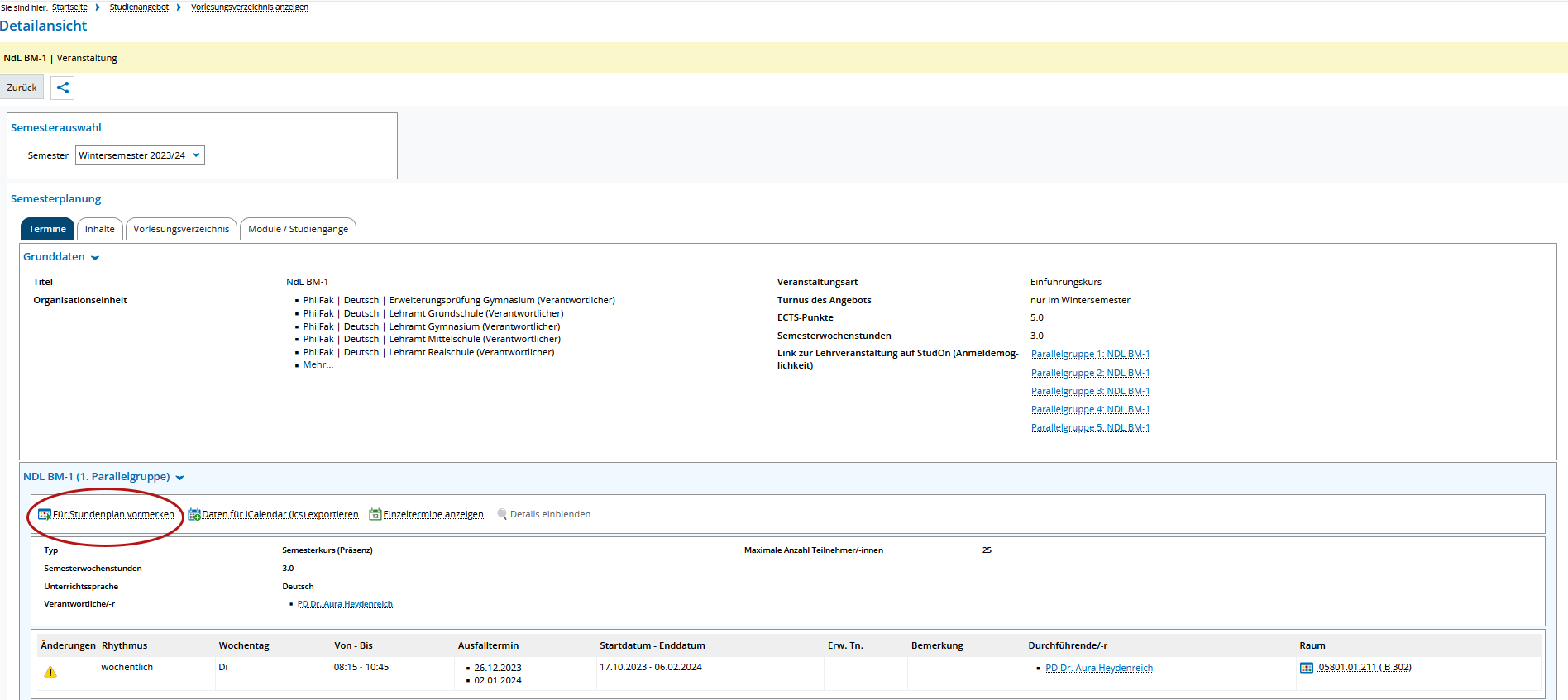
At university, students create their own timetable for the semester themselves using the course catalog, which lists the titles, times, and locations of the courses, as well as the study plan, the degree program regulations, and the examination regulations.
When planning your schedule for the very first time, you can get help at introductory events or from the Stuve (Students’ Representatives) and on the website “Planning your schedule”.
Scholarships
The Deutschlandstipendium is not the only option FAU offers for helping students fund their studies: Website for scholarship providers
Script
Written lecture notes, available from lecturers or Students’ Representatives. Many lecturers now make their course materials available online on StudOn. You can also watch some lectures on the video portal.
Semester
A semester refers to a half-year of study at the university. There are winter and summer semesters.
Semester hours (Semesterwochenstunden, SWS)
A semester hour (SWS) is the term used at universities to indicate the amount of time students spend on a course.
SWS reflect the specific scope of a teaching unit – preparation and follow-up work are not included. The designation “1 SWS” means that the corresponding course is taught weekly for 45 minutes over the duration of one semester.
Semester ticket
Due to the introduction of the “Deutschlandticket” or the discounted ticket for students and trainees in Bavaria (38 euros per month), the semester ticket has been withdrawn.
Information about the discounted ticket for students in Bavaria is available on our website.
Seminar
Events on a general topic with participants’ own contributions on individual topics.
Sexual harassment
FAU does not tolerate sexual harassment. The guidelines for dealing with sexual harassment serve to protect, educate, and raise awareness among all members of the university community. If you have any questions or require specific assistance, please contact the Office of Equality and Diversity.
Slip of paper
An important means of communication at the university, and not just among fellow students under the desk. Apartment and job offers are posted on the “bulletin board,” notice boards display important information, and forms are used to register for seminars.
Social media
The university in your pocket – FAU’s social media universe offers a wide range of insights into university life. Posts, tweets, and blogs are used to provide continuous updates on the latest news about FAU.
- Facebook: Information about upcoming events, student activities, and stories about the university provide an overview of campus life.
- Instagram: Posts about studying, research, and everyday student life are published several times a week. FAU can be found at uni_fau. Images are often shared with the hashtags #unifau and #fau_germany, and posts by other users are also frequently reposted.
- TikTok: In addition to dance and lip-sync content, TikTok offers numerous other formats – including posts from FAU.
- Bluesky: FAU is also active on Bluesky, as an alternative to Platform X (formerly Twitter).
- Mastodon: FAU is also active on Mastodon.
- YouTube: The FAU YouTube channel features videos in German and English, including information about degree programs, insights into research and teaching, and recordings of events. This provides a direct insight into activities at FAU.
Software training
IT skills make life easier. The RRZE Training Center therefore offers low-cost software training courses for students, doctoral candidates, and employees of FAU, conducted in Erlangen and Nuremberg. An overview of all the services on offer and further information about registration is available here:
Sport
The University sports program offers students, doctoral candidates, and employees of FAU a wide range of sporting activities at the university’s locations in Erlangen and Nuremberg. University sport covers both general sport courses and the option to participate in competitive sports and compete at university level. The following applies to all courses: Don’t leave it too long to register online!
Further information can be found on the university sports website.
Standard duration of study
The standard duration of study is specified for each degree program in the examination regulations. The institutes are required to design degree program and examination regulations and the courses on offer so that degree programs can be completed within the standard duration of study.
Start of lecture period
The winter semester runs from October 1 to March 31, with lectures beginning in mid-October and ending in mid-February. The lecture period of the winter semester is interrupted by the Christmas holidays.
The summer semester runs from April 1 to September 30, with lectures beginning in mid-April and ending in mid-July.
Stiftung für Hochschulzulassung (Foundation for University Admissions, SfH, previously ZVS)
This is where you apply if you want to study Medicine, Pharmacy, or Dentistry at FAU. All information at:
Student assistants
Student assistants are students who are employed for a few hours a week in an institute or administration.
The activities can vary greatly, for example, media presentations during lectures, preparation of tutorials and internships, laboratory work, or supervision in the library.
These jobs are often preferable to those on the open market, as you don’t lose sight of your studies and, on top of that, you gain a deeper insight into the inner workings of the university.
Student Associations (FSI)
FSI is an abbreviation for Fachschaftsinitiative, or student association for the reintroduction of the constitutional student body. It is an association of students studying a particular subject. The FSI is an important point of contact for problems and questions relating to your studies.
Student Committee (FSV)
FSV is an abbreviation for Fachschaftsvertretung, or Student Committee. This is the official committee of students at the faculties that deals with internal faculty matters.
Student groups and initiatives
There are over 100 student groups and initiatives at FAU. They cover a wide range of different topics, and offer the perfect outlet for students who want to make a difference, whether they are interested in politics, technology, culture or social issues.
A selection of student groups and initiatives can be found on the FAU Students’ Representatives’ website.
Student ID card
The student ID card proves within the university and externally that you are an enrolled student or doctoral candidate. Museums, theaters, cinemas, and similar institutions usually offer discounted admission tickets upon presentation of a student or doctoral student ID card.
The FAU student ID card can do much more than that, however: it is a multifunctional chip card called the FAUcard. In addition to its ID function, the FAUcard also serves as a cafeteria card, library card, copy card, and electronic access control card.
In addition, for a fee, you can obtain an International Student Identity Card (ISIC) from various student travel agencies or from Student Services. To apply for one, you need a passport photo and your student or doctoral student ID card. Once you have it, you can also benefit from the advantages abroad.
Further information is available on the FAU website.
Student Records Office
The Student Records Office at FAU is responsible for enrollment, de-registration, and changing your degree program. It is also the first point of contact for all questions on re-registration (Rückmeldung) and study leave (Beurlaubung). The Student Records Office is based in Erlangen in Halbmondstraße 6-8, Room 0.034.
Student registration number
Each student receives an individual number upon enrollment. You keep this number the whole time you are enrolled at the university. You must enter your student registration number on many forms, so it is essential to remember it. Your student ID card serves as a reminder.
Student Services
The tasks of the student services organization are to provide financial support to students, social and health care, the construction and operation of student residences, and the provision of facilities in the cultural and social sectors.
Further information can be found on the website of the Erlangen-Nuremberg Student Services Association.
Student trainee jobs
Current vacancies for student trainees can be found on Stellenwerk – FAU’s job portal.
Students’ Representatives (Stuve)
The Students’ Representatives, or Stuve for short, form the elected representative body for students at FAU. The Stuve represents student interests in various university committees and participates in state and national student associations. Students can get involved in various committees and working groups, and some, such as the Working Group Against Discrimination and Racism, also serve as contact points for students.
Further information can be found on the Stuve website. In addition, the Stuve has provided a checklist with the most important tasks to bear in mind when starting your studies.
StudOn
StudOn is FAU’s platform for online learning and course management. Students can use StudOn to register for courses and access or upload seminar materials, reading lists, and information.
It is also possible to contact instructors and fellow students directly at any time and to communicate in forums, chats, and wikis. Online examinations can also be taken via StudOn. You log in using your user ID.
Further information can be found directly on the StudOn platform.
Study advice
The Student Advice Center (ZSB) is the first port of call for questions relating to studying at university. Here you can find out everything you need to know about the degree programs offered at FAU, possible subject combinations, planning your studies, admission regulations and application procedures, studying abroad, and much more.
The team can also provide advice if you have any problems during your studies or if you want to change your subject or transfer to another university. The Student Advice Center can provide you with information on structuring your studies and on individual degree programs.
Further information can be found on the FAU website.
Study plan
List of courses to be attended during the course of study.
Study Rooms Navigator
Where can I find a study room with WiFi and a scanner that is also open in the evening? The University Library’s study rooms navigator knows.
In addition to quiet library rooms, FAU’s numerous libraries offer a variety of workspaces, such as individual study booths, lounge areas, computer rooms, and special rooms for visually impaired students or parents with children. The study rooms navigator provides information about the technical equipment and working conditions at each location – including photos of the workspaces, maps of the surrounding area, information about opening hours, and directions for getting there by public transport.
Studying abroad
If students would like to study abroad for one or more semesters, International Affairs at FAU is available to provide advice and assistance.
It is important to start finding out information early on, as the application deadlines can sometimes be very long. Applications for (financial) support are also available from International Affairs.
Further information can be found here.
Subject advisors
Provide assistance with all subject-specific questions relating to your studies. Subject advisors are members of the teaching staff at the relevant institute. Names, addresses, office hours, and telephone numbers can be obtained from the Student Advice Center.
Further information can be found on the FAU website.
Subject semester
Number of semesters a student is or has been enrolled in a particular degree program without having taken leave of absence.
Survey
The survey for students used to be known as the FAU Panel.
Every January, students are asked to participate in an online student survey. It is definitely worth taking part, as results are taken seriously and translated directly into specific measures. The aim of the FAU Panel is to improve study conditions at FAU over the long term.
Trainee program
More and more companies are offering trainee programs for graduates from different disciplines, some of which vary greatly in content and structure. Most of the programs are specifically aimed at graduates in business and economics, but there are also opportunities available for graduates in engineering, computer science, or the humanities. A trainee program usually lasts 1–2 years and gives graduates the opportunity to explore different areas of a company instead of immediately taking on a fixed set of tasks and responsibilities. These programs often serve to prepare young professionals for future leadership positions. Trainees receive a fixed salary, which is usually lower than the salary for direct-entry positions.
Current trainee positions are listed on Stellenwerk – FAU’s job portal.
Transcript of records
Academic records at the university are sometimes also referred to as certificates.
Certificates are transcripts of records or confirmation of successful participation in a tutorial, a lab course, or a seminar. The lecturer responsible determines whether successful participation should be demonstrated by means of a written examination, a presentation, a written assignment, a written report, or another form. In modularized degree programs, certificates are usually replaced by module examinations.
Transcript of Records
Introduced during the Bologna reform and is essentially an extract from the student’s examination records. It provides an overview of which examinations were taken, when, and with what success.
Tutorial
A small class with a limited number of participants, supervised by a student from a higher semester (known as a tutor). Tutorials often supplement seminars and lectures and provide students with the opportunity to ask questions that there was no time for during the course itself.
Tutorial/exercise
A class aimed at deepening theoretical, methodological, and/or practical knowledge using examples. Tutorials are usually offered in parallel with lectures and are intended to deepen or reinforce the lecture material.
Two-subject Bachelor’s degree programs
Most Bachelor of Arts degree programs at the Faculty of Humanities, Social Sciences, and Theology consist of two subjects – a primary and a secondary subject – which you specify at enrollment. You are relatively free to decide how to combine the subjects, but you should take into account how much effort you want to put into your studies. The Student Advice Center (ZSB) provides recommendations.
At FAU, Bachelor of Arts degree programs as one-subject Bachelor’s degree programs are primarily found in Business and Economics.
Further information can be found on the FAU website.
UB Coach
With UB Coach, the University Library (UB) offers all members of FAU the opportunity to get an overview of the services provided by the UB and to schedule an online consultation with a UB expert. The program covers topics such as research, publishing, copyright, licensing, and publishing law, as well as academic work and networking.
University Library
Scientific research also involves reviewing existing literature. The relevant media (books, journals, etc.) can be found in the University Library, or UB or Uni-Bib for short, and all of its branch libraries.
Further information can be found on the University Library’s website.
All library opening hours are also listed there.
University semesters
Total number of semesters you have been or are currently enrolled at a university. When changing degree programs, the university semesters still count. Subject semesters are not usually credited unless the degree programs are classed as related degree programs.
University sport
The University sports program is open to students, doctoral candidates and staff and runs a wide range of low-cost sports courses in Erlangen and Nuremberg. University sport covers both general sport courses and the option to participate in competitive sports and compete at university level. The following applies to all courses: Don’t leave it too long to register online!
Further information can be found on the university sport website.
In addition, there are a number of sports clubs you can join in Erlangen.
Vice President
The University is headed by a President and usually supported by several Vice Presidents with specific responsibilities, such as teaching or research. The number of Vice Presidents is not specified.
There is currently a total of four Vice Presidents at FAU. Their term of office normally lasts three years.
Vice President Education is Prof. Dr. Andrea Bréard. Prof. Dr. Georg Schett is Vice President Research and Prof. Dr. Kathrin M. Möslein is Vice President Outreach. Prof. Dr. Andreas Hirsch is Vice President People.
Further information on the Executive Board can be found on the FAU website.
Video portal/online lectures
The FAU video portal (www.fau.tv) offers a wide variety of videos of lectures or seminars and other videos relevant to your studies. Over 1400 “courses” are currently online.
The video portal was developed in-house by the Erlangen Regional Computing Center and can be accessed via a web browser without any additional software. Restricted content is currently only accessible via the video portal in conjunction with StudOn.
The freely-accessible videos are usually also available via Apple Podcast.
VPN (Virtual Private Network)
A VPN (Virtual Private Network) enables a secure, encrypted connection over a less secure network, such as the Internet. It protects privacy by hiding the user’s IP address and routing traffic through a secure tunnel. VPNs are often used to enhance security on public Wi-Fi networks and bypass geographical restrictions.
FAU students and staff can use a VPN to access content that is only available on the university network from home. Instructions for using a VPN can be found at: https://www.anleitungen.rrze.fau.de/internet-zugang/vpn/
Women's Representatives
The Women’s Representatives are supported by the Office of Equality and Diversity.
The Office of Equality and Diversity is committed to promoting equality at FAU. Gender, nationality, age, religion, sexual orientation, or disability should not be an obstacle to studying, obtaining a doctoral degree, or working. The office organizes various projects and activities in this respect.
Further information can be found on the Office of Equality and Diversity’s website.
Work
FAU has a platform for internal and external job offers:
Stellenwerk – the University of Erlangen-Nürnberg’s job portal offers new listings every day for entry-level positions, part-time jobs, internships, mini-jobs, student trainees, trainee programs, and final theses for students and graduates.
Writing Centre
Written assignments, final theses, research articles, job applications: The Writing Centre at the Language Centre supports FAU students and staff with writing academic texts. This support includes individual writing consultations and workshops on academic writing. These services are available to international FAU members who write in German, as well as to students and academic staff writing English texts.
Further information is available on the Languare Centre website.
The University Library offers writing support for native German speakers.
ZSB/Student Advice Center
The Student Advice Center (ZSB) is the first point of contact for all questions related to studying. Here you can find out everything you need to know about the degree programs offered at FAU, possible subject combinations, planning your studies, admission regulations and application procedures, studying abroad, and much more.
The team can also provide advice if you have any problems during your studies or if you want to change your subject or transfer to another university. The Student Advice Center can provide you with information on structuring your studies and on individual degree programs.
Further information can be found on the Student Advice Center website.
ZVS
Zentralstelle für die Vergabe von Studienplätzen, is now known as Stiftung für Hochschulzulassung.
Studying from A to Z
2FA (Two-factor authentication)
2FA is a security procedure that requires two independent factors to verify a user’s identity, for example a password and a one-time passcode that is sent to a cellphone. It significantly increases the security of user accounts and offers additional protection against unauthorized access.
Accident insurance
Students are covered by accident insurance during their studies (classes, field trips, work in the university library) and on their way between home and university. Accidents must be reported immediately to the Student Records Office.
Information on insurance cover is available on the websites of the Deutsche Gesetzliche Unfallversicherung (German Social Accident Insurance) and the Kommunale Unfallversicherung Bayern (Bavarian municipal accident insurance provider).
Admissions Office
The Admissions Office organizes the admissions process for international and German applicants. It also processes applications for swapping university places.
Contact: zulassungsstelle@fau.de.
Alma mater
Latin for “nurturing mother.” A university is referred to as an alma mater because, figuratively speaking, students are fed there with education and knowledge. The name goes back to the motto of the University of Bologna (“Alma mater studiorum”), which was founded in 1088 and is considered the oldest university in Europe.
Alumni
Alumni are the former students, doctoral candidates, and employees of the university. Incidentally, alumni is plural; a male former student is called an alumnus, and a female former student is called an alumna. FAU offers a free alumni network where all students and alumni can make connections and stay in touch.
The FAU Erlangen-Nürnberg alumni network offers a platform for staying in touch with the university.
More details about the activities and events can be found here.
Apostille
Official German certificates are generally recognized abroad only if their authenticity has been confirmed by the representation of the respective country in the Federal Republic of Germany (legalization).
Under the Hague Convention Abolishing the Requirement of Legalization for Foreign Public Documents, a simplified form of authentication, known as an apostille, replaces legalization in the countries that have signed the Convention. This is issued by the government of Middle Franconia.
Before you can be issued an apostille, you require what is known as prior certification (Vorbeglaubigung) from the University.
AStA
Abbreviation for General Student Committee. At FAU, we have students’ representatives instead of an AStA.
Audimax
Abbreviation for Auditorium maximum, the largest lecture hall at the university. The FAU’s main lecture hall is located at Bismarckstraße 1 in Erlangen and accommodates 893 people.
Bachelor’s degree
A degree originating from the English and American higher education systems that was also introduced in Germany during the restructuring of the higher education system.
The Bachelor’s degree is the first undergraduate degree and can be obtained after just six to seven semesters. It is offered at FAU as a Bachelor of Arts (BA) degree in humanities, cultural studies, social sciences, and business and economics, and as a Bachelor of Science (BSc) degree in sciences and engineering. In the field of Business Law, students earn a Bachelor of Laws (LLB) degree. Students enrolled on a teaching degree at FAU can apply for a corresponding Bachelor’s degree (BA, BSc, BEd) for the credits they have earned during their teaching degree, depending on their subject combination.
In layman’s terms, the Bachelor’s degree could be interpreted as being equivalent to an apprenticeship in academia. To stay with the image of trade qualifications: A Master’s degree would then be equivalent to the master craftsman’s examination.
Bachelor’s thesis
The final thesis in the Bachelor’s degree program. Once you have been admitted to the Bachelor’s thesis, you have two to three months to write it.
Backup
A backup is a backup copy of data that is created so that it can be restored in the event of loss, damage, or failure of the original. Backups can be stored on external hard drives, cloud services, or other storage media. Backups are essential when creating important or labor-intensive documents such as seminar papers and final theses.
BAföG
Abbreviation for Federal Training Assistance Act (Bundesausbildungsförderungsgesetz). This governs state financial support for students in Germany. The abbreviation BAföG is also used colloquially to refer to the financial assistance provided under the law.
Application forms are available from Student Services, but can also be downloaded from the Werkswelt website.
Applications must be submitted to the Training Assistance Office (Amt für Ausbildungsförderung) in either Erlangen or Nuremberg.
Addresses:
Training Assistance Office
Hofmannstraße 27
91052 Erlangen
Training Assistance Office
Andreij-Sacharow-Platz 1
90403 Nuremberg
Bridging courses (preparatory courses)
Bridging courses, also known as preparatory courses, are offered in exceptional cases (for example, when introducing a new language). Information is provided by the Student Advice Center (ZSB) or subject advisors for the respective subject or degree program.
c. t. (cum tempore)
This abbreviation appears after lecture periods and represents the famous academic quarter (15 minute delay between classes). So: 2 pm c. t. means that the lecture or seminar starts at 2.15 pm. c. t. is often omitted, since all lectures or seminars at the University usually begin c. t. The counterpart to this is sine tempore, see s. t.
campo
The campo administration portal is the virtual counterpart to the Student Records Office and the Examinations Office.
It includes student, examination, and course management. Here, students can manage their personal degree program data, register for examinations, and view their grades.
They can also print out their current study certificates and certificates of enrollment.
Online applications are processed via campo as well.
Instructions, videos and FAQs on the campo portal
Registering for/withdrawing from examinations
Academic progress (transcript of records) and schedules
The main menu can be opened using the three horizontal bars on the left-hand side. Then you can select the menu items “My studies” and then “Study planner with module plan”.
The examination regulations view is initially set as default.
You can switch to the module plan view by clicking on “Show module plan”. This is the updated version of the study plan.
Campus
The term campus comes from Latin and originally meant field; today it refers to several buildings of a university at one location. In Erlangen, however, the chairs tend to be dispersed around the city center. Therefore, FAU does not have a real campus. Rather, the entire city center is the “campus.”
The FAU Campus Erlangen (South), as well as Lange Gasse 20 and Regensburger Strasse 160 in Nuremberg, are more comparable to a campus.
As part of site development, the FAU Campus concept is being refined and consolidated. The major locations are referred to as FAU Campus Erlangen Center, FAU Campus Erlangen (South), and FAU Campus Nuremberg.
Career Service
The Career Service at FAU is open to students, doctoral candidates and graduates of all faculties. It offers a free, wide-ranging selection of advice, events, and information on topics such as job applications, choosing a career path, and starting a career.
As a central point of contact, the Career Service provides assistance to students and doctoral candidates with career orientation and helps make the transition from a degree or doctoral degree to a professional career easier for graduates.
The services it provides include:
- Individual advice on career-related topics for students from the first semester onward and for doctoral candidates
- Application portfolio review in German and English
- Seminars on job applications and soft skills
- Information day with presentations on starting a career
- Career meet-ups between students, doctoral candidates, and alumni from various subjects
- Company networking events (Faculty Career Day at the School of Law, phil.Forum)
- Online job portal with part-time jobs, internships, and entry-level positions for all subjects
- Up-to-date information on company events, recruiting events, and much more in the Career Service Blog
- Specialized library with literature on job applications, key qualifications, and choosing a career
The complete range of services can be found on the Career Service website.
The Career Service has been a central point of contact since July 2009 and is continuously being expanded. The Career Service is funded by tuition fees and is part of the Student Advice Center.
Certificate
Certificates are transcripts of records or confirmation of successful participation in a tutorial, a lab course, or a seminar.
The lecturer responsible determines whether successful participation should be demonstrated by means of a written examination, a presentation, a written assignment, a written report, or another form. In modularized degree programs, certificates are usually replaced by module examinations.
Certificate of enrollment
Can be downloaded and printed online from the “campo” portal after enrollment or re-registration. It is proof that you are enrolled at the university.
Chancellor
The most senior official in University Administration. Also responsible for the University’s budget.
Further information about the Executive Board can be found on the FAU website.
Change of name upon change of identity
FAU promotes a constructive approach to diversity and is working to improve conditions for an anti-discriminatory studying and working environment. In order to make it easier for trans*, trans-ident and transsexual students in an academic context and their day to day life at university, FAU allows students to change their name and title provisionally for internal university purposes even before a change of name or status is approved by a court.
All you need to do is submit a supplementary identification card (Ergänzungsausweis) from the German society for transsexuality and intersexuality (DGTI) together with an informal declaration of intent to the head of the department for Teaching & Studying. The Postmaster at the Regional Computer Centre Erlangen (RRZE) can then change your email address accordingly.
Please note: All members of the university can change the name in their FAU email address without giving any reasons by contacting the Helpdesk at the Erlangen Regional Computing Center .
Changing degree program
If you realize that your chosen subject is not right for you, you have the option of changing your degree program. The Student Advice Center (ZSB) provides advice on this and helps analyze problems and develop potential strategies to come to a solution.
Compensation for Disadvantages
When at university, compensation for disadvantages are measures taken to compensate for any difficulties caused by your disability during your studies and in examinations. All information on studying with a disability or chronic illness can be found under Studying with a disability or chronic illness.
Compulsory attendance
Unlike in school, there is no general attendance requirement at university.
Whether attendance is checked depends on the type of course. While you could skip a lecture if necessary, you should think carefully about whether to miss an introductory course, for example. If you are absent too often, you may no longer be able to obtain a certificate of achievement for the course in question.
If you are sick at home, it is often possible for you to watch yourclasses via the FAU video portal, which can be accessed at www.video.fau.de.
Computer rooms
FAU has set up computer rooms at numerous locations for its students and doctoral candidates, offering free Internet access. They are spread across all faculties, some of the libraries, and the RRZE in Erlangen and Nuremberg. Since they were financed through the Computer Investment Program (CIP), they are usually referred to as “CIP pools”.
They also have scanners and printers. User ID is required to use the computers. Instructions are available on the RRZE website.
Copying machines
Almost all libraries at FAU are equipped with copying machines. In addition, there are photocopiers in many buildings housing lecture halls. Students pay with their ID card, the FAUcard.
Course catalog
You can find the course catalog on campo.
Credit points
Credit points are usually referred to as ECTS credits.
In the past, the workload of a teaching unit was expressed in weekly hours or semester hours (SWS), irrespective of whether the teaching unit was a lecture or a seminar.
Today, the amount of work done at home is also added to the weekly hours spent at university. This means that the overall workload can be calculated which is much higher for a seminar than a lecture. The units for measuring student workload are called ECTS credits.
This allows course achievements to be compared and “transferred” to another university or even another country. A Bachelor’s degree program comprises a total of 180 ECTS credits. One ECTS credit corresponds to 25–30 hours of work.
DAAD
Abbreviation for Deutscher Akademischer Austauschdienst (German Academic Exchange Service). The DAAD works together with the international offices of universities and runs programs to ensure that German students and doctoral candidates can go abroad and that international students and doctoral candidates can come to Germany.
De-registration
Students and doctoral candidates can deregister from the university themselves in order to change university, withdraw from or discontinue their studies, and after completing their degree or doctoral degree.
The university can deregister students who fail to re-register, who fail an examination at the final attempt, or who have successfully completed their studies, in this case with effect from the end of the semester in which they sat their final examination.
You can apply to the Student Records Office to deregister at any time throughout the year. Unlike enrollment, de-registration is not subject to deadlines.
Dean
The head of a faculty, elected by the Faculty Council. The Dean represents the interests of the faculty and manages the affairs of the faculty administration, the Dean’s Office.
Degree program regulations
Provisions derived from the degree program and examination regulations for individual subjects that regulate the degree program structure in detail.
Deutschlandstipendium
Students at FAU can apply for a Deutschlandstipendium. Funding amounts to 300 euros per month. It is initially granted for two semesters and, provided that the funding conditions are still met, it can be extended annually until the end of the standard duration of the degree program. Half of the funding (150 euros) is provided by companies, foundations or private individuals with the second half being provided by the German Federal State.
Students can apply for the FAU Deutschlandstipendium from their second Bachelor’s semester onwards, provided they have good grades of 2.0 or better.
As well as achievements while studying, personal circumstances may also be taken into account. These include, for example, study-related stays abroad, volunteer work, and special personal circumstances.
Further information on the Deutschlandstipendium can be found on our website.
Dies academicus
An academic holiday commonly observed at many universities. At FAU, it is November 4. On this day in 1743, the University was founded. FAU celebrates its university “birthday” on this day.
Further information: Dies academicus.
Diploma supplement
A diploma supplement is an addition to a Bachelor’s or Master’s degree certificate that is issued with the certificate. It was introduced as part of the Bologna Process.
It is usually issued in German and English. The diploma supplement contains information about the completed degree program, such as admission requirements, course content, acquired skills, and possible careers.
The contents should focus on the skills and abilities of the graduates.
Disability or chronic illness
All information on studying with a disability or chronic illness can be found under Studying with a disability or chronic illness.
Doctoral degree
A doctoral degree refers to the awarding of a doctorate in a specific subject and, in Germany, is a prerequisite for a habilitation, which in turn is a prerequisite for a professorship in most academic disciplines. It demonstrates the ability to conduct in-depth academic work and is based on an independent piece of academic work, the doctoral thesis, and an oral examination.
Further information on the doctoral degree can be found on our website.
ECTS (European Credit Transfer and Accumulation System)
In the past, the workload of a teaching unit was expressed in weekly hours or semester hours (SWS), irrespective of whether the teaching unit was a lecture or a seminar.
Today, the amount of work done at home is also added to the weekly hours spent at university. This means that the overall workload can be calculated which is much higher for a seminar than a lecture. The units for measuring student workload are called ECTS credits.
This allows course achievements to be compared and “transferred” to another university or even another country. A Bachelor’s degree program comprises a total of 180 ECTS credits. One ECTS credit corresponds to 25–30 hours of work.
Further information can be found on our website.
Electric charging stations
Members of FAU (employees and students) can charge their electric vehicles free of charge at several charging stations on FAU Campus Erlangen (South). Access to charging facilities is secured with both mechanical and electronic systems and is subject to compliance with certain terms of use.
Enrollment
Enrollment or admission to the list of students and doctoral candidates. Information on enrollment can be found on the Enrollment page.
Erlangen Regional Computing Center
RRZE is the abbreviation for the Erlangen Regional Computing Center.
The RRZE is FAU’s IT service provider. Here you can find the coveted and free internet accounts for logging in and the official email addresses that students must use so that the university can contact them. RRZE often offers programming courses and other IT courses (software training) for students free of charge and they are rewarded with credit points as key qualifications for their studies.
Further information can be found on the RRZE website.
Examination deadlines
The examination regulations contain provisions specifying the deadline by which a GOP or final examination must be taken. If a student has not taken the relevant examination by this date for reasons for which they are responsible, the examination will be deemed failed for the first time. The resit examination must then be taken within a specified period of time.
If this does not happen, the examination counts as failed at the final attempt. After failing an examination at the final attempt, you will no longer be possible for you to enroll in the same degree program or the same subject at the same type of higher education institution in the Federal Republic of Germany.
These provisions are intended to encourage students to use their time at university wisely.
Examination regulations
At the beginning of your degree, you should obtain the relevant degree program and examination regulations and base your studies on them to avoid any surprises when registering for exams.
Examinations Office
If you have any questions about the how examinations are organized and conducted, please contact the Examinations Office for the relevant subject. The Examinations Office handles administrative tasks such as registration, admission, and conducting examinations, as well as the preparation and documentation of the meetings of the Examinations Committees.
You can find out which Examinations Office is responsible on the FAU website.
To participate in an examination, students must first register for it in good time (compliance with examination deadlines). All procedures related to examinations are handled by the relevant Examinations Offices at the university.
Campo can be used to manage personal data and print out study certificates. In addition, students register and de-register for examinations via this platform. It also contains an overview of grades already achieved that can be accessed at any time.
Excursion
Field trip or visit outside the university as part of a course trip, e.g., as part of a seminar that is closely related to the curriculum.
FAU is also on Facebook. Check out our Facebook page for updates, news about events and, of course, to get in touch with other students at FAU.
Faculty
Basic organizational unit of the university, in which several related subject areas are grouped together. FAU has five faculties: the Faculty of Humanities, Social Sciences, and Theology, the Faculty of Business, Economics, and Law, the Faculty of Medicine, the Faculty of Sciences, and the Faculty of Engineering.
Further information on the individual faculties can be found on our website.
Family Service
The Family Service from FAU and Uniklinikum Erlangen provides support for families (including parents and family carers) with regard to family commitments and academic life. It offers students, doctoral candidates, and employees of the university and hospital comprehensive advice on all aspects of studying and working at the university with children.
Further information can be found on the FAU Family Service website.
FAU
Short form for Friedrich-Alexander-Universität Erlangen-Nürnberg, named after Margrave Friedrich of Bayreuth and Margrave Alexander of Ansbach and Bayreuth.
More information on the history of the university can be found on the website “Historisches Lexikon Bayerns”.
FAU job portal
If you’re looking, you’ll find it here! Stellenwerk FAU is the job portal of Friedrich-Alexander-Universität Erlangen-Nürnberg. Whether you’re looking for a typical student job, an internship, or your first career position. The website offers suitable job opportunities for students, doctoral candidates, and graduates.
FAU Panel
Every January, students are asked to participate in an online student survey. It is definitely worth taking part, as results are taken seriously and translated directly into specific measures. The aim of the FAU panel is to improve study conditions at FAU over the long term.
FAU student survey
Every January, students are asked to participate in an online student survey. It is definitely worth taking part, as results are taken seriously and translated directly into specific measures. The aim of the survey is to improve study conditions at FAU over the long term. Further information and links to the results of previous surveys can be found on the page analyzing study conditions and on the Quality Management and Evaluation pages.
FAUbox
With FAUbox, the Erlangen Regional Computing Center (RRZE) offers all staff and students 50 GB of free storage on the RRZE servers. Users can synchronize their data easily via app, desktop or web client. To log in, all FAU members need is their IdM username and password. One of the main advantages of the FAUbox compared to other online services is its high level of security.
FAUcard
The FAUcard is a multifunctional chip card that also serves as an ID card for students and doctoral candidates.
It combines the functions of a student or doctoral candidate ID card, a University Library card, a wallet, and an electronic access control card. This chip card will be sent to your German address approximately 6 weeks after you enroll at FAU.
The FAUcard must be validated before you use it for the first time and at the beginning of each new semester. Vending machines are available for this purpose at various locations throughout the university. If you want to use the card’s payment function, for example to pay for meals in the cafeteria, you must first top up credit onto the chip. Several vending machines are available for this purpose across the university.
Further information about the FAUcard can be found on our website.
FAUdir (formerly UnivIS)
FAUdir is the university’s central directory.
Further information can be found directly on FAUdir.
FAUmail
All students at FAU receive a personal email address, which is activated by enabling their student user ID in IdM.
This mailbox can be accessed via the following webmail interfaces:
Helpful guides
- Redirecting emails: If you do not plan to actively use your email address, you can set up a forwarding option as an alternative.
- Optimizing the display for smartphones: You can optimize the FAUMail web interface view for smartphones.
Fellow student
Term used to refer to all students at a university, no matter which semester they are in.
Footnote
Located at the very bottom of a text page and provides additional information or a reference, for instance.
Students are taught how to use footnotes in academic writing in introductory courses or tutorials (see tutorial). If all footnotes are collected at the end of the text, they are called endnotes.
Further training: Studying while working
FAU implements the core idea of lifelong learning by organizing part-time programs in such a way that they are compatible with full-time employment.
GOP (Grundlagen- und Orientierungsprüfung)
The GOP is not a single examination, but rather consists of several examinations that students take during the first two semesters (at the latest in the third). The GOP is intended to provide students with reliable feedback on their suitability for their chosen degree program at an early stage.
Examinations for the GOP may only be repeated once if they are failed at the first attempt. Failing the GOP on the second attempt means that the student has failed at the final attempt and is unfortunately no longer allowed to continue studying the subject in question, not even at other universities.
HiWi
“HiWi” is the colloquial term for a student assistant.
HiWis are students who are employed for a few hours a week in a certain organizational unit or in administration. The activities can vary greatly, for example, media presentations during lectures, preparation of tutorials and internships, laboratory work, or supervision in the library.
These jobs are often preferable to those on the open market, as you don’t lose sight of your studies and, on top of that, you gain a deeper insight into the inner workings of the university.
Hörerschein
Textbooks written by a member of the teaching staff at an institute can be purchased by students at a reduced price in bookstores. To do this, you need what is known as a “Hörerschein” signed by the author. These are usually available from the secretary’s office of the respective institute.
IBZ/Student Advice and Career Service (now Student Advice Center, or ZSB for short)
The Student Advice and Career Service (IBZ for short) is the former name of the Student Advice Center (ZSB) and is the first point of contact for all questions related to studying. Here you can find out everything you need to know about the degree programs offered at FAU, possible subject combinations, planning your studies, admission regulations and application procedures, studying abroad, and much more.
The team can also provide advice if you have any problems during your studies or if you want to change your subject or transfer to another university. The Student Advice Center can provide you with information on structuring your studies and on individual degree programs.
Further information can be found on the FAU website.
IdM
IdM stands for “Identity Management” and is the central user management system at FAU. It is the first point of contact for managing students’ “digital identity.” Your IdM user account is used to access various web services at FAU, such as StudOn or campo.
It also provides you with an overview of your user data and data concerning your degree program.
New students must activate their user ID – which can be found on the information letter handed out by the Student Records Office together with the student ID card upon enrollment – once via the specified URL.
Further information can be found on the IdM portal.
FAU’s Instagram page shows FAU at its best. Insights into the University and various aspects of student life are posted on our Instagram feed several times a week. The University is also happy to repost pictures from other Instagram users. FAU can be found under the name uni_fau, and all images carry the hashtags #unifau and #fau_germany.
International Affairs (RIA/S-INTERNATIONAL)
FAU is part of a large international network and maintains close contacts with around 500 partner universities in 62 countries. Researchers from Erlangen and Nuremberg work closely with leading universities around the world in more than 130 research collaborations.
International Affairs (RIA / S-INTERNATIONAL) is FAU’s central point of contact for students and doctoral candidates from abroad, as well as German students and doctoral candidates who would like to go abroad.
Detailed information about International Affairs can be found on the International Affairs website.
International Office
At FAU, this is called: International Affairs (RIA – S-INTERNATIONAL)
International Affairs is the central point of contact at FAU for students and doctoral candidates from abroad and German students and doctoral candidates who would like to go abroad.
Detailed information about International Affairs can be found on the website “Service International”.
International students
Foreign graduates who are not citizens of an EU member state or Norway, Iceland, Liechtenstein, or Switzerland can remain in Germany for up to 18 months after completing their studies to look for a job, according to current legislation. During this period, you must apply for an extension of your residence permit from the immigration office. During the 18 months, unrestricted employment is permitted.
If you find a job matching your qualifications within this period, you may be entitled to a residence permit for the purpose of gainful employment without being subject to further priority checks. After two years, you may be entitled to permanent residence.
For further questions regarding residence rights, please contact the relevant immigration office.
The contact details for Erlangen are available at www.erlangen.de.
Internship
Internships, for example in commercial or industrial companies, are intended to provide students with practical work experience. In a number of university degree programs, such non-university internships are part of university education, but must be completed during the semester breaks. Further details are specified by the relevant examination regulations.
Current internship opportunities and other job offers can be found in the FAU job portal.
Introductory event
At the beginning of the semester, there are (mostly one-off) introductory events for new students in most degree programs that provide the most important information about the degree program itself, information on creating and managing a study plan as well as other tips and tricks. Not to be confused with the introductory courses offered by the degree programs as a part of the module plans. Link to all introductory events.
IT security
IT security refers to the protection of computer systems and networks from theft, damage, and unauthorized access. It includes measures such as antivirus software, firewalls, encryption, and regular security updates to ensure data integrity, confidentiality, and availability.
Further information and practical tips on IT security at FAU can be found here: https://www.intern.fau.de/informationstechnik-it/infosec/awareness/
Job portals
Many employers post their current job vacancies on online job portals. FAU also has a platform for internal and external job offers: Stellenwerk – the University of Erlangen-Nürnberg’s job portal offers new listings every day for entry-level positions, part-time jobs, internships and final theses for students and graduates.
Key qualifications / soft skills
Key qualifications cover interdisciplinary skills which prepare students to deal with their studies and when setting out into the world of work. Students can choose between special key qualification courses, language courses or courses from other disciplines. Students can also obtain credits for certain external achievements such as placements, internships or time abroad.
The specific rules governing what counts as a key qualification are set out in the respective degree program and examination regulations.
Language courses
At the FAU Language Centre, you can improve your language skills in modern languages or learn new languages. In addition, there is usually the opportunity to take foreign language exams and obtain certificates.
Further information can be found on the FAU Language Centre website.
Language learning advice
Language learning consultations support foreign language learners in achieving the learning goals they have set themselves by encouraging them to reflect on their own learning, strengths, experiences, and resources, develop these further, and use them as a basis for designing strategies and incentives for their own individual learning journey. They are available free of charge to all members of FAU.
Further information can be found on the pages of the Self-Access Language Learning Centre at the Language Centre.
Latinum
Alma mater, alumni, cum tempore, Dies academicus, numerus clausus, etc. Many Latin words are used at the university. You can find out which subjects require a Latinum certificate and which require only a basic knowledge of Latin from the Student Advice Center (ZSB).
Leave of absence from regular studies
If you have a valid reason, you can be exempted from regular study for up to two semesters (leave of absence). Reasons for exemption include studying abroad, illness, pregnancy, or raising children. The application must normally be submitted before the start of the lecture period.
Further information on leave of absence can be found on our website.
Lecture
A course lasting an entire semester with the aim of introducing a specific academic field and providing students with an overview of theoretical approaches, research findings, and research methods. There is no limit to the number of participants.
Lecture hall
A lecture hall is a large room in a college or university where lectures and seminars are taught. It is usually designed so that many students can participate at the same time, often with tiered seating so that everyone has a good view of the lecturer and the blackboard or screen.
Leisure activities
Erlangen and Nuremberg have a lot to offer, not only as university towns but also in the way of leisure activities. An overview of the diverse cultural and leisure activities on offer is available on our website.
Library
When we talk about the library, we usually mean the University Library.
Scientific research also involves reviewing existing literature. The relevant media (books, journals, etc.) can be found in the University Library, or UB or Uni-Bib for short, and all of its branch libraries.
Further information can be found on the website of the university library.
Looking for accommodation
One challenge at the beginning of your studies is finding somewhere to stay.
The following options are available: Student Services accommodation service; municipal housing agencies at the town hall (only social housing); housing cooperatives and non-profit housing associations; advertisements in the local daily newspaper and online portals. Places in student accommodation are allocated by Student Services. For student accommodation that is not run by Student Services, you must apply to the organization responsible for managing the property.
A large number of rooms that become available are advertised at the end of each semester via notices posted in university buildings and, increasingly, via virtual noticeboards.
Further information on finding accommodation can be found on the website of the Erlangen-Nuremberg Student Services Association.
Master’s degree
A degree that follows a Bachelor’s degree and is comparable to a “Diplom” or “Magister”.
Anyone wishing to enroll in a Master’s degree program must first complete the preceding Bachelor’s degree program and meet the requirements stipulated in the relevant degree program and examination regulations.
At FAU, Master’s degrees are offered as a Master of Arts (MA) degree in humanities, cultural studies, and social sciences, and as a Master of Science (MSc) degree in sciences, business and economics, and engineering. The Master of Education (MEd) is awarded in Technical Vocational Education and Training, and the Master of Laws (LLM) is awarded in Law. In addition or as an alternative to the First State Examination, students of teaching degrees for secondary education at Gymnasium can gain a Master of Education (MEd).
Further information on the Master’s degree programs is available on the FAU website.
Maternity protection provisions applicable to pregnant and breast-feeding students
Since the beginning of 2018, maternity protection provisions apply to students if the University lays down binding rules for the time, place and form of a teaching unit or if the students are carrying out an internship or practical course as a compulsory part of their degree program.
The specific implications for pregnant or breastfeeding students can be found on the information pages of the FAU Family Service.
Maximum duration of study
Most examination regulations specify the latest date by which students must register for examinations (e.g., GOP or final examinations). If the maximum duration of study is exceeded without permission from the university, the examination will be counted as failed.
Mensa
The University’s restaurant and cafeteria. The restaurants in Erlangen and Nuremberg are operated by Student Services. The current menu is available online:
www.student-services.fau.de/verpflegung/en/speiseplaene.shtml
The current menu can be accessed here using your smartphone:
Mini-job
Employment in which remuneration does not exceed 450 euros per month (before 2013, the limit was 400 euros) is considered minor employment, also known as a mini-job. Jobs paying up to 450 euros are exempt from social security contributions, i.e., the employer pays a flat rate of 13% for health insurance and 15% for pension insurance, provided that the student is covered by statutory health insurance. If the student has private health insurance, the employer only pays the flat rate for pension insurance.
Income from marginal employment is also taxable. Taxation is either based on a flat rate or the student’s income tax card.
If several minor jobs are performed simultaneously, the employer checks whether the earnings exceed 450 euros. If this limit of 450 euros is not exceeded, the student remains exempt from social security contributions.
The official registration and administrative office for mini-jobs is the Minijob-Zentrale.
Current mini-job vacancies can be found at Stellenwerk – FAU’s job portal.
Minimum duration of study
In a few degree programs, the examination regulations stipulate that students are only admitted to examinations after completing a certain minimum number of subject semesters.
If students meet the subject-related requirements (i.e., they have completed the certificates or ECTS credits required to register for the examination) or have successfully completed the relevant modules and passed the examinations, this deadline may be shortened.
N. N. (nomen nominandum)
Literally translated: The name still needs to be mentioned. This abbreviation can be found, for example, in the course catalog when the lecturer has not yet been determined.
Notice board
Important announcements for students are posted on the bulletin board of an organizational unit or institute.
Here you will find, for example, notices about rescheduled or canceled classes, professors’ and lecturers’ office hours, and examination and registration dates. Students should read the notices regularly.
Nowadays, this information is often communicated electronically, for example, via mailing lists, the Facebook page for the respective subject, or portals such as StudOn and campo.
Numerus clausus (NC)
Admission restrictions for degree programs that are in particularly high demand and have limited capacity.
Places in degree programs with admission restrictions are allocated either by the university or nationwide by the Stiftung für Hochschulzulassung (Foundation for University Admissions, formerly ZVS). The application process also varies depending on the NC.
You can check whether a degree program has admission restrictions or not on the “All degree programs” page.
Office of Equality and Diversity
Instead of focusing only on gender and equality issues, the Office of Equality and Diversity takes a broader approach in its diversity strategy and covers various other aspects of diversity including disability, sexual orientation and gender identity as well as social background and education. The office has various projects and activities related to this.
Further information can be found on the Office of Equality and Diversity website.
One-subject Bachelor's degree program
In contrast to a two-subject Bachelor’s degree program, here you “only” study a single subject, in which you set your focus areas. At FAU, all Bachelor of Science degree programs are one-subject Bachelor’s degree programs, i.e., all subjects at the Faculty of Sciences and the Faculty of Engineering. However, there are also a few one-subject Bachelor’s degree programs in the humanities and in business and economics.
Online catalog (OPACplus)
The online catalog of the University Library includes the printed media of all libraries at FAU and also allows access to all licensed e-media and databases. In addition, searches can be conducted in free data sources and in the Bavarian library catalog B3Kat. The catalog shows the availability of media, provides links to full texts, and allows users to order and reserve media. Access to the library account, where borrowed media can be renewed, is integrated into the catalog.
The online catalog also provides access to the FAUdok document delivery service and to interlibrary loan for literature that is not available at FAU.
Information on additional services can be found on the University Library website.
OPUS FAU
The OPUS FAU online publication system is the central electronic archiving and publishing platform for all members of FAU. Qualified scientific works from research and teaching can be published here free of charge. The full texts are therefore permanently available worldwide and can be easily found and cited via catalogs and search engines.
Parking
Students and doctoral candidates at FAU have the option to use the parking garage at the School of Business, Economics and Society in Nuremberg with paid parking permits. Detailed information can be found at www.wiso.fau.de/parken.
Parking permits must be applied for and paid for each semester before lectures begin.
Information about parking at FAU Campus Erlangen (South)
The parking garage on Erwin-Rommel-Str. is no longer available due to construction defects.
Patch
A patch is a software update that fixes bugs, closes security gaps, or adds new features. It is regularly released to improve the stability and security of an application or operating system.
Regular updates are a key component of IT security and protect your devices from hacking attacks.
President
Head of the university, elected for up to six years, usually from among the professors. Theoretically, the President could also come from outside the university and would not even have to be a professor.
At other universities, the President is also called the Rector. Formal German archaic form of address: Magnifizenz. The President of FAU is Prof. Dr. Joachim Hornegger.
Further information on the Executive Board is available on our website.
Prior certification (Vorbeglaubigung)
Before you can be issued an apostille, you require what is known as prior certification (Vorbeglaubigung) from the University. At FAU, this is carried out by L 1.
Psychological advice
Student Services offers a psychological counseling service. They provide professional counselling on problems affecting students’ mental wellbeing such as difficulties with studying, completing a doctoral degree or examinations, problems with partners or parents, anxiety, psychosomatic disorders and other psychological problems. The drop-in consultation session is anonymous.
Numbers to call in case of emergency:
- In an acute crisis/emergency: Emergency services 112
- Mental health hotline: 0800 111 0 111 or 0800 111 0 222
Public transport
With the 29 euro ticket for students, you can use public transport in the public transport network.
Further information is available on our website and on the Students’ Representatives website.
Re-registration
All students who have been enrolled at FAU for more than one semester must re-register for the following semester. Students are re-registered by paying the student services fee on time.
If the fee is not paid within the specified re-registration period, students may be de-registered.
The current re-registration deadlines can be found on our website. Detailed information on re-registration will be provided on campo in good time.
Reading list
A list of books that introduce the topics to be covered is often handed out during the first class in the semester.
Referat
One possible translation of the German term “Referat” is presentation and we all know what that is from our school days: a talk on a specific topic in front of the class, for which you get a grade.
However, the term has another meaning at university. Here “Referat” also refers to a specific area of responsibility or task within university administration.
At FAU, for example, we have the Referat für Internationale Angelegenheiten (International Affairs ) or the Referat für Qualitätsmanagement, Studienprogrammentwicklung und Rechtsangelegenheiten (Legal Affairs and Academic Quality Management).
Religious student communities
The Catholic student community (KHG) and the Protestant student community (ESG) are church institutions at the universities in Erlangen and Nuremberg. The student communities are open to students of all disciplines, nationalities, denominations, and religions.
KHG and ESG organize weekly meetings at their respective locations with church services and prayers, shared meals and other events.
Further information can be found on the websites of the KHG and ESG.
RRZE – Erlangen Regional Computing Center
The RRZE is FAU’s IT service provider. Here you can find the coveted and free internet accounts for logging in and the official email addresses that students and doctoral candidates must use so that the university can contact them.
RRZE often offers programming courses and other IT courses (software training) for students and doctoral candidates free of charge and they are rewarded with credit points as key qualifications for their studies.
Further information can be found on the RRZE website.
s. t. (sine tempore)
An event begins precisely at the specified time. So: 2 p.m. s.t. = event starts at 2 p.m. s. t. is always explicitly stated, unlike c.t..
Schedule
At university, students create their own timetable for the semester themselves using the course catalog, which lists the titles, times, and locations of the courses, as well as the study plan, the degree program regulations, and the examination regulations.
When planning your schedule for the very first time, you can get help at introductory events or from the Stuve (Students’ Representatives) and on the website “Planning your schedule”.
Scholarships
The Deutschlandstipendium is not the only option FAU offers for helping students fund their studies: Website for scholarship providers
Script
Written lecture notes, available from lecturers or Students’ Representatives. Many lecturers now make their course materials available online on StudOn. You can also watch some lectures on the video portal.
Semester
A semester refers to a half-year of study at the university. There are winter and summer semesters.
Semester hours (Semesterwochenstunden, SWS)
A semester hour (SWS) is the term used at universities to indicate the amount of time students spend on a course.
SWS reflect the specific scope of a teaching unit – preparation and follow-up work are not included. The designation “1 SWS” means that the corresponding course is taught weekly for 45 minutes over the duration of one semester.
Semester ticket
Due to the introduction of the “Deutschlandticket” or the discounted ticket for students and trainees in Bavaria (38 euros per month), the semester ticket has been withdrawn.
Information about the discounted ticket for students in Bavaria is available on our website.
Seminar
Events on a general topic with participants’ own contributions on individual topics.
Sexual harassment
FAU does not tolerate sexual harassment. The guidelines for dealing with sexual harassment serve to protect, educate, and raise awareness among all members of the university community. If you have any questions or require specific assistance, please contact the Office of Equality and Diversity.
Slip of paper
An important means of communication at the university, and not just among fellow students under the desk. Apartment and job offers are posted on the “bulletin board,” notice boards display important information, and forms are used to register for seminars.
Social media
The university in your pocket – FAU’s social media universe offers a wide range of insights into university life. Posts, tweets, and blogs are used to provide continuous updates on the latest news about FAU.
- Facebook: Information about upcoming events, student activities, and stories about the university provide an overview of campus life.
- Instagram: Posts about studying, research, and everyday student life are published several times a week. FAU can be found at uni_fau. Images are often shared with the hashtags #unifau and #fau_germany, and posts by other users are also frequently reposted.
- TikTok: In addition to dance and lip-sync content, TikTok offers numerous other formats – including posts from FAU.
- Bluesky: FAU is also active on Bluesky, as an alternative to Platform X (formerly Twitter).
- Mastodon: FAU is also active on Mastodon.
- YouTube: The FAU YouTube channel features videos in German and English, including information about degree programs, insights into research and teaching, and recordings of events. This provides a direct insight into activities at FAU.
Software training
IT skills make life easier. The RRZE Training Center therefore offers low-cost software training courses for students, doctoral candidates, and employees of FAU, conducted in Erlangen and Nuremberg. An overview of all the services on offer and further information about registration is available here:
Sport
The University sports program offers students, doctoral candidates, and employees of FAU a wide range of sporting activities at the university’s locations in Erlangen and Nuremberg. University sport covers both general sport courses and the option to participate in competitive sports and compete at university level. The following applies to all courses: Don’t leave it too long to register online!
Further information can be found on the university sports website.
Standard duration of study
The standard duration of study is specified for each degree program in the examination regulations. The institutes are required to design degree program and examination regulations and the courses on offer so that degree programs can be completed within the standard duration of study.
Start of lecture period
The winter semester runs from October 1 to March 31, with lectures beginning in mid-October and ending in mid-February. The lecture period of the winter semester is interrupted by the Christmas holidays.
The summer semester runs from April 1 to September 30, with lectures beginning in mid-April and ending in mid-July.
Stiftung für Hochschulzulassung (Foundation for University Admissions, SfH, previously ZVS)
This is where you apply if you want to study Medicine, Pharmacy, or Dentistry at FAU. All information at:
Student assistants
Student assistants are students who are employed for a few hours a week in an institute or administration.
The activities can vary greatly, for example, media presentations during lectures, preparation of tutorials and internships, laboratory work, or supervision in the library.
These jobs are often preferable to those on the open market, as you don’t lose sight of your studies and, on top of that, you gain a deeper insight into the inner workings of the university.
Student Associations (FSI)
FSI is an abbreviation for Fachschaftsinitiative, or student association for the reintroduction of the constitutional student body. It is an association of students studying a particular subject. The FSI is an important point of contact for problems and questions relating to your studies.
Student Committee (FSV)
FSV is an abbreviation for Fachschaftsvertretung, or Student Committee. This is the official committee of students at the faculties that deals with internal faculty matters.
Student groups and initiatives
There are over 100 student groups and initiatives at FAU. They cover a wide range of different topics, and offer the perfect outlet for students who want to make a difference, whether they are interested in politics, technology, culture or social issues.
A selection of student groups and initiatives can be found on the FAU Students’ Representatives’ website.
Student ID card
The student ID card proves within the university and externally that you are an enrolled student or doctoral candidate. Museums, theaters, cinemas, and similar institutions usually offer discounted admission tickets upon presentation of a student or doctoral student ID card.
The FAU student ID card can do much more than that, however: it is a multifunctional chip card called the FAUcard. In addition to its ID function, the FAUcard also serves as a cafeteria card, library card, copy card, and electronic access control card.
In addition, for a fee, you can obtain an International Student Identity Card (ISIC) from various student travel agencies or from Student Services. To apply for one, you need a passport photo and your student or doctoral student ID card. Once you have it, you can also benefit from the advantages abroad.
Further information is available on the FAU website.
Student Records Office
The Student Records Office at FAU is responsible for enrollment, de-registration, and changing your degree program. It is also the first point of contact for all questions on re-registration (Rückmeldung) and study leave (Beurlaubung). The Student Records Office is based in Erlangen in Halbmondstraße 6-8, Room 0.034.
Student registration number
Each student receives an individual number upon enrollment. You keep this number the whole time you are enrolled at the university. You must enter your student registration number on many forms, so it is essential to remember it. Your student ID card serves as a reminder.
Student Services
The tasks of the student services organization are to provide financial support to students, social and health care, the construction and operation of student residences, and the provision of facilities in the cultural and social sectors.
Further information can be found on the website of the Erlangen-Nuremberg Student Services Association.
Student trainee jobs
Current vacancies for student trainees can be found on Stellenwerk – FAU’s job portal.
Students’ Representatives (Stuve)
The Students’ Representatives, or Stuve for short, form the elected representative body for students at FAU. The Stuve represents student interests in various university committees and participates in state and national student associations. Students can get involved in various committees and working groups, and some, such as the Working Group Against Discrimination and Racism, also serve as contact points for students.
Further information can be found on the Stuve website. In addition, the Stuve has provided a checklist with the most important tasks to bear in mind when starting your studies.
StudOn
StudOn is FAU’s platform for online learning and course management. Students can use StudOn to register for courses and access or upload seminar materials, reading lists, and information.
It is also possible to contact instructors and fellow students directly at any time and to communicate in forums, chats, and wikis. Online examinations can also be taken via StudOn. You log in using your user ID.
Further information can be found directly on the StudOn platform.
Study advice
The Student Advice Center (ZSB) is the first port of call for questions relating to studying at university. Here you can find out everything you need to know about the degree programs offered at FAU, possible subject combinations, planning your studies, admission regulations and application procedures, studying abroad, and much more.
The team can also provide advice if you have any problems during your studies or if you want to change your subject or transfer to another university. The Student Advice Center can provide you with information on structuring your studies and on individual degree programs.
Further information can be found on the FAU website.
Study plan
List of courses to be attended during the course of study.
Study Rooms Navigator
Where can I find a study room with WiFi and a scanner that is also open in the evening? The University Library’s study rooms navigator knows.
In addition to quiet library rooms, FAU’s numerous libraries offer a variety of workspaces, such as individual study booths, lounge areas, computer rooms, and special rooms for visually impaired students or parents with children. The study rooms navigator provides information about the technical equipment and working conditions at each location – including photos of the workspaces, maps of the surrounding area, information about opening hours, and directions for getting there by public transport.
Studying abroad
If students would like to study abroad for one or more semesters, International Affairs at FAU is available to provide advice and assistance.
It is important to start finding out information early on, as the application deadlines can sometimes be very long. Applications for (financial) support are also available from International Affairs.
Further information can be found here.
Subject advisors
Provide assistance with all subject-specific questions relating to your studies. Subject advisors are members of the teaching staff at the relevant institute. Names, addresses, office hours, and telephone numbers can be obtained from the Student Advice Center.
Further information can be found on the FAU website.
Subject semester
Number of semesters a student is or has been enrolled in a particular degree program without having taken leave of absence.
Survey
The survey for students used to be known as the FAU Panel.
Every January, students are asked to participate in an online student survey. It is definitely worth taking part, as results are taken seriously and translated directly into specific measures. The aim of the FAU Panel is to improve study conditions at FAU over the long term.
Trainee program
More and more companies are offering trainee programs for graduates from different disciplines, some of which vary greatly in content and structure. Most of the programs are specifically aimed at graduates in business and economics, but there are also opportunities available for graduates in engineering, computer science, or the humanities. A trainee program usually lasts 1–2 years and gives graduates the opportunity to explore different areas of a company instead of immediately taking on a fixed set of tasks and responsibilities. These programs often serve to prepare young professionals for future leadership positions. Trainees receive a fixed salary, which is usually lower than the salary for direct-entry positions.
Current trainee positions are listed on Stellenwerk – FAU’s job portal.
Transcript of records
Academic records at the university are sometimes also referred to as certificates.
Certificates are transcripts of records or confirmation of successful participation in a tutorial, a lab course, or a seminar. The lecturer responsible determines whether successful participation should be demonstrated by means of a written examination, a presentation, a written assignment, a written report, or another form. In modularized degree programs, certificates are usually replaced by module examinations.
Transcript of Records
Introduced during the Bologna reform and is essentially an extract from the student’s examination records. It provides an overview of which examinations were taken, when, and with what success.
Tutorial
A small class with a limited number of participants, supervised by a student from a higher semester (known as a tutor). Tutorials often supplement seminars and lectures and provide students with the opportunity to ask questions that there was no time for during the course itself.
Tutorial/exercise
A class aimed at deepening theoretical, methodological, and/or practical knowledge using examples. Tutorials are usually offered in parallel with lectures and are intended to deepen or reinforce the lecture material.
Two-subject Bachelor’s degree programs
Most Bachelor of Arts degree programs at the Faculty of Humanities, Social Sciences, and Theology consist of two subjects – a primary and a secondary subject – which you specify at enrollment. You are relatively free to decide how to combine the subjects, but you should take into account how much effort you want to put into your studies. The Student Advice Center (ZSB) provides recommendations.
At FAU, Bachelor of Arts degree programs as one-subject Bachelor’s degree programs are primarily found in Business and Economics.
Further information can be found on the FAU website.
UB Coach
With UB Coach, the University Library (UB) offers all members of FAU the opportunity to get an overview of the services provided by the UB and to schedule an online consultation with a UB expert. The program covers topics such as research, publishing, copyright, licensing, and publishing law, as well as academic work and networking.
University Library
Scientific research also involves reviewing existing literature. The relevant media (books, journals, etc.) can be found in the University Library, or UB or Uni-Bib for short, and all of its branch libraries.
Further information can be found on the University Library’s website.
All library opening hours are also listed there.
University semesters
Total number of semesters you have been or are currently enrolled at a university. When changing degree programs, the university semesters still count. Subject semesters are not usually credited unless the degree programs are classed as related degree programs.
University sport
The University sports program is open to students, doctoral candidates and staff and runs a wide range of low-cost sports courses in Erlangen and Nuremberg. University sport covers both general sport courses and the option to participate in competitive sports and compete at university level. The following applies to all courses: Don’t leave it too long to register online!
Further information can be found on the university sport website.
In addition, there are a number of sports clubs you can join in Erlangen.
Vice President
The University is headed by a President and usually supported by several Vice Presidents with specific responsibilities, such as teaching or research. The number of Vice Presidents is not specified.
There is currently a total of four Vice Presidents at FAU. Their term of office normally lasts three years.
Vice President Education is Prof. Dr. Andrea Bréard. Prof. Dr. Georg Schett is Vice President Research and Prof. Dr. Kathrin M. Möslein is Vice President Outreach. Prof. Dr. Andreas Hirsch is Vice President People.
Further information on the Executive Board can be found on the FAU website.
Video portal/online lectures
The FAU video portal (www.fau.tv) offers a wide variety of videos of lectures or seminars and other videos relevant to your studies. Over 1400 “courses” are currently online.
The video portal was developed in-house by the Erlangen Regional Computing Center and can be accessed via a web browser without any additional software. Restricted content is currently only accessible via the video portal in conjunction with StudOn.
The freely-accessible videos are usually also available via Apple Podcast.
VPN (Virtual Private Network)
A VPN (Virtual Private Network) enables a secure, encrypted connection over a less secure network, such as the Internet. It protects privacy by hiding the user’s IP address and routing traffic through a secure tunnel. VPNs are often used to enhance security on public Wi-Fi networks and bypass geographical restrictions.
FAU students and staff can use a VPN to access content that is only available on the university network from home. Instructions for using a VPN can be found at: https://www.anleitungen.rrze.fau.de/internet-zugang/vpn/
Women's Representatives
The Women’s Representatives are supported by the Office of Equality and Diversity.
The Office of Equality and Diversity is committed to promoting equality at FAU. Gender, nationality, age, religion, sexual orientation, or disability should not be an obstacle to studying, obtaining a doctoral degree, or working. The office organizes various projects and activities in this respect.
Further information can be found on the Office of Equality and Diversity’s website.
Work
FAU has a platform for internal and external job offers:
Stellenwerk – the University of Erlangen-Nürnberg’s job portal offers new listings every day for entry-level positions, part-time jobs, internships, mini-jobs, student trainees, trainee programs, and final theses for students and graduates.
Writing Centre
Written assignments, final theses, research articles, job applications: The Writing Centre at the Language Centre supports FAU students and staff with writing academic texts. This support includes individual writing consultations and workshops on academic writing. These services are available to international FAU members who write in German, as well as to students and academic staff writing English texts.
Further information is available on the Languare Centre website.
The University Library offers writing support for native German speakers.
ZSB/Student Advice Center
The Student Advice Center (ZSB) is the first point of contact for all questions related to studying. Here you can find out everything you need to know about the degree programs offered at FAU, possible subject combinations, planning your studies, admission regulations and application procedures, studying abroad, and much more.
The team can also provide advice if you have any problems during your studies or if you want to change your subject or transfer to another university. The Student Advice Center can provide you with information on structuring your studies and on individual degree programs.
Further information can be found on the Student Advice Center website.
ZVS
Zentralstelle für die Vergabe von Studienplätzen, is now known as Stiftung für Hochschulzulassung.