
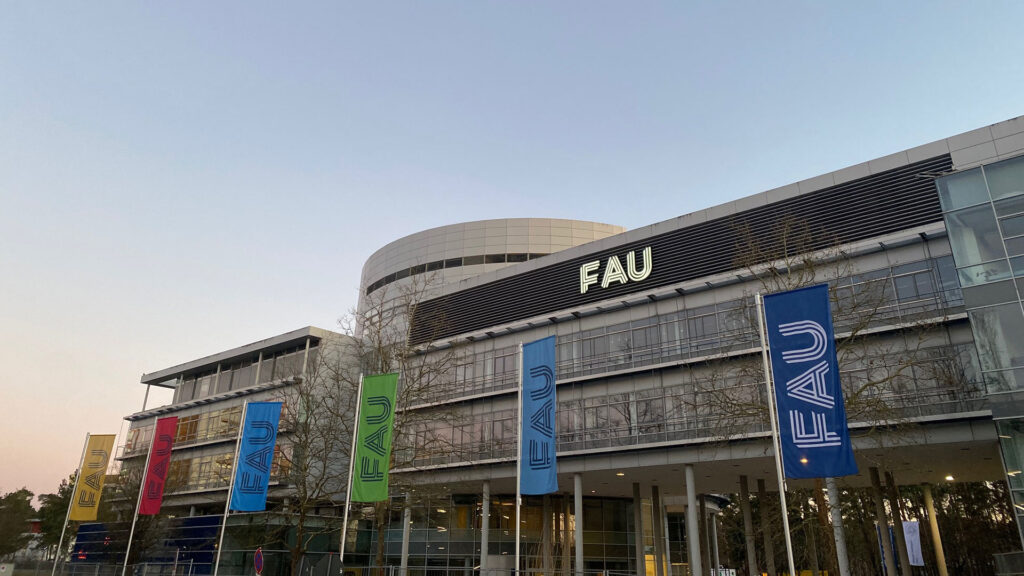
FAU has five faculties which cover the entire spectrum of academic disciplines – from the humanities, theology and medicine through to law and economics, science, and engineering.
Profile and structure of the faculties
The five faculties may be very different in terms of their areas of expertise, but they are all equally committed to research and connecting research and teaching. Each of the faculties is involved in several of FAU’s Key Research Priorities and they have also established their own interdisciplinary Research Focus Areas, which often cover subjects within several different departments.
The Faculty of Business, Economics, and Law is subdivided into the School of Law in Erlangen and the School of Business and Economics and Society in Nuremberg. It contributes to FAU’s research profile through its research and centres which are a part of the Major Research Area ‘Cohesion – Transformation – Innovation in Law and Economics’ which also involves the Faculty of Humanities, Social Sciences, and Theology.
School of Law
Since it was founded it 1743, the School of Law (in German) has made a significant contribution to Erlangen’s reputation as a key location for legal knowledge and teaching. It maintains close contact with many legal bodies and professionals and companies in the region which is beneficial for its students and enriches its teaching. The School believes in a practical focus, teaching core skills and professional development, all of which are strengthened by the Institute of Notary Law and Legal Practice and an active alumni network. All members of the School are also able to benefit from its global academic network.
School of Business, Economics and Society
The School of Business, Economics and Society is one of the most well-known in Germany and is very strong in research. More than 6,000 students from many different countries are currently studying in 21 innovative degree programmes, obtaining excellent theoretical and practical skills preparing them for careers in business, public organisations and research. Top research and teaching of international renown, internationality, a strong practical focus, outstanding networks with the business world and consistent quality assurance are the success factors of the School of Business and Economics.
Living Future Medicine – following this principle, the Faculty of Medicine at FAU is pursuing innovative approaches in personalized medicine based on modern biomedical research and treatment concepts. The Faculty of Medicine at FAU places great emphasis on close collaboration between research, teaching and patient care in order to transfer research findings quickly into practice and into medical training for the benefit of patients. The five key research priorities of Infectiology and Immunology, Tumor Research, Neurosciences, Kidney and Vascular Research and Medical and Health Engineering that are all connected via the FAU Profile Centers Immunomedicine and Medical Engineering pursue the aim of rapidly transferring research results into clinical applications (translational research). The faculty is one of Germany’s leading locations for immunology, infection research and oncology and receives considerable amounts of funding from the DFG and the Federal Ministry of Education and Research (BMBF). Our internationally renowned research in medical engineering is based on the BMBF leading edge cluster and is carried out in cooperation with the Medical Valley of the European Metropolitan Region of Nuremberg. Oncology research has very close links to the Comprehensive Cancer Center Erlangen-EMN, funded by the National Center for Tumor Diseases (NCT).
In addition to Medicine and Dentistry, the range of degree programs on offer comprises the first degree program in Molecular Medicine of its kind in Germany as well as Medical Process Management (unique within Germany since 2008/09). Logopedics has been offered since 2011. In 2021/22, the Bachelor’s degree program in Midwifery Science (leading to a vocational and an academic qualification) was launched and supplemented by the Master’s degree program in Advanced Health Care. In addition, the faculty offers the PhD program in Advanced Immunomedicine as well as the Bavarian Elite Master’s degree program in Integrated Immunology. FAU established the degree program “Medicine Erlangen/Bayreuth” in winter semester 2019/20 in order to secure the provision of medical care locally and to strengthen the entire region, the first Bavarian university to introduce a program like this. Structured qualification programs such as the Clinician Scientist program and the Master’s degree programs for working professionals in Health and Medical Management and Conservative Dentistry complete the Faculty’s profile.
The Faculty of Sciences at FAU is one of the best in Germany. It is home to the departments of Mathematics, Physics, Biology, Chemistry and Pharmacy, and Geography and Geology, which regularly appear towards the top of a variety of rankings, and its researchers have already won many prestigious prizes and awards.
The Faculty carries out both fundamental and applied research. This research is highly interdisciplinary, involving not only researchers from the Faculty’s departments but also experts from the Faculties of Medicine and Engineering, as well as other national and international institutions. The Faculty is involved in six of the University’s eight Major Research Areas and has also established its own Research Focus Areas which cover a wide range of topics, from communication and signalling to molecular materials and geodynamics, geomaterials and georesources, representation theory, astroparticle physics and optics.
Its students receive an outstanding education in a variety of degree programmes which cover all of the key scientific disciplines, with twelve Bachelor’s and Master’s degree programmes and teaching degrees (Lehramt) for the subjects biology, chemistry, geography, mathematics and physics. The Faculty ensures a close interlinking of research and teaching, allowing new knowledge to be passed directly on to its students. At the same time, students are given intensive support with their final theses which are highly research-based and contribute to the research progress. The Faculty of Sciences also runs the Bavarian elite degree programme ‘Physics Advanced’. It offers nine courses for talented school students in years 11 to 13.
The Faculty of Engineering at FAU has an excellent reputation, both in Germany and abroad. With it, FAU integrates the disciplines offered by a technical university into a university which offers the entire spectrum of academic disciplines. The Faculty comprises six Departments: Chemical and Biological Engineering, Electrical Engineering, Computer Science, Mechanical Engineering, Materials Science and Engineering and the Department of Artificial Intelligence in Biomedical Engineering (AIBE) that was established in 2020 as part of the High-Tech Agenda Bavaria and that combines biomedical research with artificial intelligence.
The Faculty’s research is dedicated to digital transformation and electrical engineering, energy – environment – climate, materials and processes, medical engineering and optical technologies. The Faculty of Engineering focuses both on fundamental scientific research and on topics that are relevant from a commercial and technological point of view. Interdisciplinary dialog between the subjects and organizational units ensures that the Faculty always ranks highly in international rankings.
This acclaim is also reflected in student numbers, as more than 10,000 young people are currently studying at the Faculty of Engineering in over 40 Bachelor’s or Master’s degree programs. The range of subjects on offer reflects the current developments in our modern world and includes everything from “traditional” disciplines such as chemical and biological engineering, electrical engineering, mechanical engineering and materials engineering to nanotechnology, clean energy processes and artificial intelligence. Many of these degree programs are interdisciplinary and the Faculty of Engineering cooperates closely with the Faculty of Sciences, the Faculty of Business, Economics, and Law and the Faculty of Medicine.
Deans – the heads of the Faculties
The dean is the managing director of a faculty or school. The dean makes decisions about staff and finance, signs Habilitation and doctoral degree certificates and awards them at public ceremonies. A dean’s teaching obligations are reduced to ensure that they can fulfil their managerial obligations in an appropriate manner. The dean is elected by the Faculty Council or the School Council for a term of two to four years.
The dean’s deputy is the vice dean (or several vice deans). In addition, there is a special representative for academic teaching, the dean of studies.
- File Name
- Dekane-Departmentsprecher
- File Size
- 41 KB
- File Type