
EU finances international research collaboration involving FAU
A unique collection of papyrus scrolls fell victim to the eruption of Mount Vesuvius in 79 AD. They were rediscovered in the 18th century, but the carbonized scrolls are badly charred, fused together, and remain largely illegible. An international project involving Friedrich-Alexander-Universität Erlangen-Nürnberg (FAU) now hopes to change that by combining and refining cutting-edge technology to reconstruct the records. They also intend to use AI algorithms. The European Research Council (ERC) will finance the project in the coming six years with over eleven million euros.
In 79 AD, Mount Vesuvius erupted without warning, after 500 years of remaining completely peaceful. In the hours following the eruption, fiery streams of gas and ash rushed down the slopes of the volcano, followed by an avalanche that covered the city with a layer of mud and ash up to 20 meters thick. The Villa of the Papyri (Villa dei Papiri) also fell victim to the natural catastrophe. It was home to a unique collection of scrolls that was only rediscovered in the 18th century.
A layperson may easily have mistaken the scrolls for the charred remains of a branch: they are entirely carbonized, and the individual layers that lie on top of each other like growth rings in a tree are firmly fused together, making it virtually impossible to unravel them. “Until now, roughly half of the approximately 1,800 scrolls and fragments of text passages included in the inventory have been unrolled, to a greater or lesser degree,” explains Dr. Vincent Christlein from the Chair of Pattern Recognition at FAU. “Even in these cases, researchers have only been able to reconstruct part of the content.”
The aim: improved accuracy at a greater speed
In principle, it should be possible to unravel the scrolls digitally, using a computer. The charred papyrus roles are screened using micro-CT. This is an imaging technique that uses X-rays to deliver very high resolution 3D images. Using complex software, researchers can then unroll these digital 3D scans to give a 2D image of the papyrus sheet.
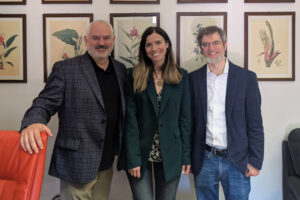
The team led by the Italian papyrus researcher Dr. Federica Nicolardi, the US American expert for digital restoration of ancient manuscripts Prof. Dr. W. Brent Seales and Vincent Christlein will pursue this approach further in the coming years. A key partner in the project is the National Library in Naples, which stores all the papyrus scrolls recovered from Herculaneum and allows researchers to access this unique collection directly. The EU will provide approximately 11.5 million euros over the next six years for the joint project with the name UnLost. “One of our aims is to improve and considerably increase the speed of the unrolling algorithm,” explains Christlein. “We also want the AI to differentiate more accurately between the writing and the background.”
Making hidden characters visible
In micro CT scans, the characters are not particularly well distinguished from the dark background. Even using imaging methods only rarely allows the contrast to be increased to a degree that actually makes them visible. “Using this method, it is impossible to reconstruct more than individual letters,” emphasizes Christlein. “We need to use other methods.” The methods he is referring to are predominantly machine learning algorithms: by feeding them with thousands of papyrus fragments which definitely do not have anything written on them and by way of contrast with areas on which letters have been identified, the AI learns to differentiate writing from the background, even in areas where it is indiscernible by the human eye.
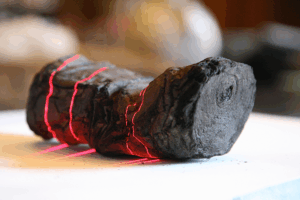
Kentucky)
The researchers also intend to experiment with different scanning methods as well. During what is known as the photo-acoustic procedure, papyrus is subjected to short laser impulses. The resulting heat creates fine ultrasound waves that allow conclusions to be drawn concerning underlying structures. In the scrolls that are physically unrolled, parts of the papyrus sometimes remain stuck to the layer above. The team hopes to identify such errors using 3D microscope images, and use AI to suggest where the fragments of papyrus actually belong.
The only surviving library from antique Roman times to be brought back to life
Using methods such as these, the researchers hope to provide new insights into a unique treasure: the finds from Herculaneum are estimated to encompass at least 4.5 million words, and probably even significantly more. By way of comparison: the books in the Bible have a total of 750,000 words, and the Dead Sea scrolls from Qumran have just over 800,000. “This is a unique cultural heritage unlike anything that has gone before: the only complete surviving library from ancient times with predominantly Greek and Latin texts that have been discovered in their original surroundings,” explains Christlein.
The research project UnLost is not only aimed at developing innovative approaches for digitalization and AI-assisted analysis, it also aims to develop new methods for preparing, archiving and providing the texts to the general public. In future, the results may then act as a model for the restoration of comparable finds across the globe.
Contact:
Dr. Vincent Christlein
Chair of Computer Science 5 (Pattern Recognition)
Phone: + 49 163 9131 85 27823
Email: vincent.christlein@fau.de