
Second funding period to focus on laser beam welding
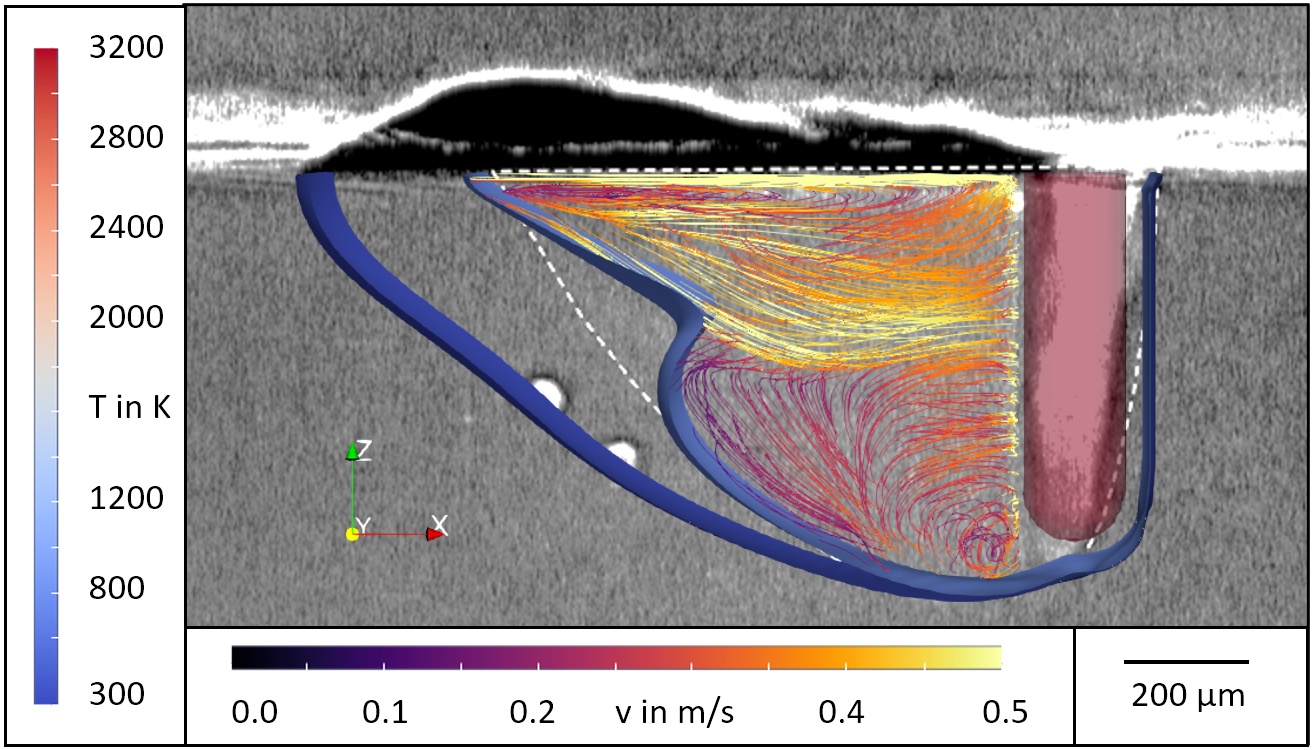
The research group FOR 5134 “Solidification cracks during laser beam welding” funded by the German Research Foundation (DFG), for which Friedrich-Alexander-Universität Erlangen-Nürnberg is the coordinating university, is to be granted a second funding period. This allows the interdisciplinary project to continue its pioneering work and make significant progress toward developing predictive models. The project is hoped to make a decisive contribution to expanding the spectrum of available materials and enhancing process safety in industrial manufacturing.
How can cracks be predicted?

Modern joining techniques such as laser welding have become indispensable in industrial manufacturing. Laser beams operate without making contact, are fast, and minimize the required energy input. However, a major challenge is posed by what is known as solidification cracks that may occur during this process. They restrict the choice of materials that can reliably be welded together and are caused by a complex interplay of material properties, process parameters and the geometry of the workpiece. As it is difficult to identify these cracks and there are currently no models available that are capable of accurately predicting their occurrence, the researchers in the research group aim to facilitate such predictions and to calculate the probabilities for various materials and processing conditions.
Which materials is the research group investigating?
“In the first funding period we investigated stainless steel as a model material in order to improve our understanding and modeling abilities for basic mechanisms. This work formed the basis for taking the next step, in other words expanding our research to cover nickel-based alloys, that are particularly relevant in practice and at the same time susceptible to solidification cracks,” explains Prof. Michael Schmidt, speaker of the research group.
The second phase will present the research group with new challenges, in particular when modeling material properties. The researchers will use traditional numerical procedures as well as taking a modern, AI-supported approach. “The extension is a clear indicator of the quality and relevance of our work to date. It allows us to continue to drive forward the current state of the art in research and to have the opportunity to transform physical-technical fundamental research into industrial applications,” emphasizes Michael Schmidt.
Which disciplines are involved in the research group?
The research group unites experts from various disciplines, from materials science to mechanical engineering to computer science and mathematics, and is spread over several locations throughout Germany. While pursuing their goal, the research group relies on fundamental scientific progress in various disciplines. This will have an impact going beyond the field of laser beam welding.
More about the research groupFurther information:
Dr.-Ing. Florian Klämpfl
Chair of Photonic Technologies
florian.klaempfl@fau.de