
FAU doctoral candidate develops an AI model that allows more accurate predictions of glacial melt
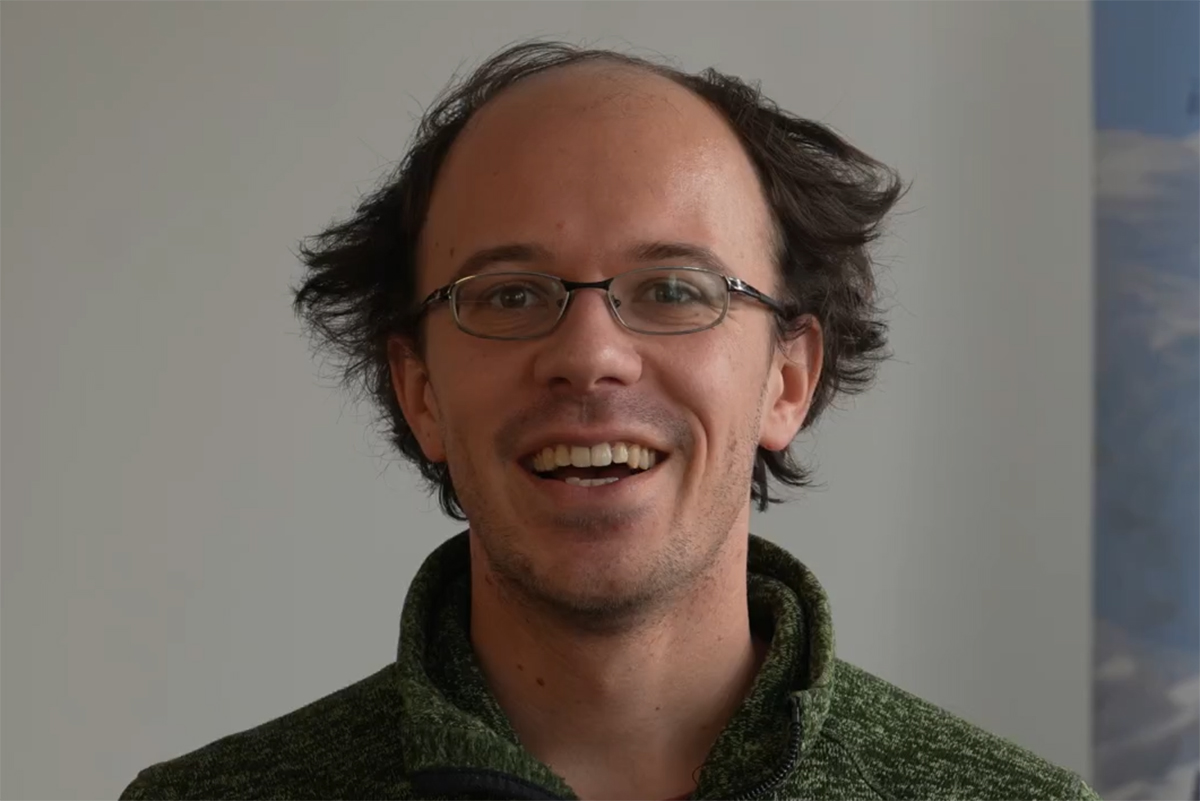
How does wind affect the distribution of snow on glaciers and what impact does this have on glacial melt? Manuel Saigger from Friedrich-Alexander-Universität Erlangen-Nürnberg (FAU) is investigating these questions with an AI model. At the Institute of Geography, he is making a valuable contribution to climate research by using the model to efficiently calculate how drifting snow influences glacial mass.
From weather model to glacier research
After completing a degree in atmospheric sciences in Innsbruck, he moved to Erlangen in 2022 in order to complete a doctoral degree in the international doctorate program M³OCCA (Measuring and modeling mountain glaciers and ice caps in a changing climate). “I find it really fascinating how wind affects glaciers. And there is still a lot of research to be done in this area,” he explains. It is hoped that Saigger’s research will succeed in improving the accuracy of glacier research. “Until now, research has basically involved just putting snow on top of glaciers, but it has neglected the effect the wind has. It is very complicated to calculate, and therefore not worth calculating over longer periods of time,” he explains.
Two years in development
The solution to the required calculating effort is to use artificial intelligence. Saigger has developed an AI model that is capable of calculating how snow drifts 100,000 times more accurately than has been possible to date. It is based on a pattern recognition program that is also used in medicine. Using a high-performance computer at FAU, he has calculated 720 different situations with a numerical weather forecast model and used this to feed his model. He has been working on the project for a total of two years. “It is great to see that something I have invested so much time in now actually works,” he explains.
How can the accuracy of glacier models for climate research be improved?
Other researchers can incorporate his findings into their glacier models. “The main goal of my work is to understand how snow is distributed over the glacier as a whole and how much new snow comes on top,” Saigger explains. It is important to bear in mind that snow does not melt at the same rate in every location, and snow reflects more sun rays than ice, thereby influencing the rate at which the glacier melts.
Saigger hopes to complete his doctoral degree by summer 2026. As the M³OCCA program has been extended for a second phase, a new generation of doctoral candidates will be able to continue his research.
Interdisciplinary collaboration
Saigger’s research is part of the international doctorate program M³OCCA, connecting FAU, TU München, the German Aerospace Center (DLR) and the Bavarian Academy of Sciences and Humanities (BAdW). Approximately half of the doctoral candidates come from abroad, from disciplines ranging from geography, geophysics, electronics and computer science. Their aim is to transfer technology and knowledge from various disciplines to climate and glacier research. The project aims to improve measurement methods and use AI to evaluate the collected data more efficiently.
M³OCCA websiteFurther information:
Manuel Saigger
Department of Geography and Earth Sciences / Institute of Geography
Phone: +49 9131 85-22643
manuel.saigger@fau.de