
Researchers at FAU investigate fundamental biological process in immunized test persons
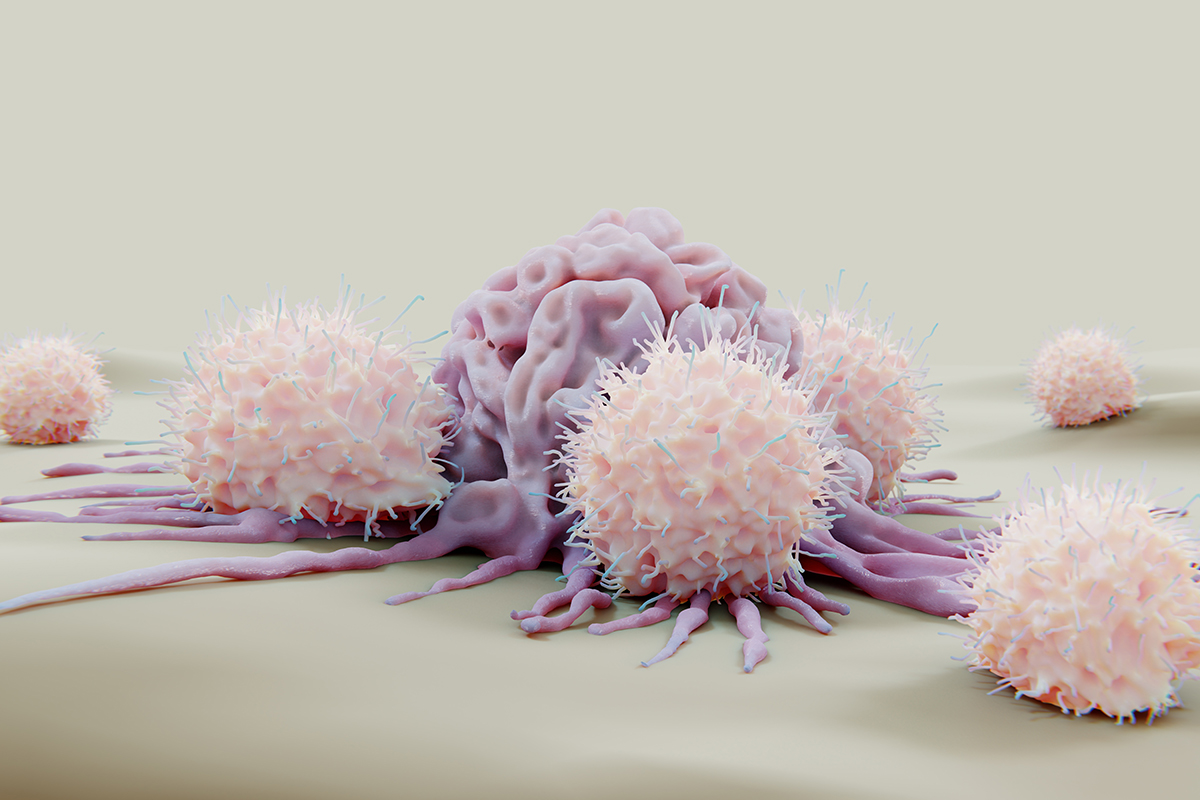
If killer cells from the immune system encounter signs of an infection, some of them start to divide rapidly. They grow to become a large defense troop that then attacks the pathogen. However, that is not the case for each individual killer cell by any means. Which criteria determine whether cells multiply or not? Researchers at Friedrich-Alexander-Universität
Erlangen-Nürnberg (FAU), Universitätsklinikum Erlangen and Helmholtz Munich have now investigated this question. They examined people who received a covid vaccination. In these people, cells only divide once their potential for fighting the feature of the virus against which they have been inoculated exceeds a certain threshold. The research findings have been published in the journal Scientific Immunology*.
Pathogens can vary greatly. However, the immune system usually succeeds in tracking them down quickly. This ability relies in part upon the approximately 100 million different types of cytotoxic T-cells (also known as killer cells) that keep watch throughout the body. Each of them is trained to recognize foreign molecules, for instance from a potential intruder. However, each of these types of cell keep watch for a different warning signal: Some killer cells, for instance, raise the alarm if they encounter a molecule consisting of influenza viruses. Others may be activated by a special tumor protein.
These responses are triggered by sensors on the surface of the killer cells: T-cell receptors. They react to specific molecular indicators that may look very different depending on the type of the receptor. “We call these indicators antigens,” explains Prof. Dr. Kilian Schober from the Institute of Microbiology – Clinical Microbiology, Immunology and Hygiene (director: Prof. Dr. Christian Bogdan) at UKER. “T-cell receptors can bind to antigens, but only if they match exactly, like a key to a lock.”
Attack of the immune system’s “clones”
When that happens, it can cause the killer cell to start dividing rapidly. This creates a whole army of identical cells, or clones. As they all have the same T-cell receptor as the mother cell, they can also recognize the relevant antigen and fight cells carrying these antigens. Binding to a foreign molecule fragment does not, however, always lead to the immune cell multiplying. “We wanted to find out why not,” explains Schober. “We investigated the immune response of test persons who received an mRNA vaccine during the covid pandemic.”
mRNA vaccines cause cells in the body to create a certain protein fragment from the covid virus. This fragment is then discovered by the matching receptors and can activate the relevant killer cells as a result. In the case of a genuine infection, the body is then able to fight the pathogens rapidly. As a rule, there are several hundred T-cell receptors that are able to dock on to the virus protein. However, some are a better fit than others, and bind together more strongly. In medical jargon, it is said that they have greater “avidity”. “We have now succeeded in showing that killer cells are only stimulated to divide once their avidity exceeds a certain threshold,” says Schober.
Diversity increases effectiveness against mutants

From the several hundred cell lines, only a few dozen remain, each of which forms a clone of immune cells. “However, it is not the case that the killer cells with the highest avidity multiply the most quickly,” emphasizes Schober’s doctoral candidate Katharina Kocher, who has conducted the majority of the experiments. “They must have a certain minimum level of avidity in order to be able to divide at all. At the end of the day, however, the extent to which they divide and how large the clone of immune cells finally becomes seems to depend on chance.” Shortly after receiving the vaccine, the test persons’ immune systems formed approximately twenty to thirty killer cell clones of differing sizes. Each of them had a different T-cell receptor, but all of them were able to bind sufficiently strongly to the virus protein formed after vaccination.
This diversity of the defense troops is a major advantage, as the researchers were able to demonstrate in experiments: “If the virus mutates over time, the probability that there are still killer cells that are able to fight it increases,” explains Schober. “An individual clone, no matter how high its avidity is, would never be able to cover all possible mutants.”
Analyses such as these are rare in humans. This is due in part to the enormous effort it entailed for the researchers: “We investigated several thousand killer cells in each test person and analyzed the structure of their receptors,” says Schober. “After that, we created models of more than one hundred individual receptors in a test system in order to be able to measure their avidity.” The effort paid off, however. “The results of our study give an interesting insight into the immune system’s strategies, which may benefit the development of new vaccines in the future.”
*DOI: 10.1126/sciimmunol.adu6730
Original publicationFurther information:
Prof. Dr. Kilian Schober
Institute of Microbiology – Clinical Microbiology, Immunology and Hygiene
Phone: +49 9131 85 32644
kilian.schober@uk-erlangen.de