
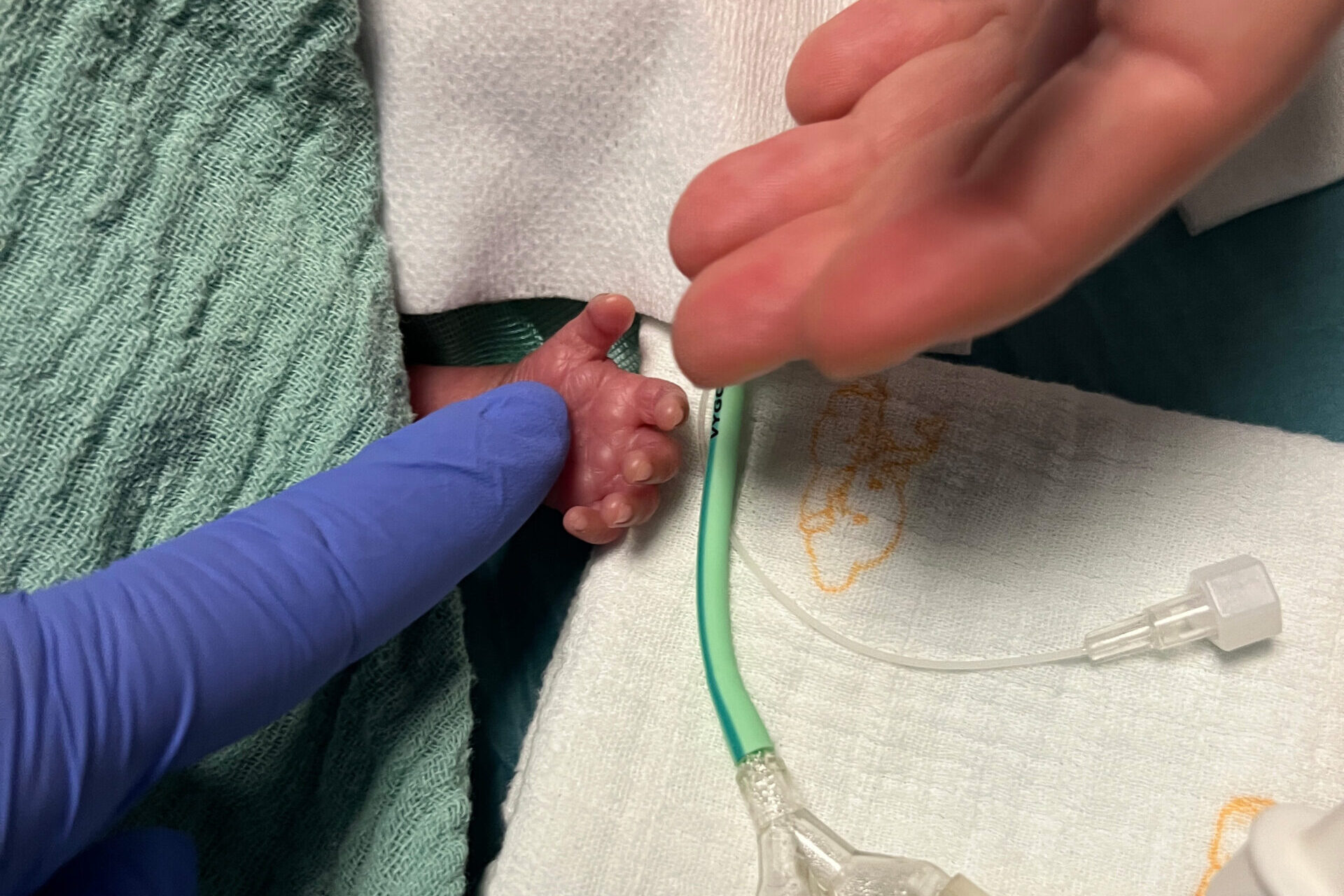
FAU researchers are developing a new suctioning technique for ventilation in new born babies, “SMART-NEO”
When babies are born weeks or even months too early, they often cannot breathe unassisted. To keep their lungs clear, mucous has to be cleared several times a day through the ventilation tube – a necessary but risky procedure. Researchers from Friedrich-Alexander-Universität Erlangen-Nürnberg (FAU) and Universitätsklinikum Erlangen (UKER) are working on an intelligent system that automatically monitors this process and protects the babies’ sensitive lungs. The project has received 300,000 euros in funding from the Bavarian State Ministry of Economic Affairs, Regional Development and Energy. By 2027, a prototype is to be developed ready for testing in a clinically relevant setting.
When they are born, premature babies only weigh a few hundred grams and rely on medical assistance. If their little lungs are too weak, they require mechanical ventilation. Mucous and fluid has to be cleared several times a day through the ventilation tube. Until now, suctioning has been carried out entirely by hand and requires utmost concentration. “The care and dedication of the nursing staff when looking after their little patients is quite eye-opening,” says Dr. Navid Bonakdar from the Chair of Biophysics at FAU. “With SMART-NEO we are doing all we can to alleviate at least some of their burden of responsibility and lower the risk of permanent lung damage.” Even small deviations in negative pressure can cause tissue damage or even trigger bleeding. This has lifelong consequences for the affected children and places the healthcare system under considerable strain.

(Photo: S. Eichinger)
Automatic technology
Current practices have not changed for decades: The system operates purely mechanically by hand, without the pressure on the lungs being regulated or measured. “It is not a coincidence that no comparable system has been available to date,” explains Prof. Dr. Patrick Morhart from Universitätsklinikum Erlangen. “Neonatology is a highly specialized area, meaning that investments in this area are not economical. But medicine is also a matter of responsibility. That is why it is so important for us to take the lead and develop a solution.” SMART-NEO relies on intelligent automatic control. The system monitors the suctioning process in real time and adjusts the negative pressure automatically. It recognizes whether air or fluid is being suctioned and prevents dangerous peaks in pressure. The innovative technique considerably reduces the strain on the lung tissue.
Research across subject boundaries
Dr. Bonakdar, Prof. Dr. Patrick Morhart and Dr. Frederick Krischke from Universitätsklinikum Erlangen are developing SMART-NEO together with an interdisciplinary team: Those involved in the project include the Chair of Automatic Control (Prof. Knut Graichen), the Department of Artificial Intelligence in Biomedical Engineering – AIBE (Prof. Andreas Kist), fluid mechanics (Prof. Stefan Becker) and neonatology (head Prof. Heiko Reutter) at the Department of Pediatrics in Erlangen (Prof. Joachim Wölfle). It is this interdisciplinary approach that makes SMART-NEO so special: “It is great to see how working together in a team can lead to new opportunities,” underlines Prof. Mohart. “Our innovative approach is only possible thanks to the combination of clinical knowledge, technical innovation and AI. It is this interaction that makes the project unique.”
Further information
Dr. Navid Bonakdar
Chair of Biophysics
navid.bonakdar@fau.de