
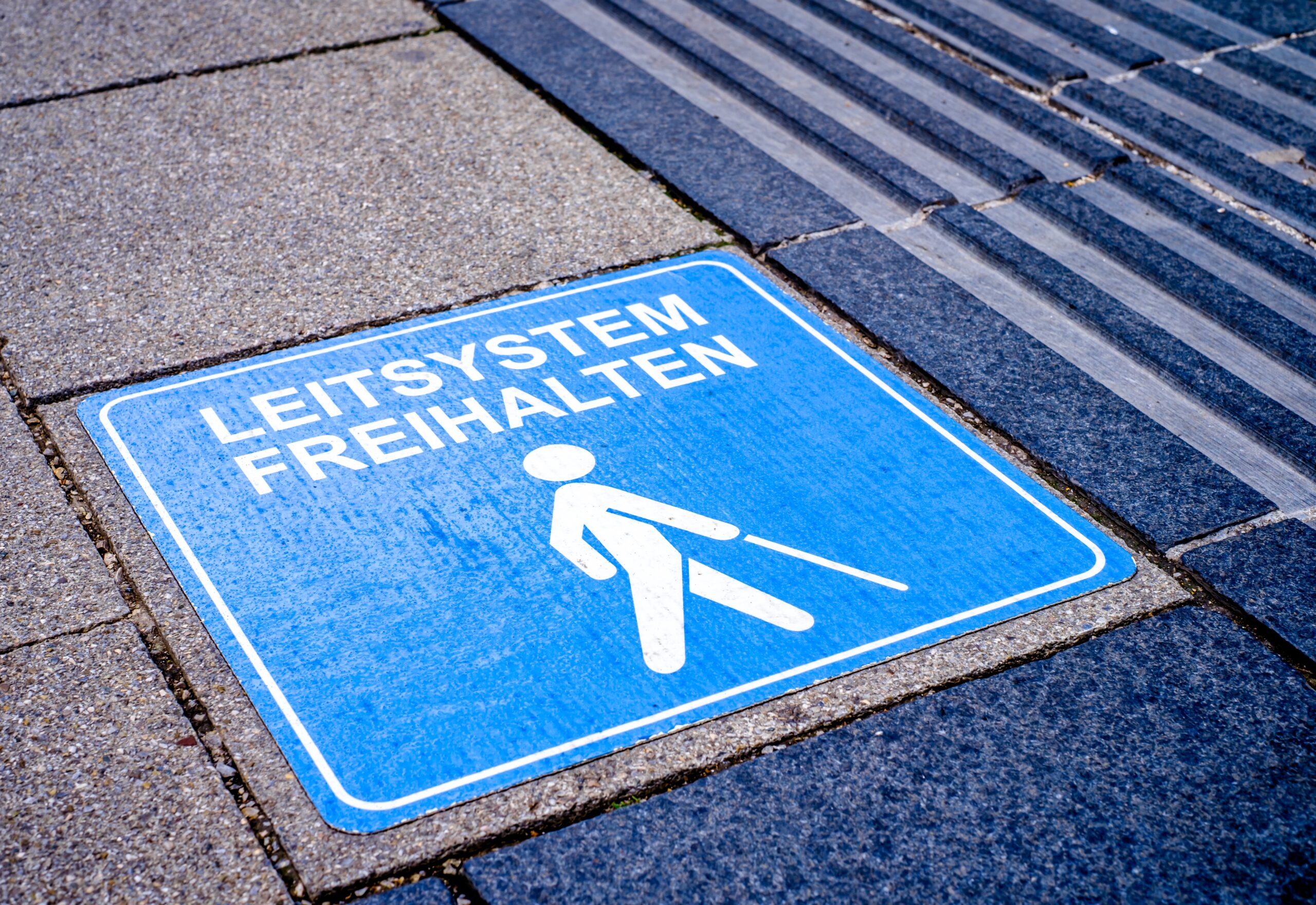
Computer scientist Hakan Calim from the Erlangen Regional Computing Center (RRZE) would like to found a startup
Hakan Calim has an ambitious goal. He aims to digitalize the physical tactile paving found in train stations or public areas to help guide people with visual impairments. He is blind himself and appreciates the importance of such mobility aids. The computer scientist works in the Research Group Network of the Erlangen Regional Computing Center (RRZE) at Friedrich-Alexander-Universität Erlangen-Nürnberg (FAU).
From his own experience, Calim knows how decisive unrestricted mobility is when it comes to participation in society. He started to lose his vision as an adolescent, and became completely blind while studying at university. He was interested from an early age in how technology can help to break down barriers. Now, he would like to use his knowledge to help other people with similar restrictions. This has motivated him to develop the research project SENSESATION, where a wearable helps blind or visually impaired people navigate.
From physical tactile paving to a digital pathway
His current plan is centered on the question of whether tactile paving can be replaced by a digital system. Such paving is not easy to lay and has to be maintained regularly to ensure that it doesn’t lose its effectiveness. Calim’s approach combines GPS and artificial intelligence. His idea involves integrating a GPS tracker into the tip of a blind person’s cane. An app compares the real-time position of the cane with a previously defined digital route. If the person walks along this defined route, the cane vibrates. If they veer away from the route, for example by going too far to the left, the vibration stops. This leads to a virtual tracking system that shows the way from A to B.
The challenge is to make the system accurate enough. Standard GPS systems often deviate by several meters. That is too much for safe navigation in traffic. The latest methods, however, can achieve discrepancies of just a few centimeters with real-time correction, and that is what Calim is building on. In the long term, this could lead to a practical solution for everyday use that could offer blind people more security and independence entirely without costly roadworks.
His vision for a startup
Calim is receiving support from Prof. Dr. Andreas Maier from the Chair of Computer Science 5 (Pattern Recognition) who is providing expert advice and assistance in developing the initial prototypes. At the same time, Calim is working on his doctoral degree in which he is investigating how deep learning can improve mobility and navigation for people with visual impairments. This work is the academic foundation on which his project is based.
At the same time, he is preparing to launch a startup in order to be able to offer the system in the Erlangen region. He is currently looking for team members specializing in electrical engineering and software development. In order to develop the prototypes further, he needs people with expertise in app development, bluetooth navigation and GPS integration. It is a major balancing act between his job at RRZE, his doctoral degree and his entrepreneurial plans.
Future model from Erlangen
Calim would be happy to hear from any Master’s students who are interested in equipping cities in future with digital tracking systems that can be expanded, updated and tailored to meet individual needs entirely without building works. The research centers at all times on those people whose visual impairment makes them reliant on accurate orientation aids.
More information
Hakan Calim
Erlangen Regional Computing Center (RRZE) Research Group Network
Phone + 49 9131 85-28689
hakan.calim@fau.de