
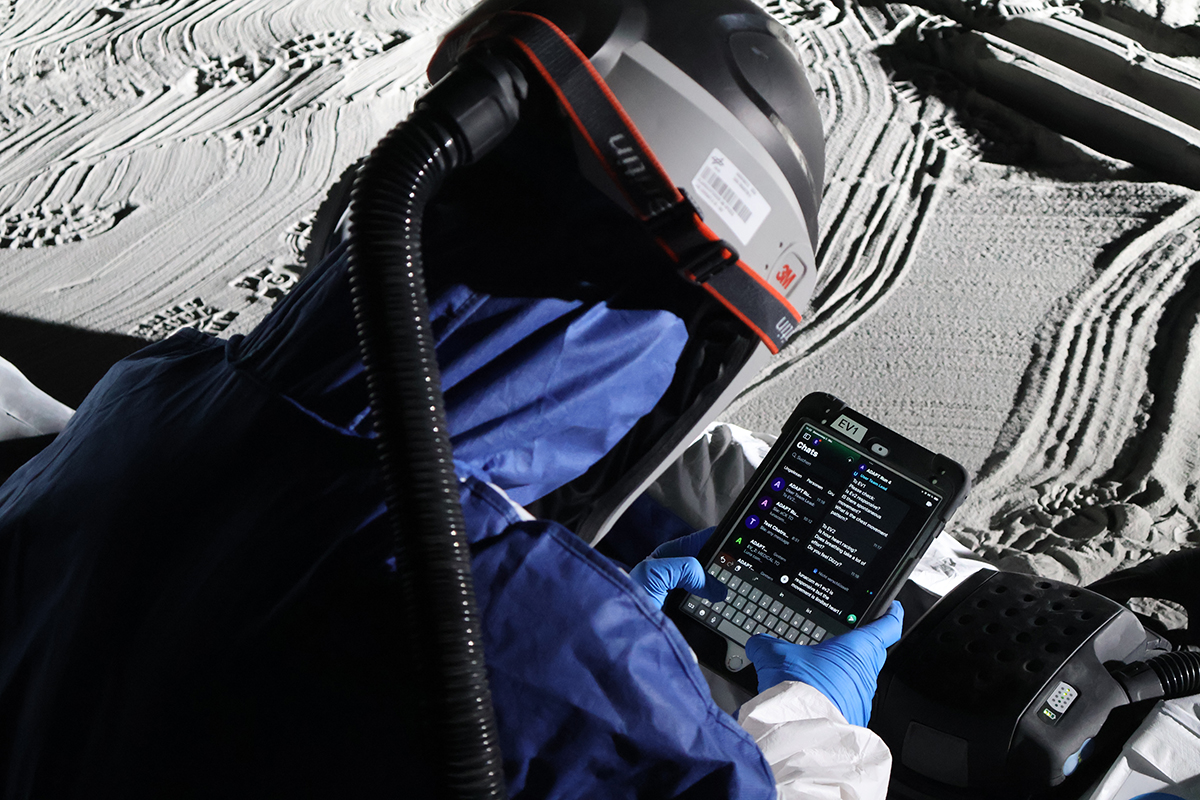
FAU testing text-based communication in the LUNA Analog Facility
What can you do in the case of a medical emergency if no-one can answer your call for help immediately? This is the question at the center of LUNA ADAPT, a research project led by Jan-Lukas Furmanek, a research associate at the Chair of Medical Informatics at Friedrich-Alexander-Universität Erlangen-Nürnberg (FAU). Using a simulated moon landscape, he and his team are investigating how injured people can be provided with medical care following instructions from medical experts when communication is disrupted.
There can be major delays in communications between Earth and the moon over radio, particularly if network issues arise. Jan-Lukas Furmanek’s team has simulated this situation in the case of a medical incident. In the scenario, spoken radio contact was not possible, meaning that communications between the crew members and the medical personnel was conducted with a delay and using a text-based instant messaging service.

For the test in the LUNA ADAPT campaign, participants without medical training simulated a medical emergency. The test location was the LUNA Analog Facility at the German Aerospace Center (DLR) and the European Space Agency ESA in Cologne. As the only facility of its kind in the world, it is used to prepare for future moon missions with astronauts and robots and includes a 700 square meter simulated moon landscape.
Medical care for a crew member
The simulation involved an acute medical incident. An astronaut was showing symptoms of ventricular tachycardia. With this condition, the heart beats so rapidly that it can no longer pump effectively and the body is not provided with enough oxygen. It is a vicious circle, as on the one hand, the speed of the heart beat means that the heart does not have enough time to provide itself with enough blood, but on the other it becomes exhausted quickly as it is working so hard. Action must be taken quickly, the affected person must be provided with medical care and stabilized urgently, which is a particular challenge in space.
Guiding a complex process with delayed communications
Contact to the extravehicular crew on the simulated moon surface was established via a DLR Flight Controller in a control room. The team tested two means of communication: freely worded chat messages like in common messenger services and structured text modules with standardized options for replies. The second option follows a strict question-answer protocol. The researchers hoped to discover which option works based when communications are delayed and only text-based. The chat app element they used is based on the Matrix protocol. The software was provided free of charge for the experiment.
Intensive test phase
Using the instructions, the affected crew member was able to be stabilized and evacuated in the tests. The two-day text phase made it clear how precise procedures and clear language can save lives. If language is delayed or text misunderstood, decisive seconds can be lost. The findings and the many pages documenting the procedure on the simulated moon landscape at LUNA ADAPT outline precise procedures and language for effective delayed, text-based communication. The aim is to make communication more resilient and safer even in the case of an outage.
About the LUNA ADAPT collaboration

At the DLR location in Cologne, the test was coordinated by the DLR campaign-lead team with Timon Schwarz, Miguel del Fresno and Aileen Rabsahl. The ADAPT campaign stands for “Asynchronous Delayed Assistance Procedural Test” and supports Furmanek’s doctoral research IM-CURE (“Instant Messaging for Crisis and Urgent Response in Emergencies”). He is investigating the use of instant messaging for communicating in emergency and crisis situations in healthcare. As an app developer, Element is also a partner in the project.
More information:
Jan-Lukas Furmanek
Chair of Medical Informatics
jan-lukas.furmanek@fau.de