
FAU researchers present new approach in the fight against liver metastases
An interdisciplinary research team at Friedrich-Alexander-Universität Erlangen-Nürnberg (FAU) and Uniklinikum Erlangen (UKER) are using new tactics in the fight against liver cancer. This new approach does not focus on the cancer cells themselves as was previously the case, but on the environment of the liver. The basis of this new approach is a protein molecule produced by the liver that makes the liver an attractive target for scattered cancer cells. The researchers have now presented their new therapeutic approach for the treatment of liver metastases in the journal Proceedings of the National Academy of Sciences (PNAS)*.
A communication channel between cancer cells and the liver
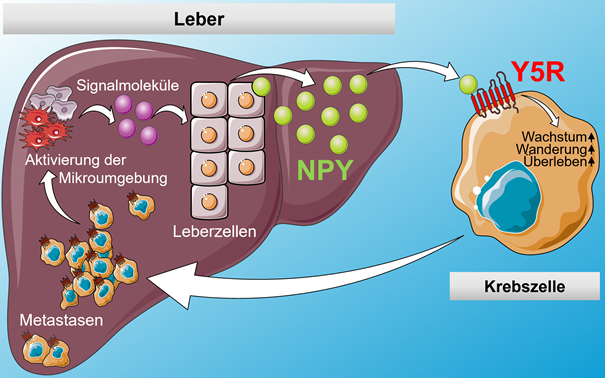
The focus of the research is on the NPY-Y5R signal axis. NPY is produced in the liver and transfers positive signals for cell migration, cell growth and cell survival. This enables a stimulating microenvironment to be established in the liver niche. Cancer cells, on the other hand, produce a “sensor” on their surface for NPY – the receptor Y5R – so that they can use the fertile environment in order to make themselves at home in the liver. If this communication is disrupted in a targeted manner, it is considerably more difficult for the cancer cells to establish themselves in the liver.
“We are addressing the niche, not the tumor”.
“Treatment types that are directly aimed at the tumor often fail due to problems such as difficulties reaching the cancer cells, a lack of specificity, serious and unexpected side effects or the rapid development of resistance”, explains Dr. Laura Wormser from the Chair of Biochemistry and Molecular Medicine and lead author of the publication. In an extremely promising approach, the research team therefore addressed the liver niche instead of the cancer cells. In their study, the researchers disrupted the communication between tumor cells and the liver niche in pre-clinical models and thus successfully limited liver metastasis. “We demonstrate that you can change the “language” of the liver in such a way that metastases cannot get established at all”, says Laura Wormser. “This step away from the tumor cell to organ niche opens up options for treatment that were not achievable up to now”, says Dr. Peter Dietrich, head of the study. “This means the tumor’s “breeding ground” is removed which it needs to colonize and grow in the liver.”
From experimental findings to clinical applications
Metastases are the main cause of cancer-related deaths and the liver is affected particularly often, for example in patients with melanoma, colon cancer, pancreatic cancer, stomach cancer and breast cancer. If the niche is disrupted, it is considerably more difficult for tumor cells to colonize and spread. “The next steps will be to fine tune the treatment type, carry out safety tests and start early clinical application”, says Dr. Laura Wormser. “However, there is still a long way to go until this treatment can be used”.
*doi: 10.1073/pnas.2518418122.Epub
The project received an m4 Award in July 2025, which is awarded to excellent biomedical innovations with potential for becoming start-ups.
A video about the project:
Further information:
Dr. Laura Wormser
Chair of Biochemistry and Molecular Medicine
laura.wormser@fau.de
PD Dr. Dr. Peter Dietrich
Department of Medicine 1– Gastroenterology, Pneumology and Endocrinology
peter.dietrich@fau.de