
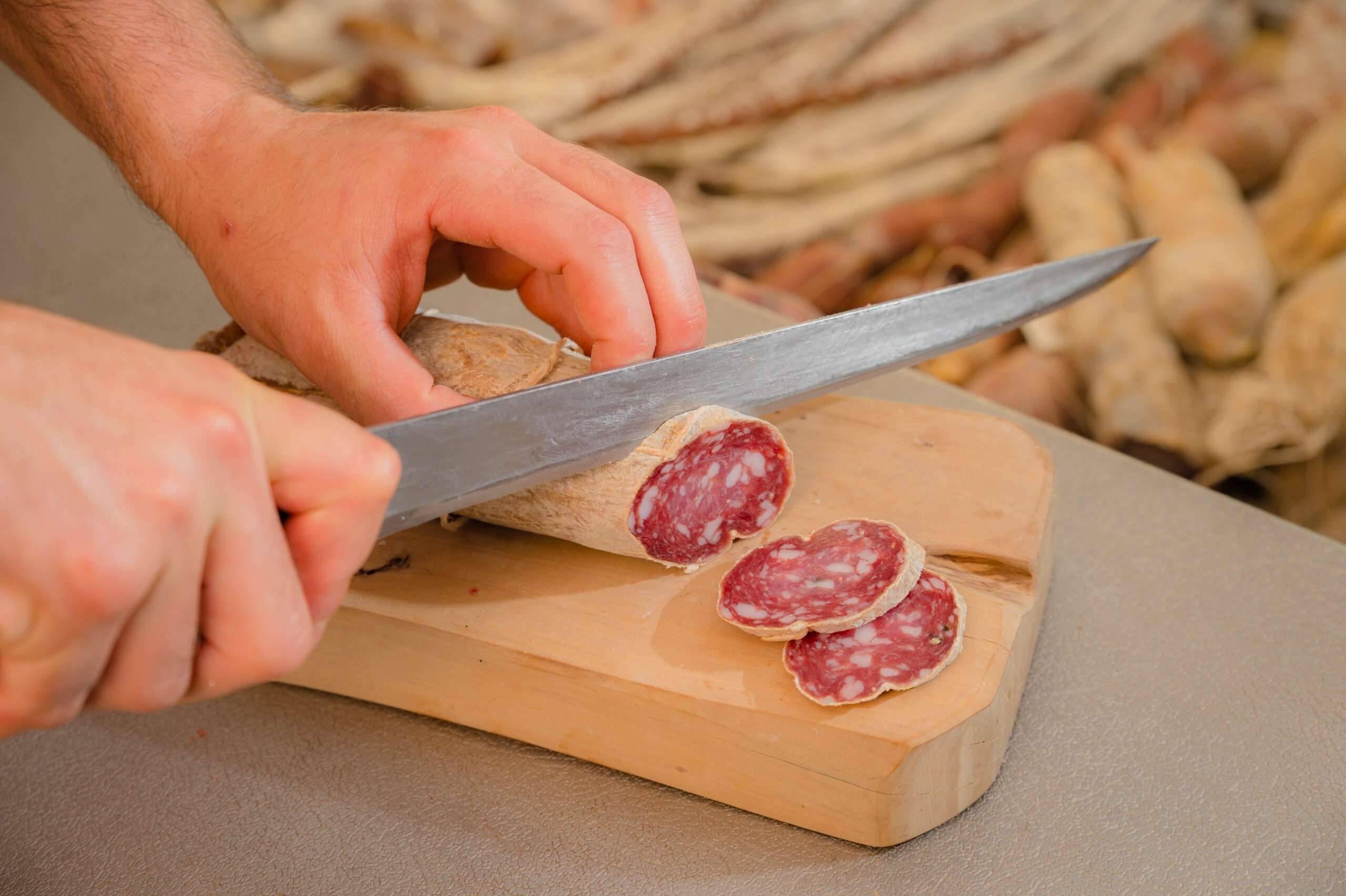
FAU researchers investigate the processes involved in cutting soft tissue
Most of us never think twice about how best to bite into a sausage or cut off a piece of it to savor. As long as it tastes good, we’re happy. Dissecting such soft materials remains poorly researched, and modern science still only knows a little about the details of cutting sausages, gelatine or synthetically produced elastomers similar to rubber. Miguel Angel Moreno-Mateos from the Chair of Applied Mechanics at Friedrich-Alexander-Universität Erlangen-Nürnberg (FAU) is now working to change this, for good reason: Food manufacturers and surgeons would like to know more in order to improve their techniques, thereby contributing to the wellbeing of consumers and patients. The results have now been published in Nature Computational Materials*.
Bread knife, carving knife, or maybe a cake knife after all?
Whether baking is your hobby or not, you may have found yourself wondering whether you should use a bread knife or a carving knife to cut your freshly baked cream cake or gateau. As neither of these options are particularly effective, experience has shown that it probably is best to go for a special cake knife. Miguel Ángel Moreno-Mateos is now investigating why that is the case. However, he is focusing not on cutting a cake but on gelatine, that has a high percentage of water. This renders this material, which is produced from the skin and bones of animals, very soft, but also highly resistant. He is also investigating synthetically produced elastomers, which can be easily reshaped, similar to rubber. And Nuremberger sausages, that consist of tiny pieces of meat and fat.
“All three materials are soft, but behave differently when being cut,” explains the engineer from FAU. The same applies to various natural substances. This is why, for instance, ants that cut leaves have quite different masticatory organs from people, whose teeth are used to chew potatoes or strawberries. Miguel Ángel Moreno-Mateos and holder of the Chair Paul Steinmann first observed what happens when soft materials are cut, before simulating the processes again using computer models.
When a blade presses down on gelatine, it first alters the structure significantly before abruptly cutting through the material when the inner resisting forces suddenly give way. A knife that presses down on an elastomer behaves quite differently, cutting through it gradually and smoothly. In the case of the Nuremberg sausage, the soft fat provides a layer of grease between the blade and the pieces of meat, allowing the blade to cut through steadily without any abrupt breaks or changes. This is probably the reason why sausages feel much softer when chewing them compared to meat: The teeth or the blade are not opening a relatively resistant surface, but instead are moving through a viscous substance that does not provide much resistance.
The video shows a blade cutting through a Nuremberg sausage
Simulations may make surgery safer
The computer models then show what exactly is happening in detail: How do friction forces affect the cutting of soft materials like these? How long does the blade deform the material and when exactly does it start to cut it? These simulations do not only show food manufacturers how they can improve their procedures and which blades they should use when to get the best results.
Animation of cutting performance
They can also help surgeons with their work and make operations considerably safer. Surgeons use scalpels to cut through very different layers, progressing from the skin to connective tissue until they reach their final goal. The cut should be as gentle as possible and only cause slight injuries which heal again relatively quickly. Nevertheless, it is easy to damage arteries, causing blood to flow between the scalpel and the tissue. This is the reason why surgeons warm their blades a little beforehand, stopping bleeding quicker and allowing them to continue operating without delay. Scalpels have tiny little holes that make the surface smaller and reduce the risk of the blade getting stuck.
Although these techniques are already very clever, they can still be improved further through experiments with soft material and computer simulations. This reduces the risk entailed in surgery and improves recovery. Surgeons and above all patients will benefit from these and future experiments conducted by Miguel Ángel Moreno-Mateos. And people will have a much better understanding of what exactly happens next time they bite into a tasty sausage at a Christmas or farmers’ market.
*DOI: doi.org/10.1038/s41524-025-01869-y