

A study from FAU has shown that lipid nanoparticles restructure their membrane significantly after being absorbed into a cell and ending up in an acidic environment.
Vaccines and other medicines are often packed in little fat droplets, or lipids. In this form, they are absorbed by cells and release their “cargo” once they are there. The trigger is a change in the pH value in the droplet’s surroundings. Researchers at Friedrich-Alexander-Universität Erlangen-Nürnberg (FAU) have now created a computer simulation of what exactly happens. Their findings may help to optimize the release of the active substances. The results have been published in the journal “Small”*.
Modern vaccines are often based on mRNA. mRNA is very sensitive and can be broken down easily by the body. To protect it, it is packed in little fat droplets, known as lipid nanoparticles, and injected in this form. In the body, the nanoparticles are absorbed by the cells and stored in microscopic sacs known as endosomes. The environment inside them is fairly acidic. “In response to the rise in acidity, the lipids deposit their cargo inside the cells,” explains Prof. Dr. Rainer Böckmann, Professor of Computational Biology at the Department of Biology at FAU.
Lipid nanoparticles consist of various components. One important component is what is known as amino lipids, in other words lipids incorporating a nitrogen atom. Amino lipids can absorb hydrogen ions in an acidic environment and become positively charged. They are absorbed at a specific pH value, which varies depending on the specific amino lipid. At this point, also referred to as the pKa value, the lipids change from not having a charge to having a charge. “This change in their properties is what ultimately causes the nanoparticles to release their content,” explains Böckmann.
An animation shows how the lipid’s membrane changes its structure in an acidic environment.
When the lipid is absorbed into the endosome, a slightly acidic setting, a chain reaction is triggered: Increasing numbers of amino lipids absorb hydrogen and become positively charged. This gradually destabilizes the nanoparticle until the cargo is delivered.
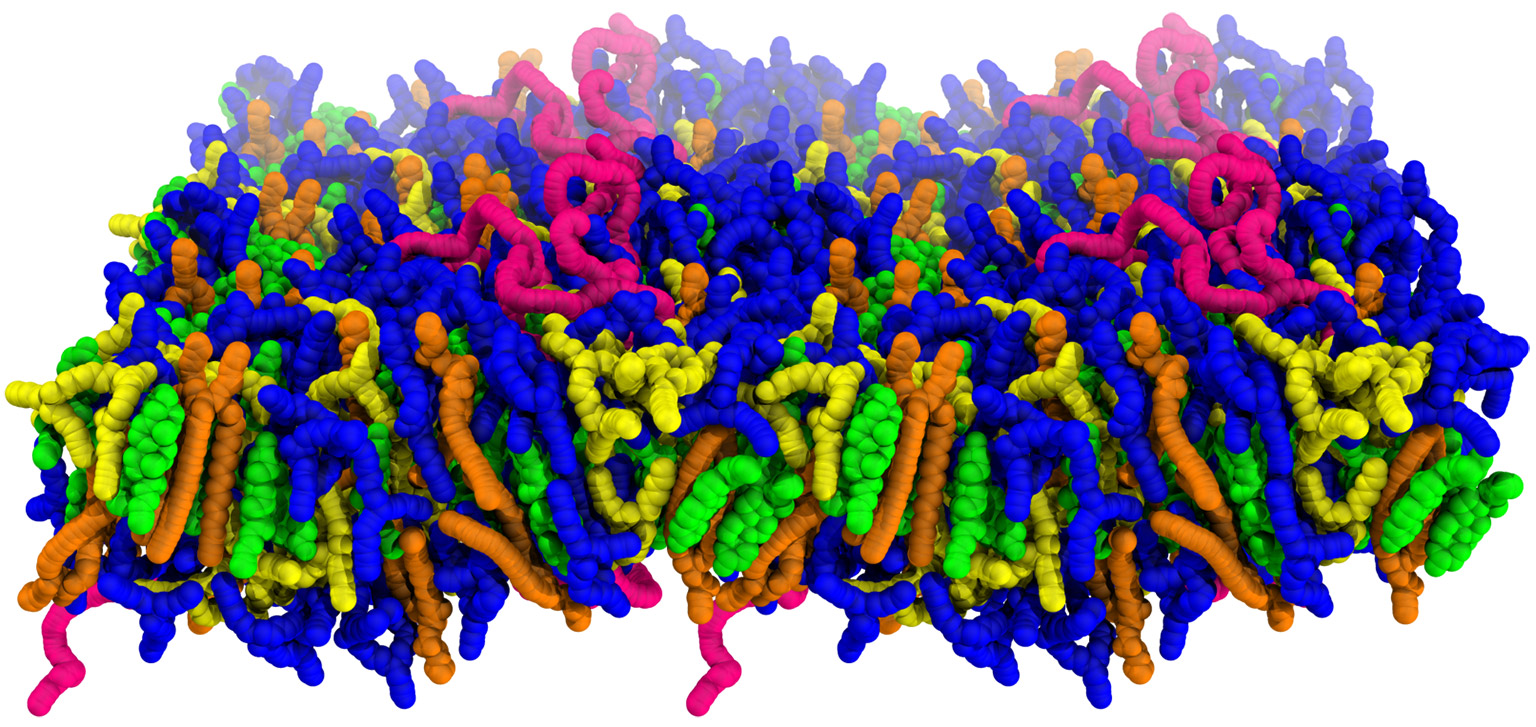
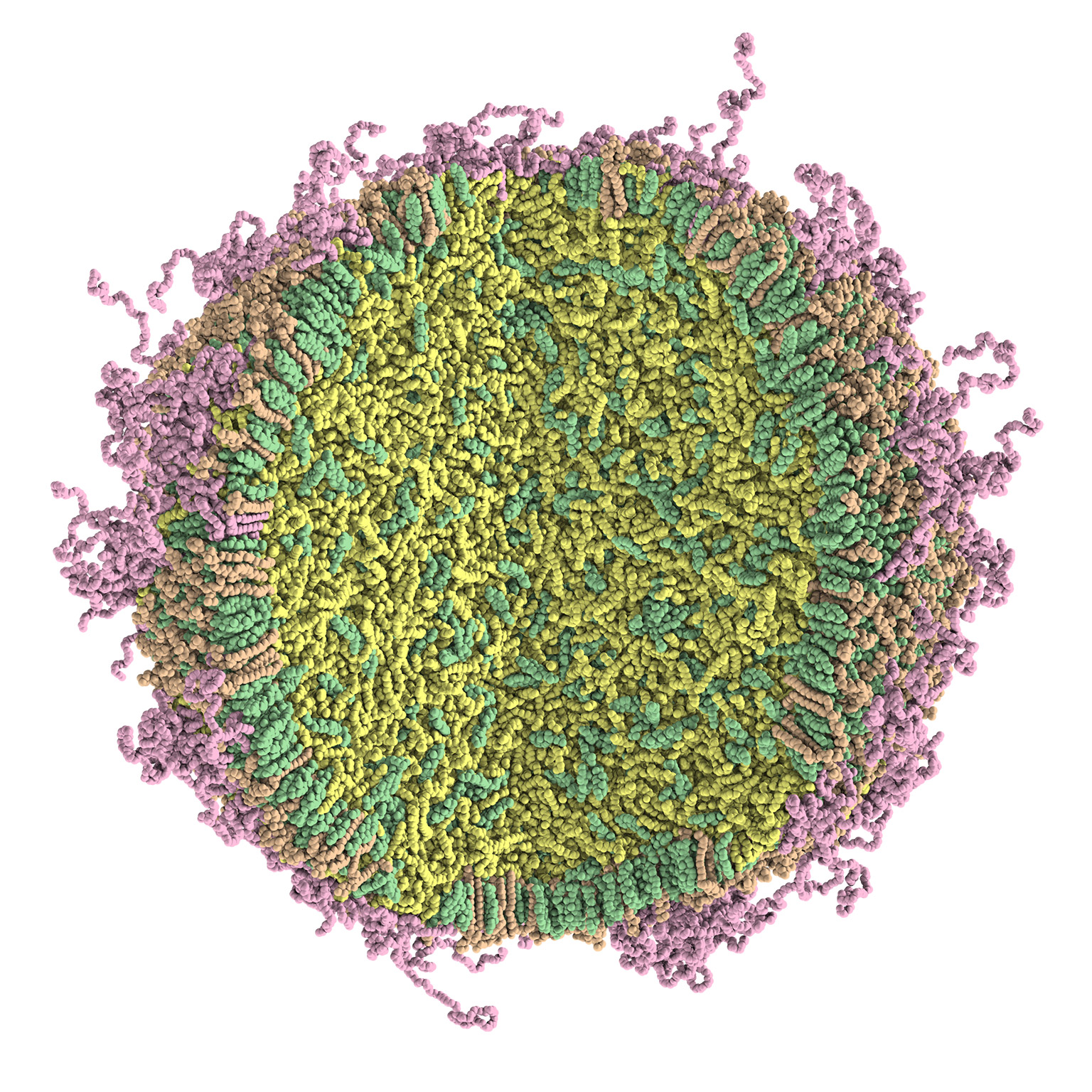
The doctoral candidate Marius Trollmann and Prof. Böckmann simulated this process on the supercomputers at the Erlangen National High-Performance Computing Center (NHR@FAU). They were able to produce a film showing how the lipid’s membrane gradually re-forms when the surrounding pH value changes. “We were also able to demonstrate to what extent the pKa value of the amino lipids depends on the surrounding molecules,” explains Böckmann: “Depending on which other compounds are available in their surroundings, it can undergo a shift of up to four units.” When they are in a watery environment with a pH value of nine, the amino lipids absorb hydrogen ions and become positively charged. The lipid environment surrounding the nanoparticle shifts the transition point to a pH value of five to six, in other words the value that is found within the endosomes.
Findings significant for research into vaccines
The study shows for the first time in detail how acidification in the endosome causes the lipid nanoparticles to release their content. The researchers simulated a lipid droplet with a molecular composition that is already used in practice: Nanoparticles such as these are used as transport vehicles for mRNA vaccines, not only in the fight against covid, but potentially in future also for treating cancer. “In order for that to be successful, it is important that the nanoparticles release as large a quantity of their mRNA into the cell as possible,” stresses Böckmann. “Using our simulation, it is possible to continue to optimize the composition of the nanoparticles to make the process even more effective in future.”
*DOI: http://doi.org/10.1002/smll.202511381