
FAU team investigates how our brain makes memories
How does the brain remember new words, faces or movements? And what role does sleep play? Prof. Dr. Hajo Hamer, head of the Epilepsy Center at Uniklinikum Erlangen at Friedrich-Alexander-Universität Erlangen-Nürnberg (FAU) is investigating the electrical processes involved in learning and memorizing.
Learning as an electrical process
Learning or making memories involves an interplay between various electrical activities in neurons in different regions of the brain. A key role is played by the hippocampus, that absorbs and structures new content, and whose shape resembles a sea horse. The hippocampus forwards information to the neocortex, where the long-term memory is located.
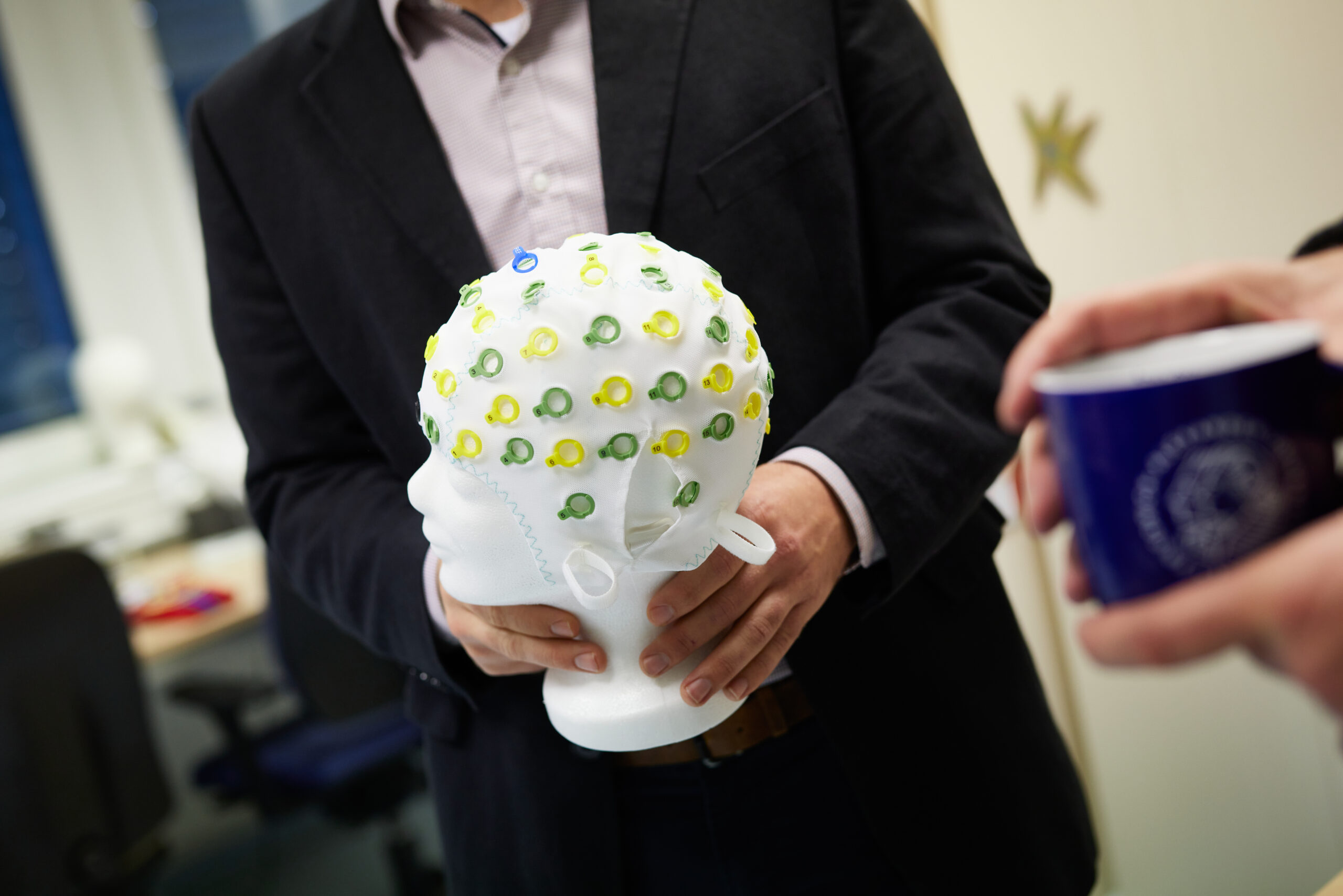
Current research based on EEGs indicates that learning is linked to specific electrical frequencies. These frequencies follow a certain precisely timed sequence. Only when this sequence is followed can the brain store information permanently. The same processes occur in the reverse order when it comes to remembering.
Researchers measure brain activity without additional intervention
Professor Hamer uses a special clinical situation to investigate these processes in more detail. His study focuses exclusively on patients who who are already receiving medical treatment for epilepsy.
Physicians implant depth electrodes with millimeter precision into the brain, assisted by an implantation robot. These electrodes are used for clinical diagnostic purposes, in other words to identify the area in the brain where the epileptic seizures originate. At the same time, the electrodes allow the researchers to literally observe patients as they learn. The electrical signals of individual neurons produce EEG measurements with unprecedented resolution.
The memory tasks themselves do not represent an additional medical intervention. During their stay in hospital, patients are asked to complete simple memory tasks, for example to memorize certain words or perform certain movements. The team of researchers continuously record these EEG data over a period of several days.
What happens during sleep
Scientists already know that sleep is vital for newly learned content to become permanently anchored in the brain. Professor Hamer and his team would now like to find out how and where exactly this process takes place.
The study has already delivered the first findings: In addition to the mechanisms involved in memory processing, the state of the brain immediately beforehand also plays a role. Information is saved more reliably if the brain is prepared electrically a fraction of a second before it receives the learning stimulus. Aspects that influence this prepared state include attentiveness and general ability to learn.
European research network
The research in Erlangen is part of a wider international research group that is funded by the European Research Council (ERC) and headed by the University of Glasgow: “The human hippocampus as a complementary indexing machine for episodic memory”. The aim of the Advanced Grant is to identify a typical EEG signature for making memories, in other words a typical pattern of electrical activity in the neurons in the brain when it successfully forms memories.

More information:
Prof. Dr. Hajo Hamer
, Professorship for Epileptology
hajo.hamer@uk-erlangen.de