
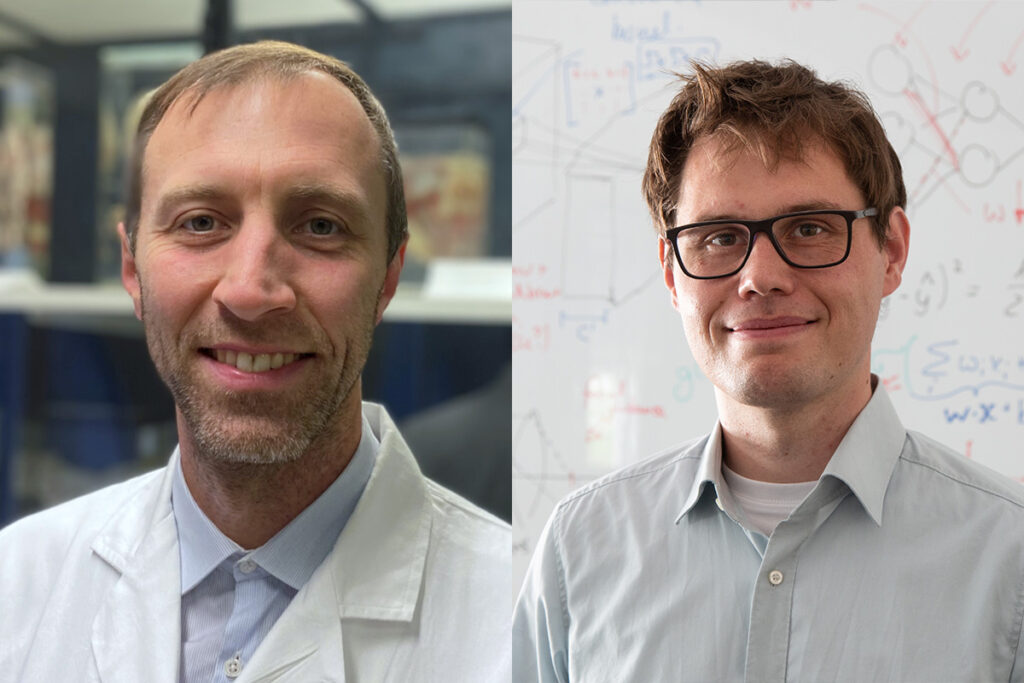
Two lecturers at Friedrich Alexander Universität Erlangen-Nürnberg (FAU) have received the Prize for Excellence in Teaching from the Bavarian Ministry of Science. Prof. Dr. Andreas Kist, Professorship for Artificial Intelligence in Communication Disorders and Dr. Philipp Arnold from the Institute of Anatomy are this year’s prizewinners from FAU. Science Minister Markus Blum awards the prize in recognition of excellent teaching at universities across Bavaria.
Andreas Kist hopes to teach students values

Prof. Dr. Andreas Kist from the Department of AIBE at the Faculty of Engineering focuses on methods of automatic signal processing, in other words processes that are able to recognize, analyze and interpret images, videos or audio content. Together with his team, he uses artificial intelligence, for instance, to analyze video material of patients with swallowing disorders. At work, Andreas Kist has focused on artificial intelligence since 2018, but his background is in science. He studied molecular medicine at FAU before completing a doctoral degree in neuroscience.
When describing his own career to date, Prof. Kist explains, “I haven’t studied engineering, I am really a scientist who has started to explore new avenues.” He is now based at the interface between biology, medicine and technology, holding, for instance, classes in cognitive neuroscience for AI developers. He also teaches his students the foundations of data science and AI. It is important for him that students learn through taking a practical and application-oriented approach. “The verb “to grasp” is a semantically wonderful word, as I can only understand something if I can actually grasp it.”
Each summer semester, the professor organizes a practice-oriented Tracking Olympiad. He challenges his students to program an algorithm they can use to track hexbugs, miniature robots that move randomly. The best team wins the Olympiad and receives the Tracking Cup. “Creativity knows no boundaries. After I have explained the basics, it is up to the students to work independently to develop solutions.” At the end of the day, the main aim is to teach students the importance of relevance. What impact does my research have on society? What can I achieve with my newly acquired abilities? “And relevance lies in practice,” says Prof. Kist.
In return, he expects his students to become actively involved. “A general sense of interest, a feeling that students are motivated, that they are here because they want to be here and because they want to learn. That’s important for me.”
Andreas Kist believes that he is bound by a higher duty: “The better I train the students, the more positive the impact will be on society. It is not only important that students learn how a neural network works.” For him, it is just as crucial that students are taught particular values: “Teaching values such as critical questioning, fact checking and taking an academic approach is my contribution towards actively combating populism and the trend in society to just stand up and say ‘I don’t believe that!’ even when the facts are clearly on the table.”
Philipp Arnold feels honored to supervise his students
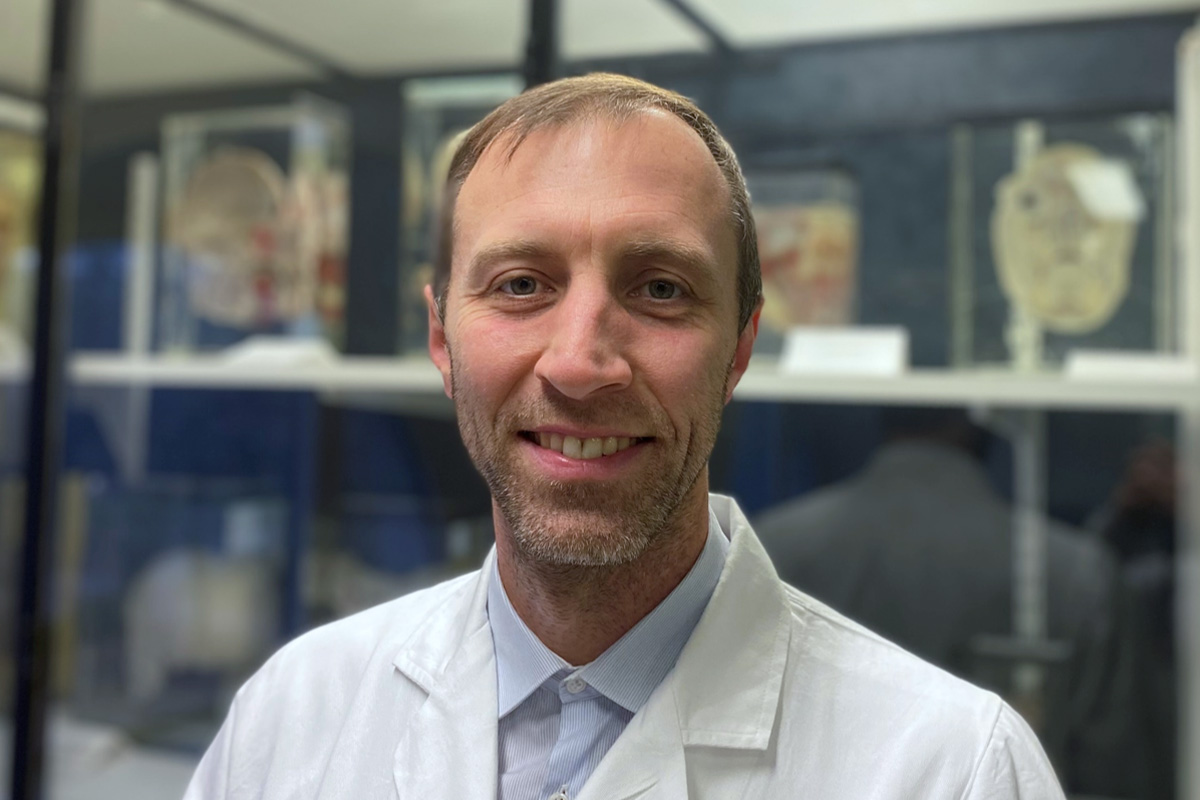
While Andreas Kist is a scientist who is now teaching at the Faculty of Engineering, Dr. Philipp Arnold moved from the Faculty of Sciences to the Faculty of Medicine. Philip Arnold originally studied biology. He completed a doctoral degree at Johannes Gutenberg University Mainz, moved to Kiel as a postdoctoral researcher in 2013 and came to Erlangen in 2020. He now holds the position of “Akademischer Oberrat” at the Institute of Functional and Clinical Anatomy and lectures in anatomy at FAU.
Philipp Arnold is mainly responsible for students in their first and second semesters. Although he aims to teach the subject matter in a way that grabs students’ attention, in his opinion the greatest challenge is helping new students find their feet at university: “Each year, more than 600 students start to study medicine here at FAU. Helping them get off a good start is essential if they are to continue studying successfully.” One way of helping them settle in and find their feet is to offer many opportunities for contacting lecturers and encouraging contacts between students. That is important for students to be able to find study groups that help them cope with the unaccustomed volume of material. “Good teaching also involves offering assistance and structuring course content as clearly as possible,” Dr. Arnold explains.
As well as supervising students in their first and second semesters, Philipp Arnold is passionate about supporting his doctoral candidates. He helps with applications, encourages students to take the initiative and creates space for dialog and expert discussions. In 2025, the FAU Doctoral Candidates’ Council recognized his dedication to supervision with an award.
Philipp Arnold finds motivation for his work in the inspiring careers of his students and doctoral candidates. “I am impressed again and again by the way some students develop. Several times now I have met students for the first time in lectures, then as tutors in anatomy courses, before having the opportunity to supervise them as doctoral candidates,” he explains. “My first doctoral candidates are now successful physicians involved in research and patient care. For me, it is a true privilege to be able to follow their development and provide them with support along the way.”
About the Prize for Excellence in Teaching
Every year, FAU nominates two members of its teaching staff for the Prize for Excellence in Teaching awarded by the Bavarian State Ministry of Science and the Arts. The Students’ Representatives select the candidates that the President of the University then nominates. The prize honors the work of the best teachers at state universities in Bavaria and is worth 5000 euros. Teaching staff who have demonstrated excellence in teaching for at least two academic years at a university in Bavaria are eligible to be nominated for the prize.
Further information
PD Dr. rer. nat. Philipp Arnold
Chair of Functional and Clinical Anatomy
Contact
Prof. Dr. Andreas Kist
Professorship for Artificial Intelligence in Communication Disorders