
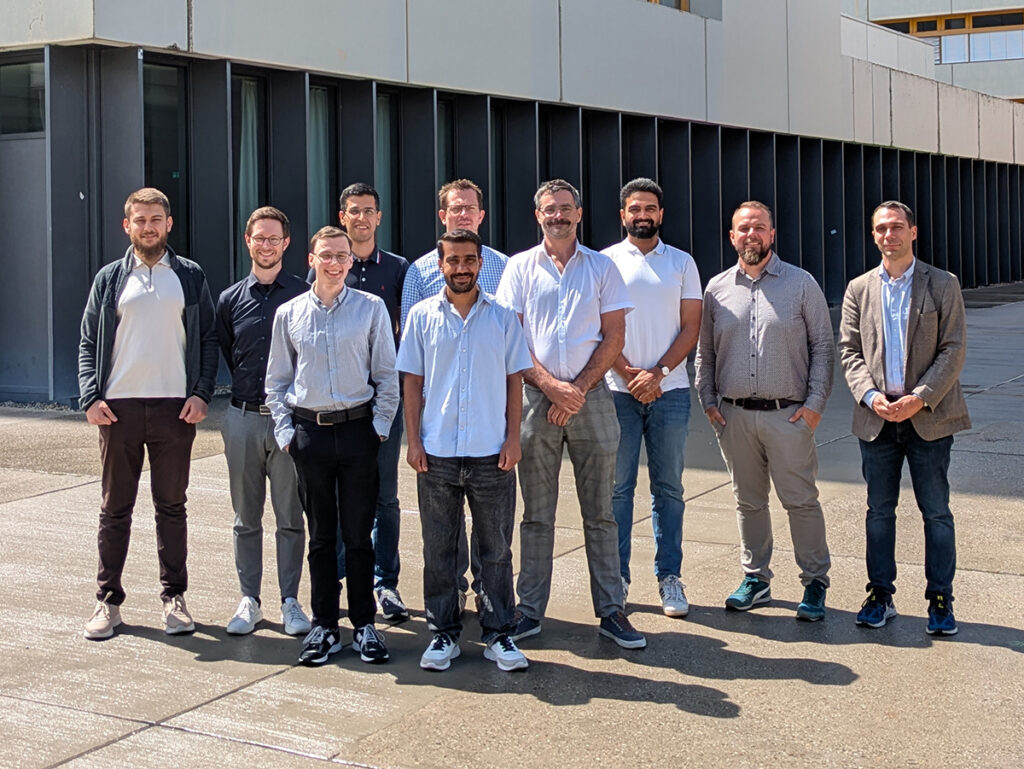
Team of researchers from FAU improves autonomous driving on the roads
Even without eyes, they can see almost as well – radar sensors. They scan their environment in rain, fog and in the dark. However, many vehicle radar systems only scan rough outlines, which is a problem for autonomous driving. The BAVAR-RADAR project uses AI and new combinations of datasets to overcome precisely this drawback. A team from Friedrich-Alexander-Universität Erlangen-Nürnberg led by Prof. Dr. Vasileios Belagiannis is playing a leading role in the project.
Imprecise detection during autonomous driving
Vehicles driving autonomously must be able to scan their environment reliably and quickly. Radar sensors are considered robust and cost-effective, but often only provide rough data. The low resolution makes it more difficult to make clear distinctions between objects and to detect movements precisely. In critical situations on the road in particular, this can limit the responsiveness of autonomous systems, for example if pedestrians suddenly appear.
Digital twin as a basis for training
A team of researchers led by FAU professor Vasileios Belagiannis from the Professorship for Machine Learning in Signal Processing is tackling this problem with a new dataset. In the “Bavarian Advanced Resolution Radar (BAVAR-RADAR)” project, the researchers are linking real measurements with artificially generated data from digital twins of the same scenarios. This generates combined datasets that enable a direct comparison of the real and simulated perception of the sensors to train modern AI models.

Lots of work on the computer
At FAU, researchers are training neural networks with large quantities of data from real vehicle radar systems. The models learn how to reconstruct detailed 3D point clouds from these sparse signals. Generative models convert the radar points into dense 3D structures. At the same time, they also reconcile the differences between simulated and real data. This enables the teams to gradually improve the accuracy of environmental perception in autonomous vehicles.
Safe driving functions
The BAVAR-RADAR project aims to significantly improve the performance of existing radar systems without developing new hardware. The aim is to create more precise environmental perception for driver assistance and autonomous driving. For example, the systems should be able to detect children behind parked vehicles early on and react accordingly. The intention is to incorporate the methods developed into production vehicles in the future.
For more safety on the road
By 2028, the researchers hope to demonstrate in a test vehicle that AI-based signal processing can significantly improve radar-based perception. In addition to FAU, the University of Applied Sciences in Hof is participating in the project. It is focusing on generating digital twins, simulating scenarios and providing support for installing the IT in a test vehicle.
Valeo GmbH is the industrial partner and responsible for providing and equipping the test vehicle. The company is also supplying real measurement data from vehicle radar sensors.
More information:
Prof. Dr. Vasileios Belagiannis
Professorship for Machine Learning in Signal Processing