
The 3R initiative was founded in Erlangen a year ago
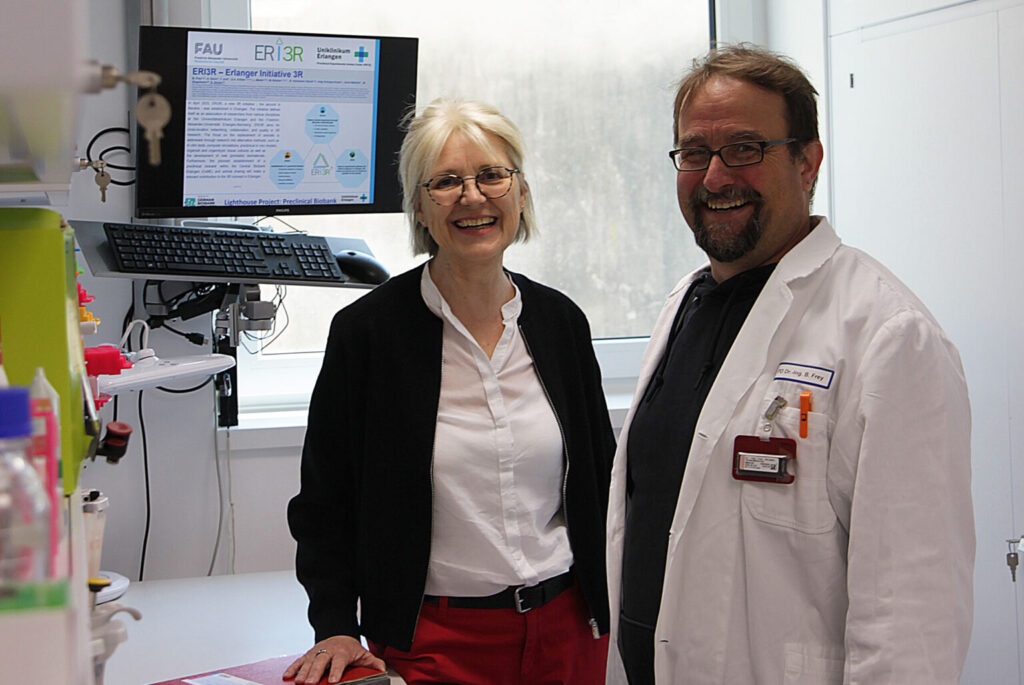
The Erlangen 3R initiative, or ERI3R, is celebrating its first anniversary on April 29, 2026. Behind the acronym is a working group of researchers, who are dedicated to consistently implementing the 3R principle across all faculties at Friedrich-Alexander-Universität Erlangen-Nürnberg and Uniklinikum Erlangen. In research involving animal experimentation, 3R stands for “replace”, “reduce”, and “refine”, concepts that reduce animal experiments to a justifiable minimum and improve animal welfare. PD Dr. Elisabeth Zinser and Prof. Dr. Benjamin Frey, spokespersons of the working group, take stock after one year of ERI3R.
The 3R principle was developed by British scientists William Russel and Rex Burch as early as the 1950s.
Today, the 3R principle is an integral part of research involving animal experimentation: In order to use animal models in their research, scientists must submit an application that illustrates how the 3R principle will be used and includes precise details of the number of animals involved and the exact burden on the animals. There is currently no comprehensive overview of testing methods that comply with 3R in many places, however.
Comprehensive strategy for FAU and Uniklinikum Erlangen
“The 3R principle has a very interdisciplinary approach. 3R processes often arise in very different, decentralized areas, for example in cell biology, materials science or computer science. In some cases, these measures arise as a response to a situation, without those involved knowing that they could be a transferable solution for others. Without a platform for sharing knowledge, these measures often remain isolated,” explains Privatdozentin Dr. Elisabeth Zinser from the Faculty of Medicine and spokesperson of ERI3R.
This is exactly the reason why scientists at FAU and Uniklinikum Erlangen came together and set up ERI3R. The initiative regards itself as a platform that bundles existing expertise in order to develop a comprehensive strategy which researchers in Erlangen can refer to in future. Expertise is offered for example, through informational resources, such as guidance on alternative methods or on preparing research‑proposal applications, as well as through training and advisory services.
ERI3R to hold networking meeting for researchers in July
ERI3R’s success depends on good networking. The aim is to overcome any possible hurdles that may be preventing networking between research groups and partners. A symposium is being planned in July for precisely this reason: “The event on July 6 is an important milestone for our recently established initiative,” explains deputy spokesperson Prof. Dr. Benjamin Frey, who is Deputy Director of Translational Radiation Biology at Uniklinikum Erlangen. “We are not only inviting members of ERI3R, but also researchers from all fields who deal with research involving animal experimentation and are interested in making a contribution to its development in Erlangen.”
This corresponds to the idea behind ERI3R. “A special feature of this initiative is the fact that ERI3R was set up by researchers who work directly with animals and have the required proximity to the topic. This is something we would like to continue. Researchers who have experience of animal models should play an active role in shaping the future of ERI3R and contribute to a transparent approach to the 3Rs in animal experimentation,” emphasizes Frey.
Another success for the initiative after only one year is the start of a pre-clinical biodatabase in Erlangen. “This collection of biological, pre-clinical samples, such as blood or the organs of a laboratory animal is essential for research since it provides high-quality, standardized samples, facilitating valid and reproducible research, and improving the transfer of fundamental knowledge into clinical applications,” says Zinser.
Preclinical biodatabases fulfill the requirements of “Reduce”: The number of tests can be reduced because biosamples do not need to taken several times from a single animal. Furthermore, research teams can also enter biomaterials they did not need for their own research into the database that could be useful for a different research project.
Significant progress in animal-free methods
The era where medical research no longer relies on animal experimentation at all has not yet arrived. “Animal experimentation is required mostly where complex interactions in the entire organism have to be investigated,” explains Zinser. “These include the immune system, processes in the metabolism or systemic diseases such as cancer or neurological disorders. These experiments continue to be crucial for developing and safety‑testing new therapies, and may even be mandated by regulators. On an EU and national level, there are also legally required animal experiments that serve to check the safety of medication and chemical substances.
However, important progress has been made in research methods that do not rely on animal experimentation. Frey explains: “In many areas today, organoids, which are miniature organs made of stem cells, precision cut tissue samples, or the organ-on-a-chip model, can be used. In tumor research in particular, or for active substance testing, it is already possible to replace animal experiments with animal-free methods today or to reduce them significantly. Alternative testing models complement pre-clinical biomedical research and form the methodological basis of modern research projects.”
Further information:
PD Dr. Elisabeth Zinser and Prof. Dr. Benjamin Frey
ERI3R
eri3r@fau.de