
With over 270 degree programs, FAU is among the 15 largest and leading universities for research in Germany. Over 6,000 employees and more than 39,000 students promote a culture of innovation, diversity and passion.
Get to know our newly-appointed professors who are driving forward research with their fresh ideas and creative approaches. Find out more about the people behind our research projects and their career paths, visions, and motivation for a successful academic future.
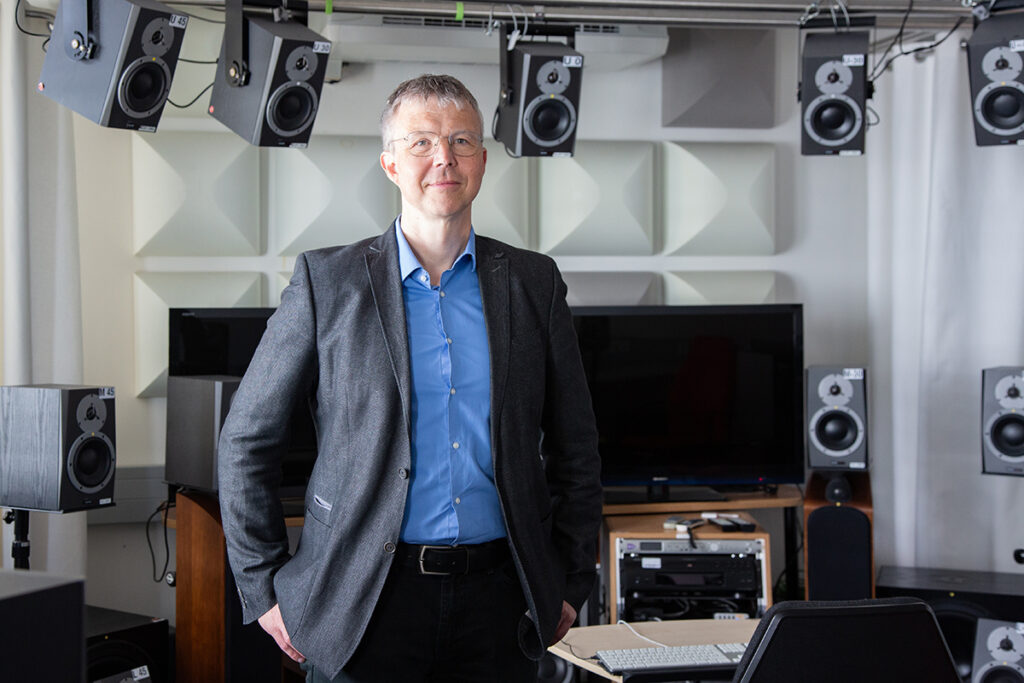
Prof. Dr. Frederik Nagel – Professorship for Human-Centered Data Science
He would like to write the perfect algorithm for making music to give you goosebumps – Prof. Dr. Frederik Nagel.
What is your main area of research?
My research focuses on the interface between audio signal processing, artificial intelligence, and empirical research into human perception. In particular, I investigate perceptual audio encoding, quality assessment of media, AI-assisted signal processing and the question as to how technical systems can be better geared toward human perception.
Why did you choose this topic?
I have been fascinated with the connection between mathematics, technology and human perception for many years now. Audio and music are particularly interesting in this context, because they are both technically challenging and their effect and perception is also fascinating. The combination of academic depth, practical relevance and significance to society is what makes this field of research particularly appealing to me.
Where were you before coming to FAU?
Before my appointment at FAU, I was Head of Department for Audio and Media Technology at Fraunhofer IIS, where I set up research projects about AI and signal processing and worked on current audio encoding standards.
Where did you study and what subjects?
I studied mathematics with computer science and medical biology as an application subject at the University of Hanover. I then completed a doctoral degree in neuroscience and music psychology at the Center for Systems Neuroscience in Hanover about the emotional effect and perception of music with a focus on the “goosebump effect”.
Which events and activities would you like to take part in in Erlangen and the surroundings?
I live in Heroldsberg and I am very impressed with the wealth of culture in the region, particularly where I live. I also like mountain biking or going out on my gravelbike in Franconian Switzerland.
What is your most useful tool as a professor?
Curiosity. My career path led me from mathematics and medicine into neuroscience and music psychology and then onto engineering and into signal processing and now into data science. I am always open to and interested in new things.
What did you want to be when you were growing up?
Something with music and computers, so it’s worked out very well.
Do you have a role model? If so, did they influence your academic or professional career?
The scientific community expects and encourages people who carry out particularly in-depth research in their fields. This is also essential for scientific progress. People who bring together different perspectives, who have broad horizons in science and can put research results into practice impress me.
Have you got any hidden talents?
I like to make music, play the organ and piano and recently joined a brass instruments class for adults where I play tenor saxophone.
Is there something you’ve always wanted to do?
I’ve always wanted to write the perfect algorithm for music guaranteed to give you goosebumps, so that I can compose music that really makes everyone happy. And because that probably won’t be a success, I would really like to do the great tour around the Karwendel mountain range on my mountain bike.