
FAU researchers discuss the challenges surrounding remembrance and commemoration
The crimes of the NS regime’s program of “euthanasia” happened more than 80 years ago, but are still raising questions even today. For the first time, a research project at Friedrich-Alexander-Universität Erlangen-Nürnberg (FAU) is carrying out a comprehensive reconstruction of the murders of the sick and disabled by the National Socialist regime in Erlangen between 1939 and 1945. Dr. Sabrina Freud from the Chair of the History of Medicine is participating in the project. She is also co-organizer of the conference ““Euthanasia” under National Socialism in Franconia”.
The research project on National Socialist “Euthanasia” in Erlangen is conducting a comprehensive investigation into the murders of the sick and disabled in the city for the first time. What central questions is your work focusing on?
Our work centers on reconstructing the murders of the sick and disabled in Erlangen and how it was possible for them to be carried out in the first place. This means we are also interested in the medical and social conditions at the time. We are not just looking at the victims, but also at the responsibility of the perpetrators and which scope of action they had at the time.
We ask which role the staff at the institutions, health service and the university psychiatric department played and how society in the city reacted to the systematic murders of mentally ill and disabled people.
You are a research associate on this project. Which findings or documents have you found to be particularly moving during your work?
The rare cases where there are reports by the patients themselves are particularly poignant. These “ego documents” are only found in a small number of files. I can remember one case in particular where a female patient sent postcards to her brother. In them, she wrote about how hungry she was and about her situation in the former asylum in Erlangen. The postcards were never sent, but confiscated by the doctors and put in her patient file.
This story is used in the foreword for the first volume of the research project: Link to foreword.
What is the significance of your research for public remembrance culture?
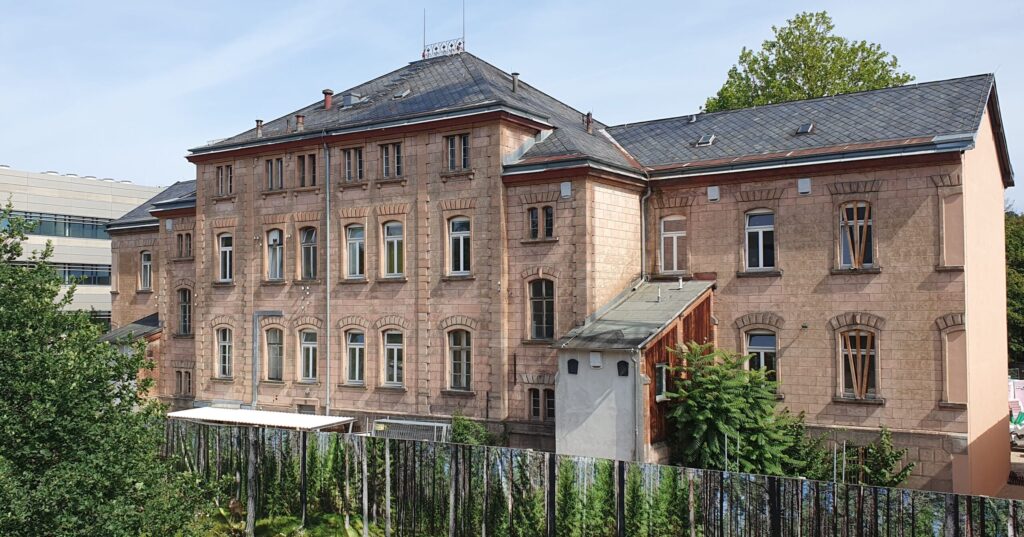
I think that historical research is the basis for an active and well-founded culture of remembrance. This means its important that the results of our project don’t just disappear into some archives, but are made public. The planned memorial on the site of the former asylum in Erlangen is an important step. The aim of the memorial is to present the story of the Nazi “euthanasia” in a way that is easy to understand.
The Institute of the History of Medicine and Medical Ethics and Erlangen City Archive are now holding a conference about the NS regime’s murder of the sick in Franconia. The title of the conference includes the words “Verdrängung, Bewältigung, Erinnerung” (suppression, overcoming, memory). Why are these three perspectives particularly suitable for dealing with this topic?
These three terms describe central phases in how the crimes committed during the Nazi regime’s “euthanasia” were dealt with. After 1945, several aspects were suppressed for a long time or dealt with insufficiently.. Today, we are primarily asking ourselves how we can shape memory and what significance it has for the present and the future. This topic is therefore not just limited to historians.

“Die Ergebnisse unseres Projekts sollen…nicht in Archiven verschwinden, sondern auch öffentlich sichtbar werden…Ziel ist es, die Geschichte der NS-„Euthanasie“ verständlich darzustellen.”Dr. Sabrina Freund
What is being presented at the conference?
The three topics “suppression, overcoming and memory” form the structure of the program. The conference brings together experts in history, medicine and criminal law and consciously looks beyond the crimes committed in Erlangen. Presentations will be held and there will be time to exchange ideas about educational concepts for remembrance and exhibition formats.
In addition, current developments at the site of the former asylum in Erlangen will be presented, for example, Dorothea Rettig and Julius Scharnetzky will be conducting a tour of the planned memorial.
The conference is open to all those interested in the topic.
The conference is specifically aimed at all those who are interested and provides a forum for exchange and discussion. Participation is free of charge. For organizational reasons, please send an email to renate.rittner@fau.de by June 30, 2026 if you wish to attend.
More information:
Research project website: https://www.ns-euthanasie-erlangen.de/de/home
Information about how the site of the former asylum is being turned into a memorial: https://www.fau.de/2025/11/news/universitaet/magazin/magazin-2025/vielfalt-2025/vom-schweigen-zum-sprechen/
Contact
Dr. Sabrina Freund
Chair of the History of Medicine
Research associates
Contact
Prof. Dr. Karl-Heinz Leven
Chair of the History of Medicine
Professors