
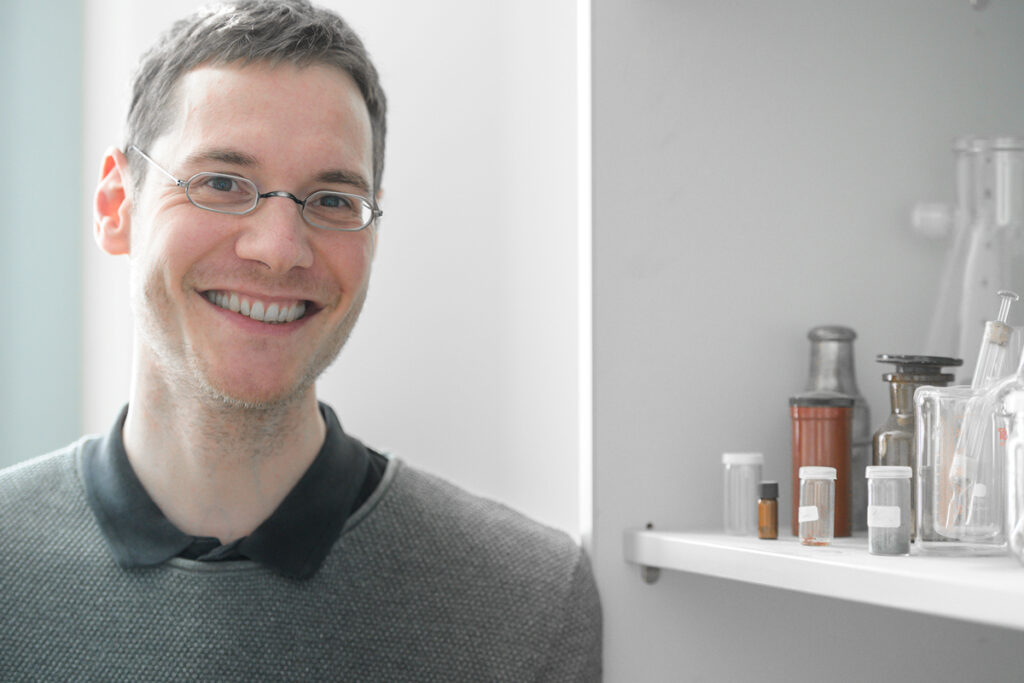
Researchers at FAU, with funding from the Volkswagen Foundation, are developing intelligent materials based on tiny molecular machines
Robotic muscles that contract in response to a light pulse; cube-shaped screens on which three-dimensional images can be viewed from all angles: Professor Dr. Henry Dube of Friedrich-Alexander-Universität Erlangen-Nürnberg (FAU) is hoping to develop materials for entirely new applications over the next four years. They are based on tiny molecular machines, each consisting of only a few dozen atoms. Chemist Dube hopes to link different types of these machines into three-dimensional structures that can perform different functions depending on the type and arrangement of the building blocks. The Volkswagen Foundation is providing approximately 900,000 euros in funding for the project.
Dube’s idea isn’t as far-fetched as it sounds: Countless molecular machines, each specialized for specific tasks, are at work in all living organisms. Muscles are made up of proteins that slide along one another in a pull-up-like motion, causing the muscle to contract. “We have been developing molecules for some time now that enable similar functions in principle,” explains the scientist, who has been head of the Chair of Organic Chemistry I at FAU since 2020. “However, they are generally built quite differently from their natural counterparts and are also significantly smaller.”
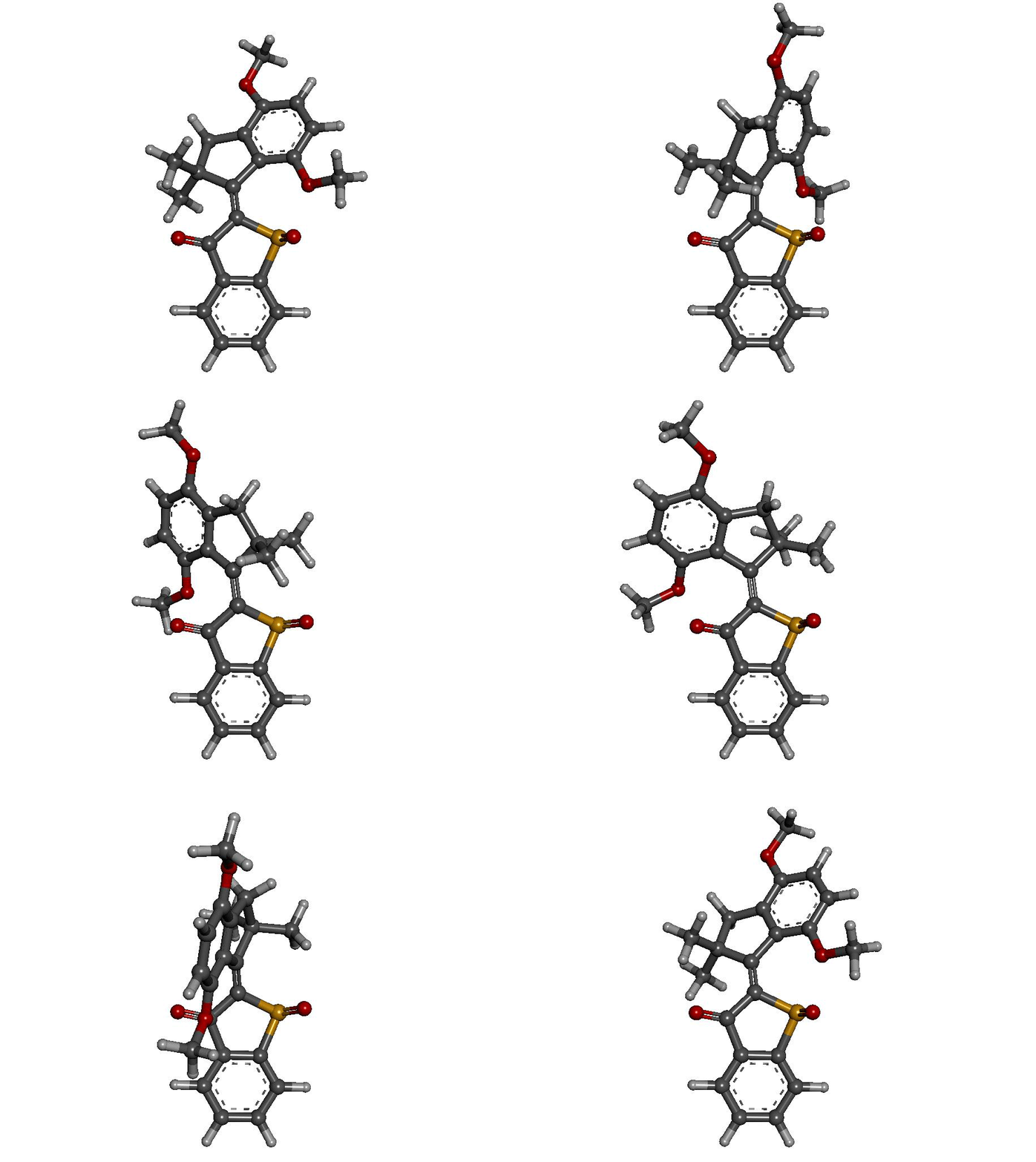
These include, for example, tiny gears consisting of only a few dozen atoms that can be arranged in series to form gear units. Dube has also already built nanomotors and tweezers capable of grasping the tiniest objects. He now hopes to take things a step further in the Volkswagen Foundation project. In a muscle, countless “pull-up molecules” are connected in series. They are bundled together by the hundreds of thousands so that they can generate enough power collectively. “We also want to create three-dimensional structures to link several molecular machines together in ways that follow defined rules,” says the chemist. “Depending on which different types of building blocks we combine in these polymers, we can create intelligent materials for a wide variety of applications.”
Materials whose properties can be programmed using light
This approach should make it possible, for example, to create artificial muscles for innovative robots. Unlike their natural counterparts, these muscles are not controlled by electrical pulses, but by light. “Many of the nanomachines we use change shape when exposed to light,” says Dube. “This allows us, for example, to trigger movements.” Often, this change in shape also causes them to change color. In this way, it is possible, for example, to create cube-shaped screens onto which three-dimensional images can be projected. These can be viewed from all angles and, unlike laser engravings on glass, can also be easily erased.
“We are also planning to produce materials whose properties can be programmed,” explains Dube. “For example, they could become rigid under blue light, but elastic under red light.” It could even be possible to design a gripper arm that becomes flexible only for a short time and at a specific point, allowing it to bend at that point.
Uncharted scientific territory
Dube is breaking new ground with this project. The Volkswagen Foundation is supporting it as part of its Momentum Program. This program is intended for researchers who have recently taken up a professorship and wish to expand their expertise into a new field. “As organic chemists, we usually work with individual molecules,” says Dube. “With our ideas, however, we are venturing into materials science – a field that requires a completely different set of expertise.” He will therefore use the foundation’s funds to support, among others, postdoctoral researchers who possess the necessary expertise in this specific field. “I am absolutely confident that we can successfully put our ideas into practice this way.”
Further information:
Prof. Dr. Henry Dube
Chair of Organic Chemistry I