
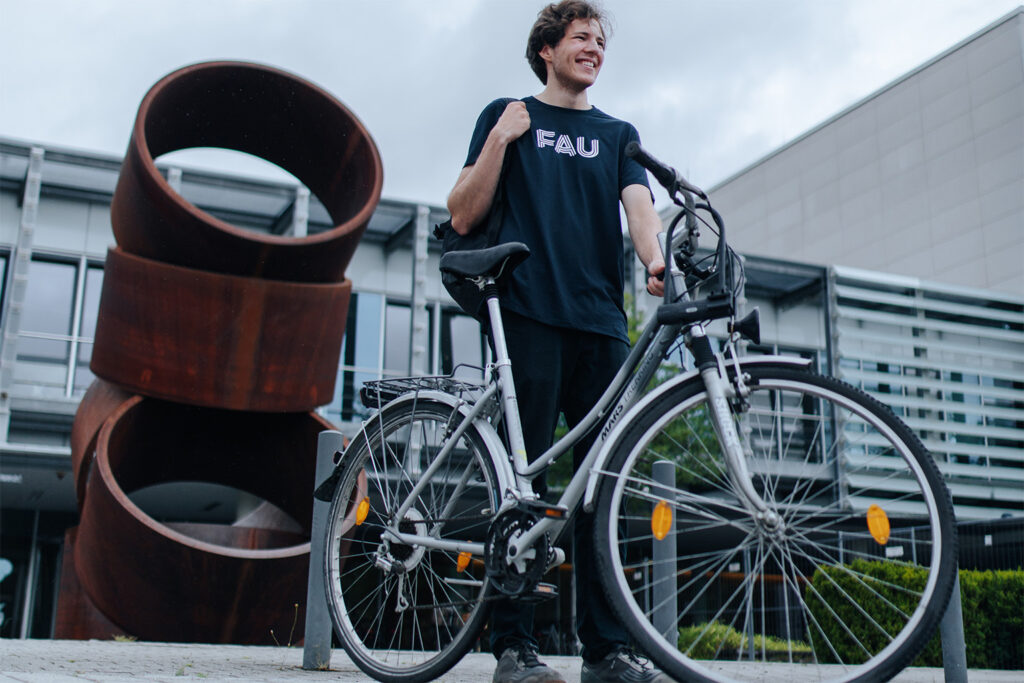
More than one million euros of funding for cycling infrastructure
Cycling to university will be more convenient at FAU in future. Thanks to a large funding application from the Green Office and Facility Management at FAU, more than one million euros of funding has been approved for the University for the next four years from the National Climate Initiative of the Federal Ministry for the Environment, Climate Action, Nature Conservation and Nuclear Safety (BMUKN). From 2030 at the latest, FAU will be able to offer improved infrastructure for cycling at a total of 31 locations in Erlangen, Nuremberg and Fürth.
The program includes covered bike parking and bike stands, bike repair stations and showering facilities. Planning has already begun and construction will start gradually during the next few years. Work will begin at locations at FAU Campus Erlangen South, followed by FAU Campus Erlangen Center and FAU Campus Nuremberg.
In addition to the improvements to infrastructure, the money will be used to finance information material and to equip the bike workshop at the FabLab with tools.
“The fact that our bid was successful is a real asset for our students and staff,” says FAU Chancellor Christian Zens. In addition to the benefits for the cyclists among staff and students at FAU, the project is a clear contribution to FAU’s campaign for more sustainability. “Commuter traffic accounts for almost a third of all CO2 emissions in FAU’s greenhouse gas balance sheet. At the same time, the mobility survey made it very clear that around 7 percent more staff members would cycle to work than currently do so, if the relevant infrastructure was in place.”
The Green Office is hoping for a clear result here, continues Dr. Kathrin Furhmann, head of the Green Office: “We believe a change of around 3 percent of all passenger kilometers currently traveled by car to work to bikes is realistic – and this alone would cut emissions on journeys to and from work by around 325 tons per year.”
The success of the project is particularly pleasing because some specific measures of the FAU’s mobility concept can now be implemented during a short time frame, for which there would otherwise only have been very few resources available.