
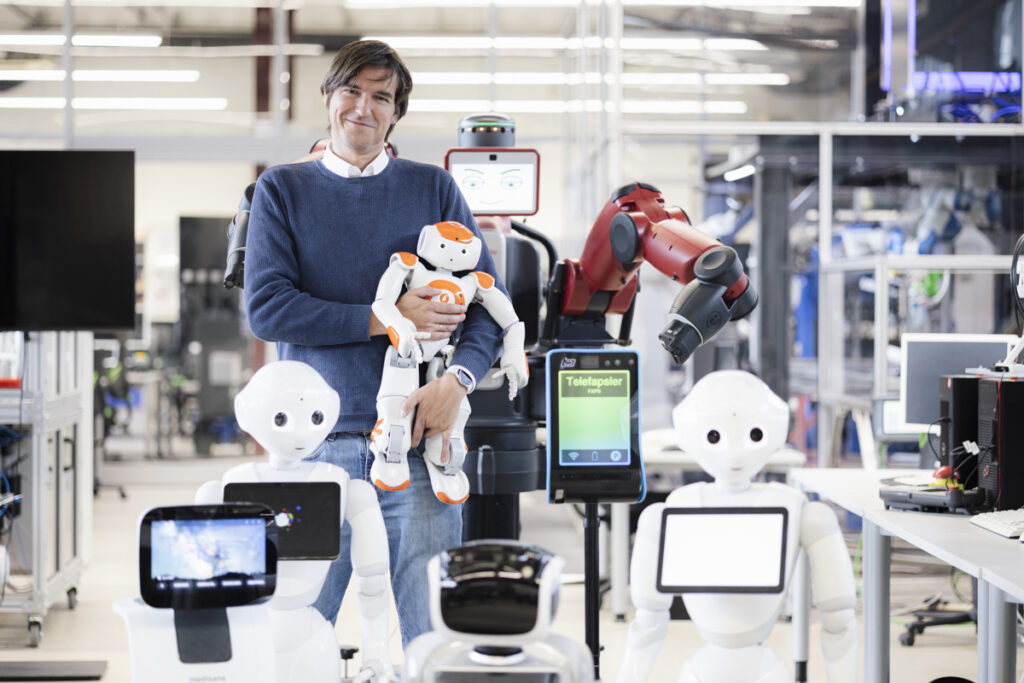
FAU presents future technology with significant economic potential
Humanoid robots are no longer science fiction: They can take on tasks that challenge humans and have the potential to play an important role in industry, services, or private households in the future. At Friedrich-Alexander-Universität Erlangen-Nürnberg (FAU), researchers are working on hardware and software for human-like robots. Dr. Sebastian Reitelshöfer from the FAU Chair of Manufacturing Automation and Production Systems explains in an interview how humanoid robots could support us in the future and why this future technology on two legs could be an opportunity for the northern Bavarian industry.
What exactly is meant by a humanoid robot, and what distinguishes it from other robots?
Humanoid robots are designed to resemble humans in their external form. Many walk on two legs. However, this is not a mandatory feature. There are also humanoid robots that move on a mobile platform. One important, not necessarily technical difference from other robotic systems is that they almost always immediately elicit strong reactions, associations, and expectations in humans. Visitors to our lab often try, for example, to communicate directly with our humanoid robots because they intuitively assume that something human-like can also speak. This can be used to initiate interaction with inexperienced users without them having to read an instruction manual first. However, it also presents developers with the challenge of not disappointing these intuitive expectations, which could otherwise result in poor acceptance.
What capabilities or tasks should humanoid robots take on in the future that are particularly challenging for humans?
The expectation for humanoid robots is that they can perform a wide range of tasks. Since they have similar body dimensions to humans, they can, for example, restock logistics shelves in an industrial environment, just like human workers. Even though locomotion on legs is technically more difficult than moving on wheels, legs enable humanoid robots to navigate our complex everyday world, where not exclusively flat surfaces are found. Therefore, in the not-too-distant future, they could be used, for example, in private settings, to support tradespeople, or in outpatient care for seniors.

“When humanoid robots are capable of understanding complex requirements expressed in natural language and have scene understanding from images, applications in the real world will become feasible for the first time.”
Dr. Sebastian Reitelshöfer
What technological hurdles still exist before humanoid robots can be widely used in everyday life or in companies?
With the currently available AI approaches, robotics has already made a huge leap toward real-world applications. When humanoid robots are capable of understanding complex requirements expressed in natural language and have scene understanding from images, applications in the real world, such as in households, will become feasible for the first time. A service robot in a care facility can now also clear the table in an actual patient’s room, even though there is a travel bag on the floor, clothes draped over a chair, and flowers still in a vase on the table. While it has proven futile to manually program strategies for such complex scenarios using classical programming methods, AI can now navigate safely and only clear the dishes from the table. AI is therefore a major enabler, though further research is still needed here, as current AI approaches achieve success rates of, for example, 80 percent when performing tasks. Although this can already provide helpful relief in some use cases, it is still nowhere near enough to meet current industrial manufacturing needs, for instance, as it would be unacceptable for a humanoid robot to incorrectly assemble 20 percent of the produced parts.
Beyond the software, there is an even greater need for research into humanoid robots. For example, the durability of drive elements is a major issue. At the last Beijing Marathon, it was a breakthrough that many robots managed to complete the half-marathon distance, although doing so pushed them to their limits. In an intralogistics scenario, however, it would be unacceptable if the legs of a humanoid robot broke down after several dozen kilometers and needed to be replaced. Outside of industry, robots must become more sensitive and have softer surfaces and extremities, as they would otherwise not be suitable for direct contact with humans.
What opportunities arise from the use of humanoid robots for both the economy and society?
We have many large companies in the northern Bavarian region that have so far served as suppliers for the automotive industry. These companies possess tremendous expertise in producing high-quality, robust, and complex mechatronic systems at scale. These are actually ideal conditions to permanently create jobs in the region for the production of humanoid robots. Especially given that existing robotic systems still have significant development needs in the area of hardware. Centers and hubs should be established as quickly as possible to develop exemplary robot platforms, since there are no major robot manufacturers for suppliers to serve.
Hopefully, societal development will quickly lead to numerous useful applications, for example, to relieve nursing staff of non-care-related secondary tasks. Furthermore, humanoid robots can help retain jobs and, through increased automation, continue to enable production in Germany and Europe.
Let’s take a look ten years into the future. What might everyday life with humanoid robots look like?
An exact estimate of how far the technology will have advanced in ten years is not really feasible. However, overall, I believe that the current situation is roughly comparable to the early 1980s if we draw parallels to the personal computer. Back then, computers were widely known. However, computers were not part of people’s everyday lives but were instead found in large companies like insurance firms and banks. Just as people in the 1980s could hardly imagine that today it would be common for there to be many more computers than people in a room, we today struggle to envision how sustainably and extensively robotics will become part of our future.
On July 8 and 9, the Chair of Manufacturing Automation and Production Systems is hosting a two-day technical seminar on “Technologies, Applications, and Value Creation Potential of Humanoid Robots” in Erlangen.
More information about the seminar is available here: Humanoid Days – Technologies, Applications, and Value Creation Potential for Humanoid Robots
Further information:
FAU researchers are attempting to make robots more empathetic: Robots with empathy
Current research on AI at FAU: AI Research at FAU
Contact:
Sebastian Reitelshöfer
Chair of Manufacturing Automation and Production Systems at FAU
Sebastian.reitelshoefer@faps.fau.de