
Over 90 years of Swedish at FAU
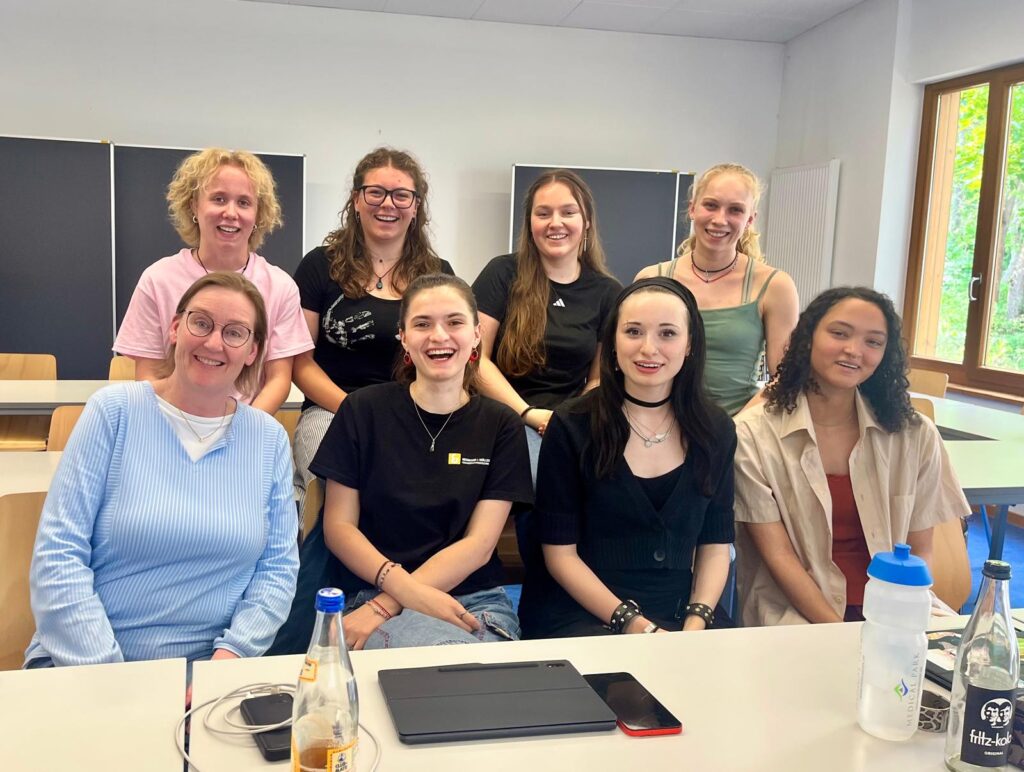
Pippi Longstocking, the Noisy Village, cinnamon buns, and Midsummer – many people crave the lifestyle they associate with Sweden. But is that enough to learn a language that only about ten million people worldwide speak as their native tongue? Swedish has been taught at Friedrich-Alexander Universität Erlangen-Nürnberg (FAU) for over 90 years. Why would someone choose Swedish in 2026? We asked in Karina Brehm’s class, a lecturer in Scandinavian Studies.

Jule
“I’m studying Cultural Geography, not Scandinavian Studies. I was advised early on to learn a second language in addition to English. When I thought about which one to choose, I thought: Lots of other applicants can speak French. Since I had already worked in Sweden for a while before starting my degree, I already had a connection to the language. That was the decisive factor. I could also imagine living and working in Sweden later on.”
Melanie
“It’s similar for me as it is for Jule: I was in Sweden before starting my degree too, with Jule in fact, and traveled around the country working on various organic farms, including around Västerås and up in the north. I’m studying Theater and Media Studies and would love to work in radio later – maybe even in Sweden. For that, it definitely makes sense to speak another language besides German and English.”
Fanny
“I’m studying Scandinavian Studies and need to include a Nordic language. But even after graduating from high school, I knew I wanted to learn another language. Through various series, YouTube, and Swedish pop culture, I became interested in Swedish, for example, thanks to the series Young Royals. I thought to myself: I’ll just give it a try. I also really like the way Swedish sounds. After finishing my degree, I want to go into theater, and there it’s always helpful to speak several languages.”


Smilla
“I often traveled to Scandinavia and Sweden with my parents. I always felt very at home there and could imagine moving there later on. At some point, I started learning Swedish, and it was so much fun that I wanted to explore the language in more depth at university too. Plus, I’m really interested in Old Norse.”
Agnes
“I definitely wouldn’t have come to Erlangen to study if Swedish wasn’t offered here. Scandinavian studies has fascinated me for a long time. As a child, I read sagas and was interested in Norse mythology. Later, I got into Scandinavian music, and I picked up a lot of the language that way. I find Swedish almost a little romantic, with its Nordic and rugged quality. I also love the Swedish countryside with its wilderness and wide open spaces. Sweden is just an amazing country.”


Serree
“I’m studying Scandinavian Studies and am interested in Scandinavian languages in general. I started with Norwegian at FAU. At the same time, I’ve always been interested in Swedish music, especially Swedish rap. Now that I’ve mastered Norwegian quite well, I wanted to see how Swedish compares. Being able to speak two Scandinavian languages is really cool.”
Robert
“I’m not a traditional student, I signed on through the Scientia program. Sweden has been our top travel destination for many years. At some point, you start wanting to have more in-depth conversations with the locals. For me, the advantage over community college or online language courses is that with the Scientia program, I can also take literature and cultural studies to broaden my background.”


Martyna
“I’m studying English and Scandinavian Studies. I moved from Poland to Germany for my sport – I was previously on the Polish national climbing team. I originally only wanted to study English, but in Bavaria, you have to study it in combination with another subject. I looked at the subjects offered by other universities here in Franconia and thought Scandinavian Studies sounded the most interesting. I’ve not regretted it. At first, I just studied Norwegian, then I started with Swedish. The course is really well structured, the group’s lovely and Karina is a great lecturer.”
Lecturer Karina Brehm is happy to have such motivated students. In summer, they are once more setting off on a field trip to Borgafjäll in south Lapland. “Traditionally, there are very close ties between FAU and Sweden. More than 90 years of Swedish – that is very unusual for a Bavarian university. However, 2026 is not only an anniversary for FAU, it is also a special year for the city of Erlangen because we have been twinned with Eskilstuna for 65 years now.” Erasmus exchanges with partner universities in Sweden are also very popular.
Swedish is a North Germanic language and is therefore surprisingly accessible to those who know German and English, says Karina Brehm. “You make rapid progress, and gain access to a modern, innovative society.” Many people are drawn to Sweden to live, study, or work there. Anyone who wants to settle permanently and become part of everyday life will find Swedish language skills indispensable. If you know Swedish, you effectively have Norwegian and Danish as well – essentially three languages for the price of one, opening up the whole of Scandinavia.
Over 90 years of Swedish at FAU
Swedish has been part of the curriculum at Friedrich‑Alexander Universität Erlangen–Nürnberg for more than nine decades. The language became part of the curriculum when Nordic Philology was established in 1935 and has been taught continuously since winter semester 1936/37. This makes Swedish one of the languages with the longest tradition in the Faculty of Humanities, Social Sciences, and Theology.
Over the years, it has been joined by other Nordic languages. Since the introduction of Scandinavian Studies in 2017, Danish and Norwegian have joined Swedish as the key linguistic elements of the degree program. Language practice is combined with literature, cultural studies and linguistics.
For many years the Swedish Institute in Stockholm has been an important support. It supports the teaching of Swedish through guest lectures, study trips, teaching materials, professional development and scholarships, thereby strengthening academic and cultural exchange between Germany and Sweden.
At FAU, Swedish can be studied as a major or minor subject . The language and cultural skills acquired open up opportunities in academia, the media, publishing, cultural institutions, and in education and translation.
Contact
Karina Brehm
Department of German and Comparative Studies