
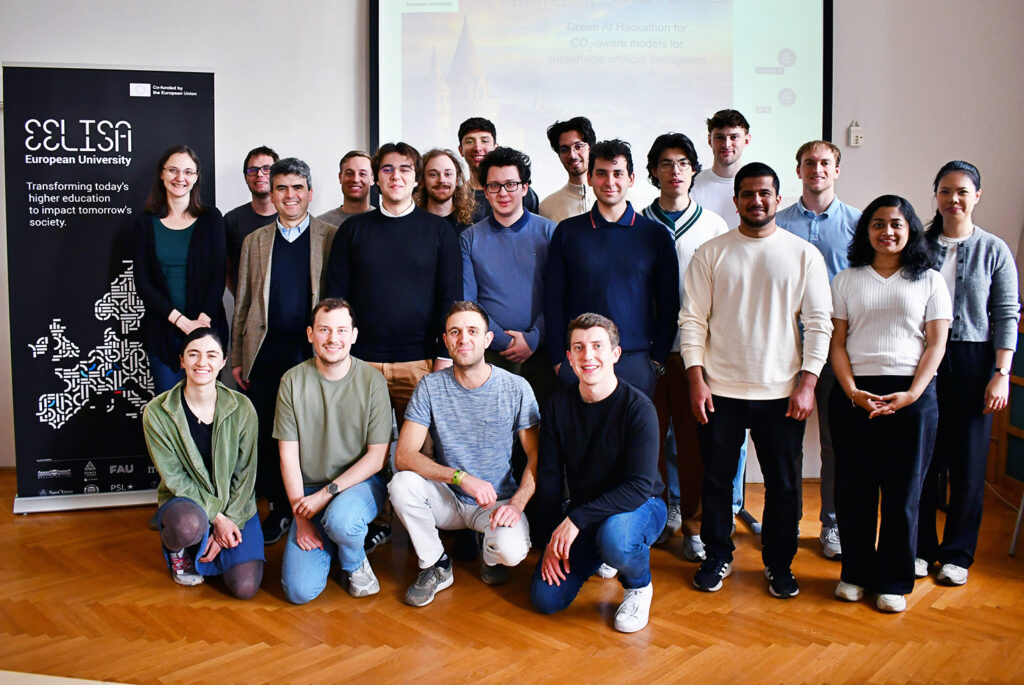
In late March 2026, researchers from the EELISA partner universities—the Budapest University of Technology and Economics (BME) in Budapest and the Scuola Superiore Sant’Anna (SSSA) in Pisa, together with FAU Professor Dr. Andreas Kist (Department of Artificial Intelligence in Biomedical Engineering – AIBE), organized the “Green AI Hackathon for CO₂-aware models for sustainable AI” at BME.
As part of the “Green AI Hackathon,” Andreas Kist, who specializes in the analysis of high-speed video endoscopy, is collaborating for the third time with Prof. Dr. Ágnes Urbin from “Department of Mechatronics, Optics, and Mechanical Engineering Informatics” at BME in Budapest, as well as with Prof. Dr. Calogero Maria Oddo from “The BioRobotics Institute” at SSSA in Pisa. The project is funded by the EELISA Joint Call #6.
European hacking for green AI
Nine FAU students traveled to the EELISA Hackathon for three days and worked in interdisciplinary and international teams to develop various prototypes for more sustainable AI models. The event, funded through the EELISA Joint Call for Communities, gave participants the opportunity to network internationally and develop innovative ideas for sustainable AI.
Additional insights into the event, including personal reflections, are available in the LinkedIn posts by Tim Steiner, Jonas Stenglein and Yannis Maag.
An interview with the organizers of the EELISA Green AI Hackathon: A conversation with Prof. Dr. Kist, Prof. Dr. Urbin, and Prof. Dr. Oddo
Your hackathon was about Green AI. What does that mean?
Prof. Dr. Kist: According to the IEA, Artificial Intelligence is estimated to consume as much energy as 60-70 TWh per year, roughly as much as Switzerland, Austria or Finland. And this is only estimated from data centers, not taking into account the energy used to produce the precursor materials and chips themselves.
Especially, when the energy used relies on fossil energy, this consumption results in a poor carbon footprint for AI.
Prof. Dr. Urbin: But there are several mechanisms for improvement to make it more sustainable. Making an AI green means, optimizing the hardware or the software. For example, using the waste heat of the servers that are running the AI to heat buildings nearby.
What exactly did you do in the hackathon?
Prof. Dr. Oddo: We raised awareness of the topic of Green AI among technical students from very different backgrounds, and we presented some examples of mechanisms to reduce the carbon footprint. Within the hackathon itself, the mixed teams worked on specific problems and tried to develop solutions for practical use cases. A couple of days is, of course, not enough to have a highly functional, complex prototype, but the teams developed really good ideas and were highly motivated.
And what kind of prototypes have been produced during the hackathon?
Prof. Dr. Kist: We had three teams. One of them, called “tinyfire” worked on wildfire detection. They have been really explorative, and their idea is still at a really early stage. Their aim was to bring a computer vision algorithm on an Edge device, that runs locally on battery, potentially solar powered. Attached to a camera-drone, the device could automatically detect wildfires at an early onset and would allow for earlier interference. Preventing larger outspreads of wildfires is already ecologically beneficial, as precious wildlife is protected. In addition, the AI runs directly on the device with no connection needed to high-power data centers for image processing.
Another team, called “SustainaBatch” developed code that runs AI workloads only when a specific amount of green energy is available in the grid, and therefore, the CO2 footprint is below a defined threshold. They track the grid’s carbon footprint automatically and in close to real time and pause the AI when there is more “dirty” energy in the grid. For example, during the night or when the sun is not shining. They got quite far in the development – please feel free to try it out on your own. The team members published the code open source. You can access the code on GitHub and try it out for yourself!
Prof. Dr. Urbin: Actually, it was heart-warming to see how motivated the students were. We had to kick them out of the room at the end of the day! And we really hope that they take some of that spark and their ideas into their future careers as engineers.
Prof. Dr. Kist: It is great, that we have this opportunity through EELISA to bring together students across Europe and make such collaboration possible. In science, you have to meet and mingle to see how everything comes together!
Prof. Dr. Oddo: And being able to do that so freely, without bureaucratic burdens like applying for visas is a European gift that you have to embrace!

The call for proposals for „Joint Academic Programs“ remains open until June 20, and the call for „Research Retreats“ is open year-round. The next call for „Joint Call for Communities“ will open in September.