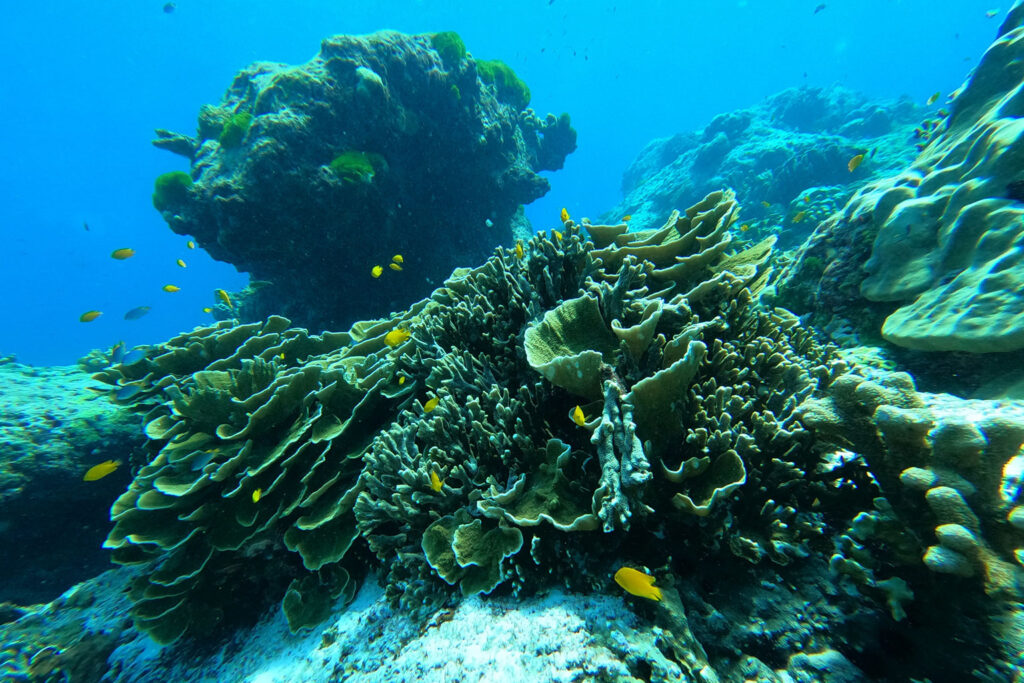
Reef corals off the Similan Islands, Thailand. (Photo: Wolfgang Kießling)
FAU study reveals how corals respond to a changing environment
Which species benefit from climate change, and which are coming under pressure? A new international study involving FAU shows: Evolutionary success follows no fixed rules. Using corals as an example, researchers demonstrated that even seemingly successful life strategies can lose their advantage when environmental conditions change.
The findings, now published in the Proceedings of the National Academy of Sciences (PNAS), provide key insights into understanding today’s biodiversity crises and the impacts of climate change.
“Our analyses show that no way of life is permanently superior,” says Prof. Dr. Wolfgang Kießling, a paleontologist at FAU and co-author of the study. “Environmental conditions are the crucial factor that decides whether species succeed. Earth’s history makes clear just how much the rules of survival can shift over time.”
Corals as a model for adaptation and vulnerability
The study focuses on two distinct groups of corals. Reef-building corals live in close symbiosis with algae, which require light for their metabolism. This partnership enables rapid growth and the construction of large reefs but also makes these organisms dependent on light and stable environmental conditions. The other group of corals does not rely on this symbiosis and can live in deeper waters.
Environmental conditions are the crucial factor that decides whether species succeed. Earth’s history makes clear just how much the rules of survival can shift over time
Prof. Dr. Wolfgang Kießling
Using extensive fossil data, statistical modeling, and artificial intelligence methods, the researchers reconstructed the evolution of both strategies over roughly 500 million years of the Earth’s history. The oldest corals included in the study are 470 million years old.
The key finding: Today’s dominant reef-building corals were not always the more successful organisms. Over long periods, corals without algal symbiosis had the advantage. Only with the rise of modern hard corals during the Triassic period around 245 million years ago did symbiosis become the decisive success factor.
“Our findings show that the symbiosis between corals and algae is not a fundamentally superior survival model,” says Prof. Wolfgang Kießling. “Whether it offers an advantage is largely determined by the prevailing environmental conditions. The rules of survival have thus shifted multiple times over the course of the Earth’s history.”
Implications for climate change in the world today
The study also helps put current developments into perspective:
Symbiotic, light-dependent reef corals are particularly sensitive to short-term warming, such as coral bleaching.
In contrast, non-symbiotic species in deeper waters are less vulnerable to such stressors.
However, over the long term, these species are also affected by rising temperatures and will need to shift their distribution ranges.
The findings underscore that there are no one-size-fits-all strategies for protecting corals. Instead, varying ecological traits and responses to environmental changes must be taken into consideration.
International collaboration
The study involved researchers from China, the United Kingdom, and Germany. The results were published in the journal Proceedings of the National Academy of Sciences (PNAS).