
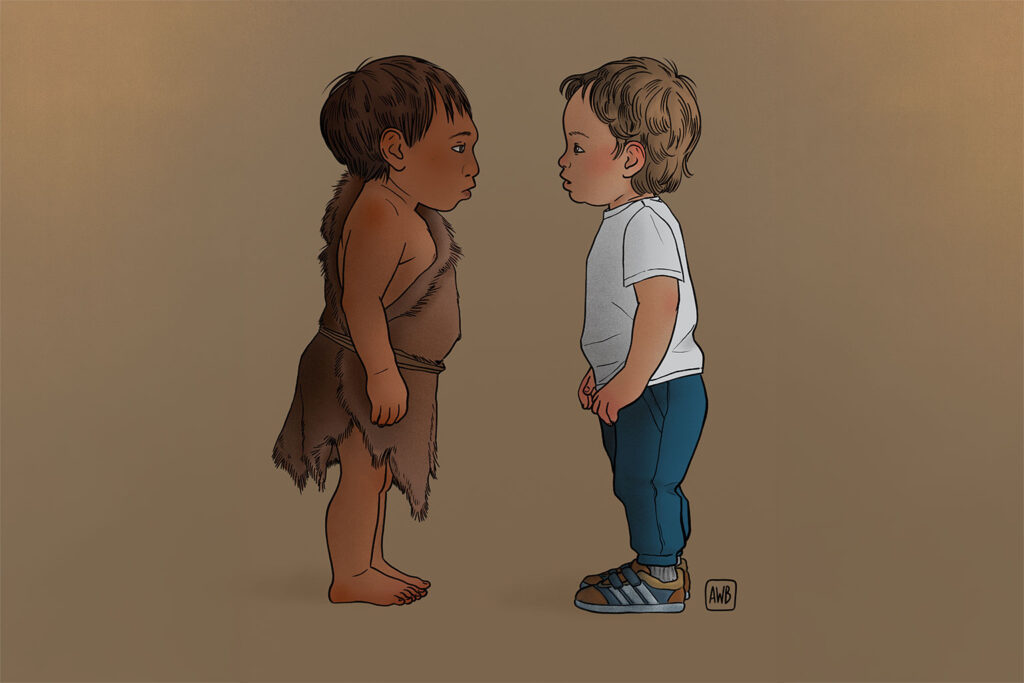
New fossil finds indicate that early childhood development was surprisingly similar to that of modern humans.
Were Neanderthals fundamentally different from us modern humans from the very beginning? Researchers have pondered this questions for decades. A new study on unusually rare remains of Neanderthal infants from the Sesselfelsgrotte cave in Lower Bavaria now delivers significant new insights. The results, to which FAU researchers also contributed, suggest that Neanderthals and modern humans were considerably more similar in their earliest childhood development than had been assumed to date.
The physique of adult Neanderthals differs considerably from modern humans, but there are also surprising similarities. “Our results indicate that both human forms progressed through strikingly similar growth processes, at least during the later stages of pregnancy,” explains Prof. Dr. Thorsten Uthmeier, Chair of Prehistoric Archaeology at FAU. These new findings provide new insights for the ongoing debate: “Genetic analyses have demonstrated that Neanderthals and modern humans were closely related. Nevertheless, there is an intense debate about whether this genetic relatedness is sufficient for Neanderthals to be considered a subspecies of the species we belong to, Homo sapiens.”
Using high-resolution micro computer tomography (micro-CT), an international team of researchers has investigated the fossils from three young Neanderthals who lived approximately 75,000 to 50,000 years ago – bone fragments from a Neanderthal fetus and milk teeth from two children. The new analyses of the fetus that died around the time of birth indicate that the development of the skeleton before birth is largely similar to the patterns we can observe in modern humans.
Surprisingly similar development before birth
The micro CT analyses revealed that the fetus’ bones show typical characteristics of rapid growth in the last third of the pregnancy. Overall, this paints a picture that is remarkably similar to the prenatal development of modern humans.
Our results suggest that both human forms went through remarkably similar stages of growth, at least during the later stages of pregnancy.Prof. Dr. Thorsten Uthmeier
In some bones, researchers found indications of slightly more advanced growth compared to modern humans. However, these differences do not change the key conclusion of the study: There do not appear to be any fundamental differences in the biological programs of Neanderthal and Homo sapiens in the earliest stages of their development.
Teeth give insights into early childhood
Scientists were also able to gain a deeper understanding of the life of young Neanderthals after examining two milk teeth. In them, the team of researchers found mineralization disorders that indicate physiological issues before or slightly after birth. Such changes are connected, among others, to a lack of vitamin D or calcium, but it is no longer possible to determine their exact cause.
If the interpretation is confirmed, the finds from the Sesselfelsgrotte cave may become the oldest known proof of such early developmental disorders in Neanderthals.
The study was conducted within the framework of the SHARP project funded by the National Geographic Society and led by Alvise Barbieri at the Interdisciplinary Center for Archaeology and Evolution of Human Behaviour (ICArEHB) at the University of Algarve.
Further information:
Original publication: “Early development of Neanderthals revealed through virtual microanatomy”
DOI: https://doi.org/10.1098/rsos.260485
More on Neanderthal research at FAU: Archaeogenetics – Neanderthals Had to Pass Through a Bottleneck
Interview with Prof. Dr. Thorsten Uthmeier on the FAU projects at the Sesselfels Cave: An Outstanding Site for Paleolithic Research