
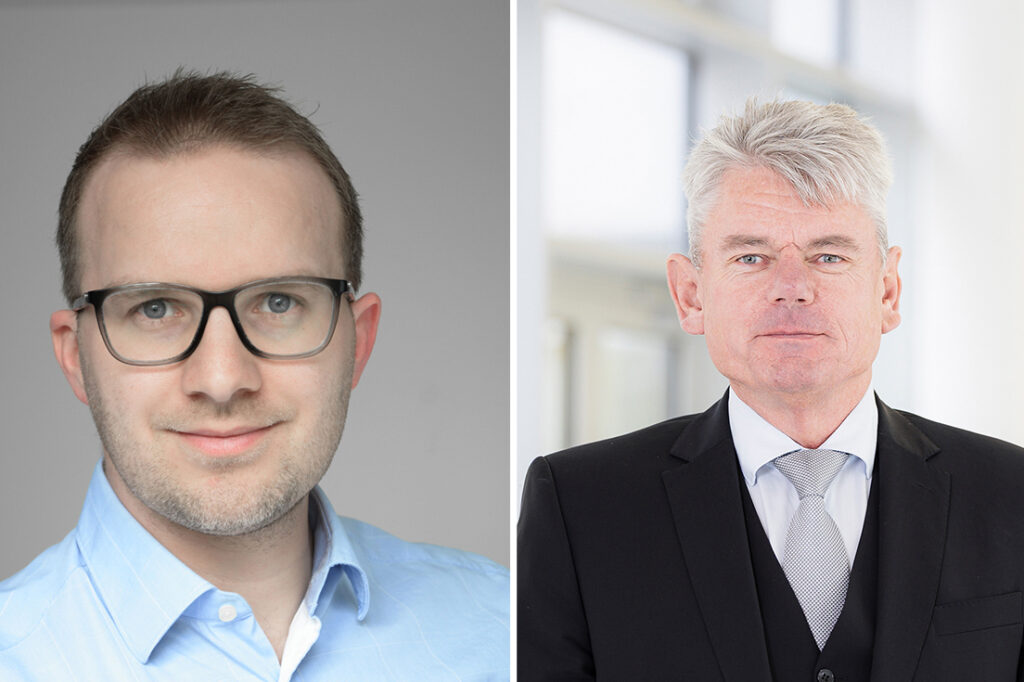
Two FAU projects demonstrate their value to funding organizations
Two new projects underscore the research strength of Friedrich-Alexander-Universität Erlangen-Nürnberg (FAU). The German Research Foundation and Bavarian Transformation and Research Foundation will provide FAU with joint funding of almost 1.1 million euros. Prof. Dr.-Ing. Habil. Andreas Paul Fröba plans to make devices and processes in thermal and energy engineering more efficient. Meanwhile, Dr.-Ing. Matthias Markl aims to significantly reduce energy consumption in a specialized metal 3D printing process.
Better cooling for the energy transition: FAU researches condensation behavior
Not only the boom in data centers for AI applications or the shift to heat pumps require more expertise in thermal and energy engineering. Air conditioning in offices, hospitals, and private households, as well as refrigerators and freezers, along with industrial refrigeration in the food, pharmaceutical, and chemical industries, account for enormous energy demand. The transition from banned CFC successors to climate-neutral refrigerants is far from complete.
A key focus is the investigation of the condensation behavior of climate-neutral refrigerants, such as pure hydrocarbons and their mixtures, on condensation tubes in refrigeration systems. This enables a fundamental understanding of the condensation process occurring in heat pumps and refrigeration systems, allowing them to be designed for greater energy efficiency. This is the objective of two research projects led by Prof. Andreas Paul Fröba in his research team, with the participation of Dr. Tobias Klein and Dr. Michael Rausch from the Chair of Advanced Optical Technologies – Thermophysical Properties (AOT-TP) at FAU. Professor Fröba and his team have secured over 750,000 euros in funding from the German Research Foundation and the Bavarian Transformation and Research Foundation. Over the next three years, his team will investigate condensation behavior on condensation tubes and in tube bundles at the high-pressure laboratory of FAU’s Faculty of Engineering.
Fröba and his team expect to gain important insights into the condensation and heat transfer process using high-speed imaging and laser spectroscopy. This will allow the effects of flow phenomena to be characterized directly on the condensation tube. The results of the two research projects promise to contribute to more efficient and improved operation of devices and processes in thermal and energy engineering.

Melting by design: New algorithm makes metal 3D printing more efficient
In future, high-performance components for aerospace, medical, and energy applications can be produced more resource‑efficiently and to higher quality standards Researchers aim to improve the specialized 3D printing process for metals in a powder bed, known as Selective Electron Beam Melting (EBM). For this purpose, the FAU Chair of Materials Science and Engineering for Metals, in cooperation with pro-beam GmbH & Co KGaA from Gilching, secured 345,000 euros for the project “High-Performance Process Strategies for Selective Electron Beam Melting – HiPe-EBM”. It is funded by the Bavarian Research Foundation (BFS) for a period of three years.
In the EBM process, the material of each layer can be melted point-by-point according to the component geometry using state-of-the-art process strategies. Until now, the sequence of melting points was determined either via a defined point grid or purely randomly. The project now aims to control the electron beam more effectively using a new algorithm. The algorithm, as project manager Dr.-Ing. Matthias Markl refers to the project goal, selects the optimal sequence from several hundred thousand melting points per layer. This sequence is optimized so that the ideal temperature is maintained throughout the process and components can be manufactured in previously unattainable quality.
The project aims to significantly increase the productivity of the EBM process. The core idea is based on the high deflection speed of the electron beam, which enables quasi-simultaneous point exposure. This process revolution paves the way for more cost-effective series production with massively reduced energy input.
Further information:
The Deutsche Forschungsgemeinschaft (DFG) is Germany’s largest research funding agency and the central self-governing organization for the scientific community. It uses its funding to support research of the highest quality and makes a significant contribution to prosperity and sustainable progress. It is funded by the federal government and the states.
The Bayerische Transformations- und Forschungsstiftung (BFS) funds projects jointly supported by industry and academia. The focus is on the subsequent economic value creation resulting from the project outcomes. Key funding areas include digitalization, production technology, and materials science.
Contact
Prof. Dr.-Ing. habil. Andreas Paul Fröba
Chair of Advanced Optical Technologies – Thermophysical Properties
Contact
Dr.-Ing. Matthias Markl
Chair of Materials Science and Engineering for Metals