
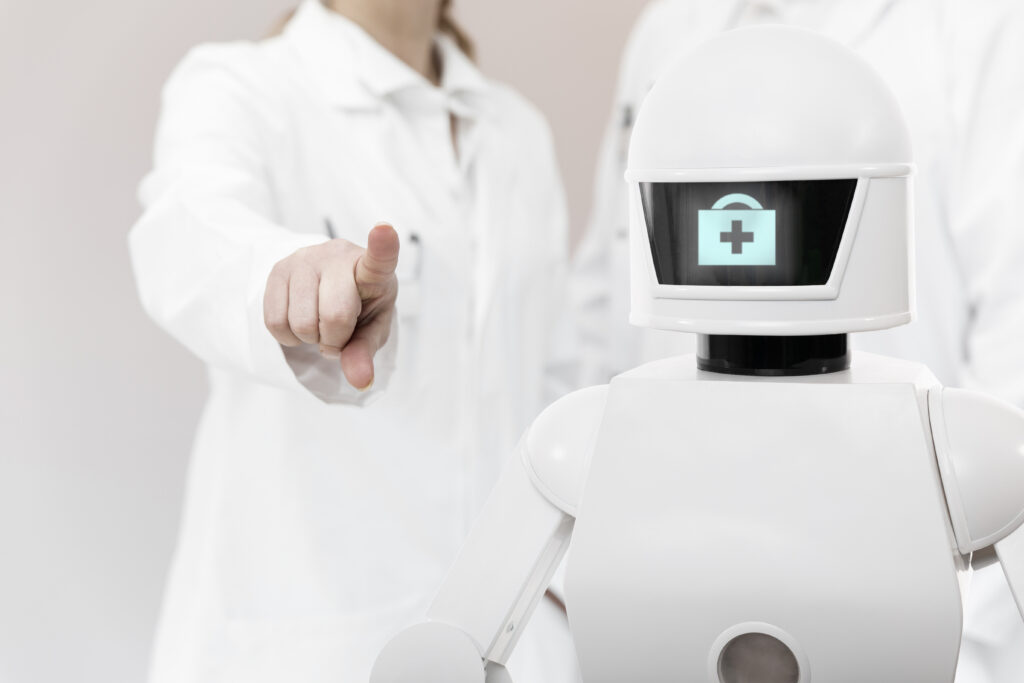
A new research consortium gathers data on nursing experience using AI-based robotics
In a new project involving researchers from Friedrich-Alexander-Universität Erlangen-Nürnberg (FAU), artificial intelligence and humanoid robotics will be used to preserve and make the valuable experiential knowledge of nursing professionals accessible to trainees. The project “Sensor-based recording of experiential knowledge in nursing care and its conveyance via AI-based humanoid robotics” has received approximately €1.5 million from the Daimler and Benz Foundation as a “Ladenburg Research Network”.
Loss of nursing professionals’ knowledge
By 2050, Germany is projected to face a shortage of between 280,000 and 690,000 nursing professionals, as the demand for care continues to rise due to an aging population. Demographic change is already presenting nursing education with a previously underestimated challenge: As experienced nursing professionals reach retirement age, not only are valuable staff lost, but also decades of acquired knowledge based on their personal experience. Daily routines, interactions, and intuitive decision-making processes can hardly be documented or conveyed in textbooks.
“PD Dr. Heiko Gaßner, Fraunhofer Institute for Integrated Circuits IIS and Unklinikum Erlangen, explains, “The expertise gained through experience by nursing professionals comprises two key aspects. Firstly, cognitive knowledge based on classical professional experience, and secondly, embodied movement knowledge, which is essential for supporting and mobilizing individuals in need of care.” The latter is anchored solely in the awareness of nursing experts and cannot be conveyed through verbal description alone. He adds: “When such a nursing professional retires, this critical resource is lost.”
How can knowledge loss in nursing be addressed?
Existing pedagogical and technological approaches are insufficient to compensate for this loss of knowledge. As the scientific director of the new project, Gaßner works with his colleagues in an interdisciplinary team consisting of nursing and movement scientists, physicians, and engineers from the areas of medical technology and robotics. Using a body-fitted sensor network, the researchers aim to capture real nursing actions directly on the bodies of experienced nursing professionals. The collected movement data will be analyzed, processed, and subsequently transferred to a humanoid robot.
How can robots be used in nursing education?
In nursing education, the robot will assume a dual role in the future. As a “nursing care professional” it demonstrates curated movement sequences, and as a “care recipient” it simulates realistic resistance from patients. At the heart of the project is a dataset for nursing interactions that an artificial intelligence accesses. “By combining it with AI, the robot becomes an intelligent learning partner,” Gaßner summarizes. The principle can also be applied to other areas where experiential knowledge is systematically lost, such as in industrial production, skilled trades, or agriculture.
Further information:
- Another AI project at FAU funded by the Daimler and Benz Foundation: Managing patient flows
- Other medical engineering projects: Medical engineering at FAU
- Other AI projects: Artificial intelligence at FAU
Contact
Jonas Walter
Chair of Factory Automation and Production Systems
Research associates